
BMR Calculator
Estimate your Basal Metabolic Rate and daily calorie needs by activity level.
What Is a BMR Calculator?
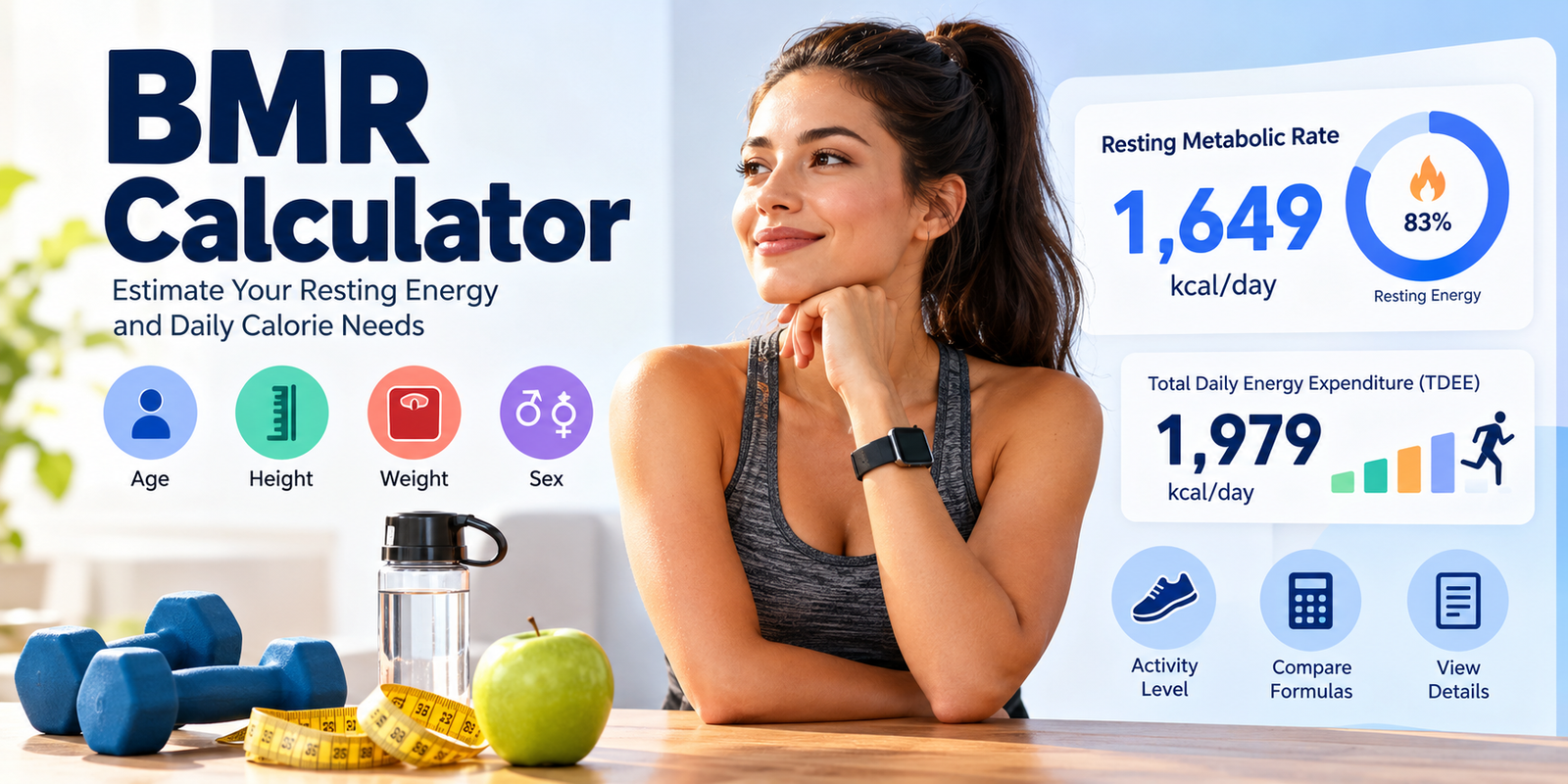
A BMR Calculator (Basal Metabolic Rate Calculator) helps estimate how many calories your body burns at rest to support essential functions such as breathing, blood circulation, temperature regulation, and cell maintenance.
Even when you're sitting quietly or sleeping, your body needs energy to keep these processes working.
Our free BMR Calculator uses your age, height, weight, and sex-based equation selection to estimate resting energy expenditure in calories per day.
You can also compare two established calculation formulas, explore how activity affects estimated daily energy needs, and view your results in an easy-to-understand format.
Important: These equations predict resting metabolic rate (RMR), which is closely related to—but not identical to—laboratory-measured BMR. Your result is an estimate, not a recommended daily calorie intake.
How to Use the BMR Calculator
The calculator is designed to give you a useful result without complicated measurements or manual calculations.
- Choose Your Measurement System: Select US Units (pounds, feet, and inches) or Metric (kilograms and centimeters).
- Enter Your Age: Provide your age in completed years. The calculator is intended for adults.
- Select the Equation Coefficient: Choose the male or female coefficient used by the published prediction equations.
- Enter Your Height: Use feet and inches or centimeters.
- Enter Your Weight: Provide your current weight in pounds or kilograms.
- Click Calculate BMR: View your estimated resting calorie expenditure.
- Explore Your Daily Energy Needs: Select an activity level to calculate an approximate TDEE.
- Compare Formulas: Switch between Mifflin–St Jeor and Revised Harris–Benedict to see how the estimates differ.
- Copy or Reset: Copy your result or reset the calculator to its initial example values.
Your results update automatically when you change an input, activity level, or calculation method.
How Is BMR Calculated?
Basal metabolic rate is influenced by several factors, including body size, age, body composition, and physiological characteristics.
Online calculators commonly use mathematical equations developed from measured resting energy expenditure.
This calculator supports two prediction methods:
- Mifflin–St Jeor Equation
- Revised Harris–Benedict Equation
Both use age, weight, height, and sex-based coefficients, but their mathematical relationships differ.
1. Mifflin–St Jeor Equation
The Mifflin–St Jeor equation was published in 1990 and is widely used to estimate resting energy expenditure in adults.
Male equation:
BMR estimate = (10 × Weight in kg) + (6.25 × Height in cm) − (5 × Age) + 5
Female equation:
BMR estimate = (10 × Weight in kg) + (6.25 × Height in cm) − (5 × Age) − 161
The equation estimates resting energy expenditure based on personal measurements rather than directly measuring your metabolism.
Example BMR Calculation
Consider a hypothetical 30-year-old adult using the male equation with these measurements:
| Measurement | Value |
|---|---|
| Age | 30 years |
| Weight | 70 kg |
| Height | 175 cm |
| Equation | Mifflin–St Jeor (male) |
Step 1: Multiply weight by 10
10 × 70 = 700
Step 2: Multiply height by 6.25
6.25 × 175 = 1,093.75
Step 3: Multiply age by 5
5 × 30 = 150
Step 4: Apply the formula
700 + 1,093.75 − 150 + 5 = 1,648.75
Estimated resting energy expenditure: 1,649 calories per day.
This is the predicted amount of energy used at rest. It does not include a separate allowance for daily physical activity.
2. Revised Harris–Benedict Equation
The Revised Harris–Benedict equation is another method for estimating resting energy expenditure.
It is based on a reevaluation of the original Harris–Benedict equations.
Male equation:
BMR estimate = 88.362 + (13.397 × Weight in kg) + (4.799 × Height in cm) − (5.677 × Age)
Female equation:
BMR estimate = 447.593 + (9.247 × Weight in kg) + (3.098 × Height in cm) − (4.330 × Age)
Because the coefficients differ from the Mifflin–St Jeor method, the two equations may produce different calorie estimates for the same person.
Neither formula can guarantee an exact result for every individual.
Mifflin–St Jeor vs. Harris–Benedict: Which Is Better?
Both equations are commonly used to estimate resting metabolism, but they were developed using different research data and mathematical models.
| Feature | Mifflin–St Jeor | Revised Harris–Benedict |
|---|---|---|
| Publication | 1990 | 1984 revision |
| Purpose | Predict resting energy expenditure | Estimate resting energy needs |
| Uses age | Yes | Yes |
| Uses height and weight | Yes | Yes |
| Uses sex-based coefficients | Yes | Yes |
| Result | Estimated kcal/day | Estimated kcal/day |
Mifflin–St Jeor is a reasonable default for general adult estimates, but the accuracy of either equation varies between individuals and populations.
Use the calculator's Compare Calculation Methods section to examine both estimates.
If the results differ, that does not necessarily mean one is wrong. Prediction formulas have limitations, and direct measurement may provide a better estimate when greater accuracy is needed.
What Is the Difference Between BMR and RMR?
Basal metabolic rate (BMR) and resting metabolic rate (RMR) both describe energy expenditure at rest, but they are measured under different conditions.
BMR refers to energy used under tightly controlled basal conditions, typically after fasting and sleeping, with the body physically and mentally at rest.
RMR refers to energy used under less restrictive resting conditions.
RMR is generally somewhat higher than strictly measured BMR because of differences in measurement conditions.
Many tools called BMR calculators actually use equations developed to predict RMR or resting energy expenditure.
That is why this calculator labels its primary result as an estimated resting energy value.
BMR vs. TDEE: What Is the Difference?
Your resting energy expenditure is only one component of the energy your body uses throughout the day.
TDEE (Total Daily Energy Expenditure) estimates total energy use across an entire day, including resting metabolism, movement, exercise, and digestion.
| BMR / RMR Estimate | TDEE Estimate |
|---|---|
| Energy used at rest | Total daily energy use |
| Does not separately account for regular activity | Includes an activity adjustment |
| Based on body measurements | Based on resting estimate and activity level |
| Useful for understanding resting metabolism | Useful for exploring total energy expenditure |
For example, suppose your estimated resting energy expenditure is 1,649 calories per day.
Using a sedentary activity multiplier of 1.2:
Estimated TDEE = 1,649 × 1.2 ≈ 1,979 calories per day
The difference reflects the activity adjustment used in the model.
These figures should not be interpreted as exact measurements or automatic calorie intake targets.
How Activity Level Affects Estimated Daily Calories
The advanced calculator includes five activity levels.
Selecting a different activity level changes your estimated TDEE while keeping your resting metabolic estimate based on the same body measurements and selected equation.
| Activity Level | Multiplier | General Description |
|---|---|---|
| Sedentary | 1.20 | Little planned exercise |
| Lightly Active | 1.375 | Light exercise approximately 1–3 days weekly |
| Moderately Active | 1.55 | Moderate activity approximately 3–5 days weekly |
| Very Active | 1.725 | Frequent vigorous activity |
| Extra Active | 1.90 | Very demanding physical activity |
These are simplified activity categories. Occupation, daily movement, exercise intensity, and individual characteristics can affect actual energy expenditure.
Choose the category that most closely represents your usual activity, recognizing that the resulting TDEE is approximate.
What Factors Affect Basal Metabolic Rate?
Your resting metabolic rate depends on several factors.
Age
Resting metabolic rate often changes with age, partly because of changes in body composition and lean tissue.
Body Weight
A larger body generally requires more energy to maintain its tissues and essential functions.
However, two people with the same weight can have different resting metabolic rates.
Height and Body Size
Height helps prediction equations estimate energy needs because it provides information related to body size.
Muscle Mass and Body Composition
Lean body tissue contributes significantly to resting energy expenditure.
People with different proportions of muscle, organs, and fat tissue may have different metabolic rates even when their height and weight are similar.
Biological and Hormonal Factors
Hormones and individual physiology can influence energy expenditure.
Common predictive equations do not capture every hormonal difference or medical circumstance.
Health Conditions and Physiological Changes
Certain illnesses, medications, pregnancy, and other physiological changes can affect energy needs.
A general-purpose calculator may not accurately represent those situations.
How Accurate Is a BMR Calculator?
A BMR Calculator provides a scientifically informed estimate, not an exact measurement.
The accuracy depends on how closely your individual metabolism matches the population data used to develop the prediction equation.
A calculator may produce a useful estimate for one person and be less accurate for another.
Several factors can influence the difference between predicted and measured energy expenditure, including:
- Body composition
- Age and physiological characteristics
- Health conditions
- Individual metabolic variation
- Measurement accuracy
- The equation selected
For greater precision, resting energy expenditure can be assessed through indirect calorimetry, a method that uses respiratory gas measurements to estimate energy use.
Most people do not need laboratory testing simply to understand the basic concept of resting metabolism. However, it may be appropriate when a qualified clinician needs more individualized information.
What Is a Normal BMR?
There is no single BMR value that is normal or ideal for everyone.
Resting energy expenditure varies according to individual measurements and body composition.
For this reason, a calculated BMR of 1,400, 1,600, or 1,900 calories per day cannot be classified as healthy or unhealthy without additional context.
A higher BMR does not automatically mean better health, and a lower BMR does not automatically indicate a metabolic disorder.
The most useful interpretation is understanding what the number estimates and why it might differ between people.
Is BMR the Number of Calories You Should Eat?
No. Your BMR or RMR estimate is not a personalized recommendation for daily calorie intake.
The estimate represents resting energy use, whereas your total energy expenditure also includes movement, exercise, digestion, and other factors.
Your nutrition requirements may also depend on health status, medical history, physiological needs, and personal circumstances.
Avoid treating the calculator result as a required calorie limit or using it alone to determine a restrictive eating plan.
For individualized nutrition advice, consult a registered dietitian or qualified healthcare professional.
Common BMR Calculation Mistakes
Confusing BMR With TDEE
BMR describes resting energy use, while TDEE estimates total daily expenditure.
These results answer different questions.
Entering the Wrong Measurement Units
Using pounds where kilograms are required, or inches instead of centimeters, can cause incorrect results.
The calculator converts US and metric measurements automatically.
Treating the Estimate as an Exact Measurement
The equation predicts metabolic rate based on population data.
Actual energy expenditure can differ from the predicted value.
Choosing an Unrealistic Activity Level
An inaccurate activity selection can produce a misleading TDEE estimate.
Consider your overall daily routine, not just a single workout.
Assuming a Higher BMR Is Always Better
A higher or lower resting metabolic rate is not automatically an indicator of health, fitness, or metabolic efficiency.
Comparing Results From Different Formulas Without Context
Different equations can reasonably produce different estimates.
Understanding the assumptions behind each equation is more useful than choosing the highest or lowest result.
Frequently Asked Questions
What does BMR stand for?
BMR stands for Basal Metabolic Rate. It refers to the energy your body uses to maintain essential functions under basal resting conditions.
How do I calculate my BMR?
Enter your age, height, weight, and equation coefficient into the calculator above. It automatically applies the selected formula and displays an estimated resting energy value in calories per day.
What is the best BMR calculator formula?
Mifflin–St Jeor is a commonly used method for estimating resting energy expenditure in adults. No single equation is guaranteed to be the most accurate for every person.
Is BMR the same as calories burned while sleeping?
No. Sleeping metabolic rate and basal metabolic rate are related but are measured under different physiological conditions. Energy use can vary across sleep and waking rest.
Does exercise increase BMR?
Physical activity increases energy expenditure while you are active. Longer-term changes in body composition can also influence resting metabolism, but the effect varies between individuals.
Can my BMR change over time?
Yes. Resting metabolic rate can change with body size, body composition, age, physiology, and health status.
Why does my BMR decrease as I get older in the calculator?
Both supported equations include an age term that reduces the predicted result as age increases when other measurements are held constant. Actual age-related changes vary from person to person.
What is the difference between BMR and BMI?
BMR estimates resting energy expenditure in calories per day.
BMI (Body Mass Index) uses height and weight to calculate a body-size screening measure.
They represent different concepts and should not be used interchangeably.
Can I calculate BMR using pounds and inches?
Yes. Select US Units and enter your weight in pounds and height in feet and inches.
The tool converts these measurements internally before applying the equation.
Does BMR include walking and other everyday activities?
Strict BMR does not include the energy used for ordinary physical activity. The calculator provides a separate activity-adjusted TDEE estimate.
What is the difference between Mifflin–St Jeor and Harris–Benedict?
Both are mathematical prediction methods for resting energy expenditure. They use different coefficients and may produce different results for the same measurements.
Is this BMR Calculator suitable for children?
The calculator is intended for adults aged 18 and older. Children and adolescents have different energy needs and require age-appropriate assessment methods.
Can I use my BMR result for a medical diagnosis?
No. A prediction equation cannot diagnose a metabolic condition or replace medical evaluation.
Is the BMR Calculator free?
Yes. You can use the SkillsElevate BMR Calculator without paying or creating an account.
Scientific References
The calculator's methodology and explanations are based on published research and established medical and nutrition references:
- Mifflin MD et al. (1990). A New Predictive Equation for Resting Energy Expenditure in Healthy Individuals. American Journal of Clinical Nutrition. Read the research.
- Roza AM and Shizgal HM (1984). The Harris Benedict Equation Reevaluated: Resting Energy Requirements and the Body Cell Mass. American Journal of Clinical Nutrition. Read the research.
- Cleveland Clinic. Basal Metabolic Rate: What It Is and How to Calculate It. Medical reference.
- National Academies of Sciences, Engineering, and Medicine (2023). Dietary Reference Intakes for Energy. Scientific reference.
Related Tools
Explore these other SkillsElevate calculators:
- BMI Calculator — Calculate Body Mass Index using height and weight.
- Macro Calculator — Explore macronutrient calculations and understand how dietary energy is distributed.
- Age Calculator — Calculate your age in years, months, and days.
- Date Difference Calculator — Calculate the time between two dates when planning personal schedules or fitness milestones.
Understand Your Resting Energy Needs
The BMR Calculator offers a straightforward way to explore your estimated resting metabolic rate using established prediction equations.
Enter your measurements, compare calculation methods, explore activity-adjusted energy estimates, and review the formula details to understand how your result was produced.
Remember that your BMR estimate is only one part of understanding daily energy expenditure. It is a useful educational starting point, not a complete assessment of your metabolism or personal nutritional requirements.