
30 Days Ago
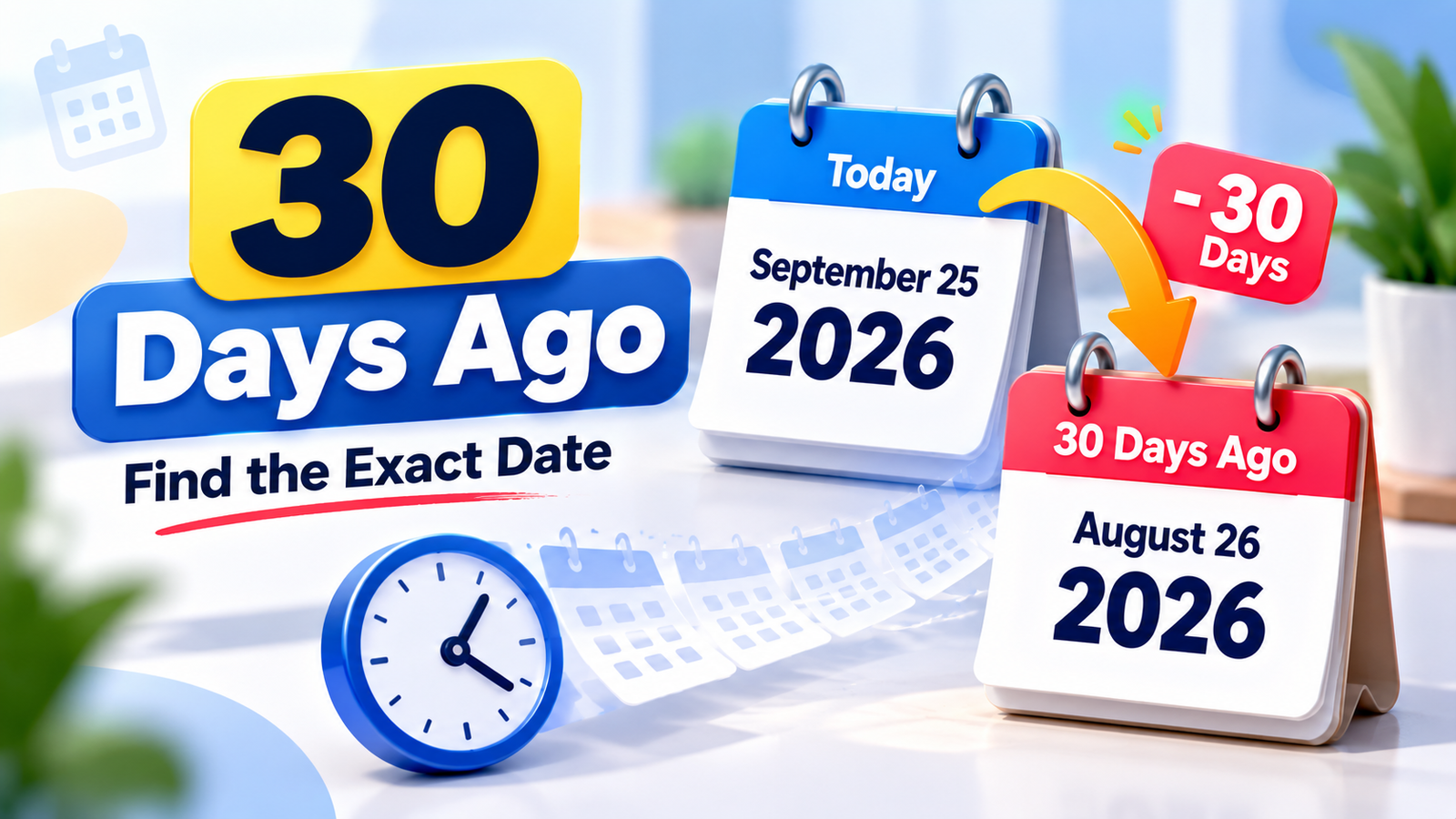
30 Days Ago: Find the Exact Date
Wondering what date it was 30 days ago? This page helps you find the exact date quickly without manually counting through a calendar. Enter a date below and the calculator will subtract exactly 30 calendar days and show the resulting date and day of the week.
The phrase “30 days ago” means a fixed period of 30 days before a particular date. It does not necessarily mean the same calendar date in the previous month because different months contain different numbers of days.
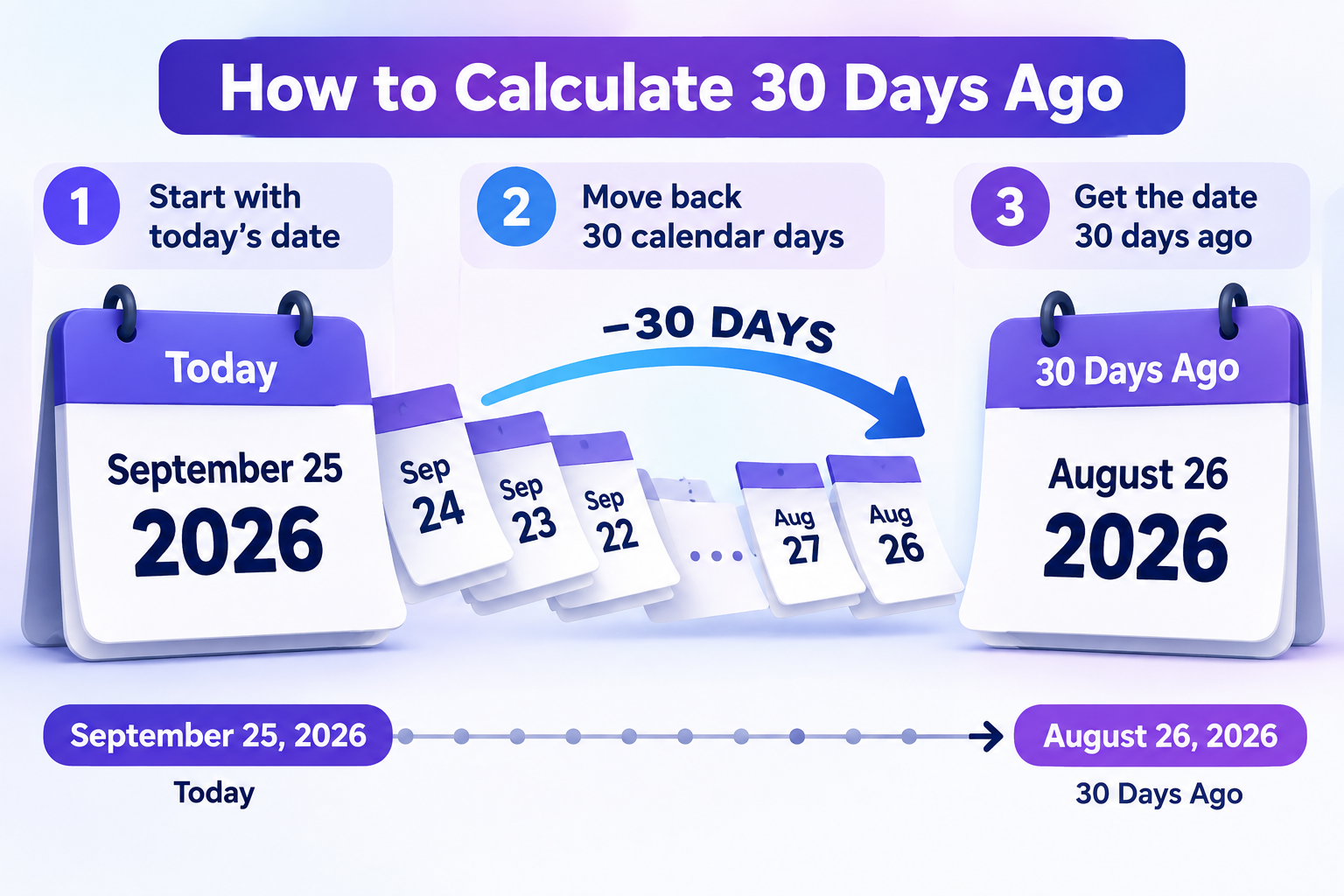
30 days ago means exactly 30 calendar days before today. The exact date changes every day, so the most reliable way to find it is to subtract 30 days from the date you are checking.
30 Days Ago Calculator
Use the calculator below to find the date exactly 30 days before any date. It automatically handles changes between months and years.
What Does “30 Days Ago” Mean?
When someone says “30 days ago,” they are referring to a date exactly 30 days before the date being used as the starting point. The calculation moves backward through the calendar one day at a time.
For example, if the starting date is September 25, 2026, subtracting 30 days gives August 26, 2026. The calculation crosses from September into August because September has 30 days.
30 Days Is Not Always One Month
A common mistake is assuming that 30 days ago always means one month ago. A calendar month can have 28, 29, 30, or 31 days, while a 30-day period always contains exactly 30 days.
How Does the 30 Days Ago Calculator Work?
The calculator takes the starting date and subtracts the number of days entered in the calculator. For the standard “30 days ago” calculation, the number of days is 30.
Because the calculation uses actual calendar dates, it can automatically move from one month to another or from one year to the previous year when necessary.
This can be today's date or any other date you want to use as the starting point.
Move backward through the calendar by exactly 30 days.
The resulting date is the exact date that occurred 30 days before the starting date.
The calculator can also determine which day of the week the earlier date falls on.
How to Calculate 30 Days Ago Manually
You can calculate 30 days ago without a calculator, although manually counting becomes less convenient when the calculation crosses between months or years.
Start with the date you are checking. Then move backward through the calendar while keeping track of how many days have passed. When you reach 30 days, the date you land on is the answer.
If the starting date is September 25, 2026, moving backward 30 days gives August 26, 2026.
For a manual calculation, always account for the number of days in each month. This is particularly important around February because February can have 28 or 29 days.
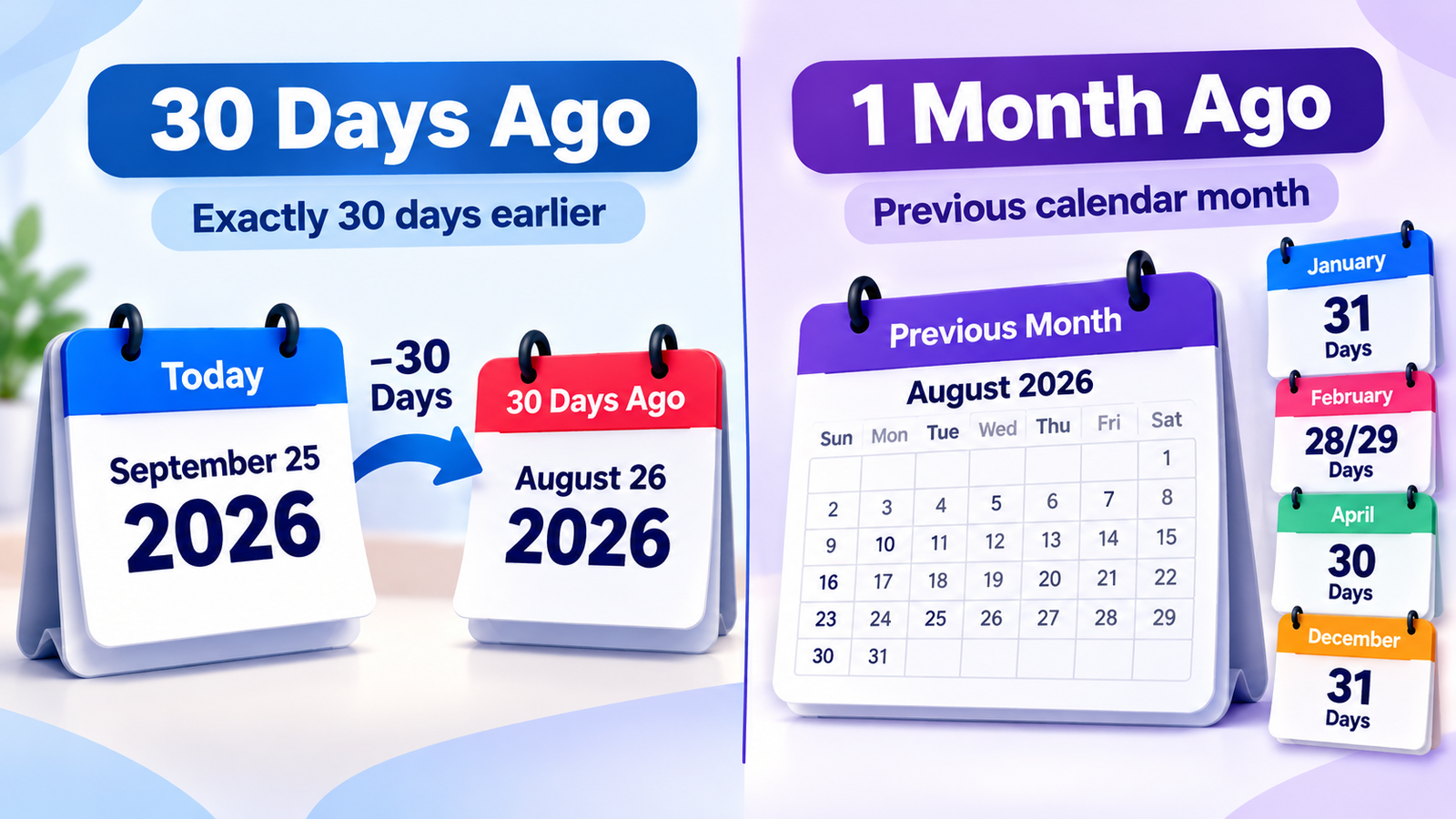
Is 30 Days Ago the Same as One Month Ago?
No. Although the two expressions can sometimes produce the same date, they describe different types of calculations.
“30 days ago” means subtract exactly 30 days. “One month ago” refers to moving back one calendar month. Since calendar months do not all have the same number of days, the results can differ.
| Expression | Meaning |
|---|---|
| 30 days ago | Exactly 30 days earlier |
| 1 month ago | The corresponding date in the previous calendar month when possible |
| 2 weeks ago | Exactly 14 days earlier |
| 7 days ago | Exactly 7 days earlier |
Why the Difference Matters
If a date calculation is being used for a deadline, record review, subscription period, reporting period, or another situation where the exact number of days matters, it is important to distinguish a fixed 30-day period from a calendar month.
Examples of 30 Days Ago
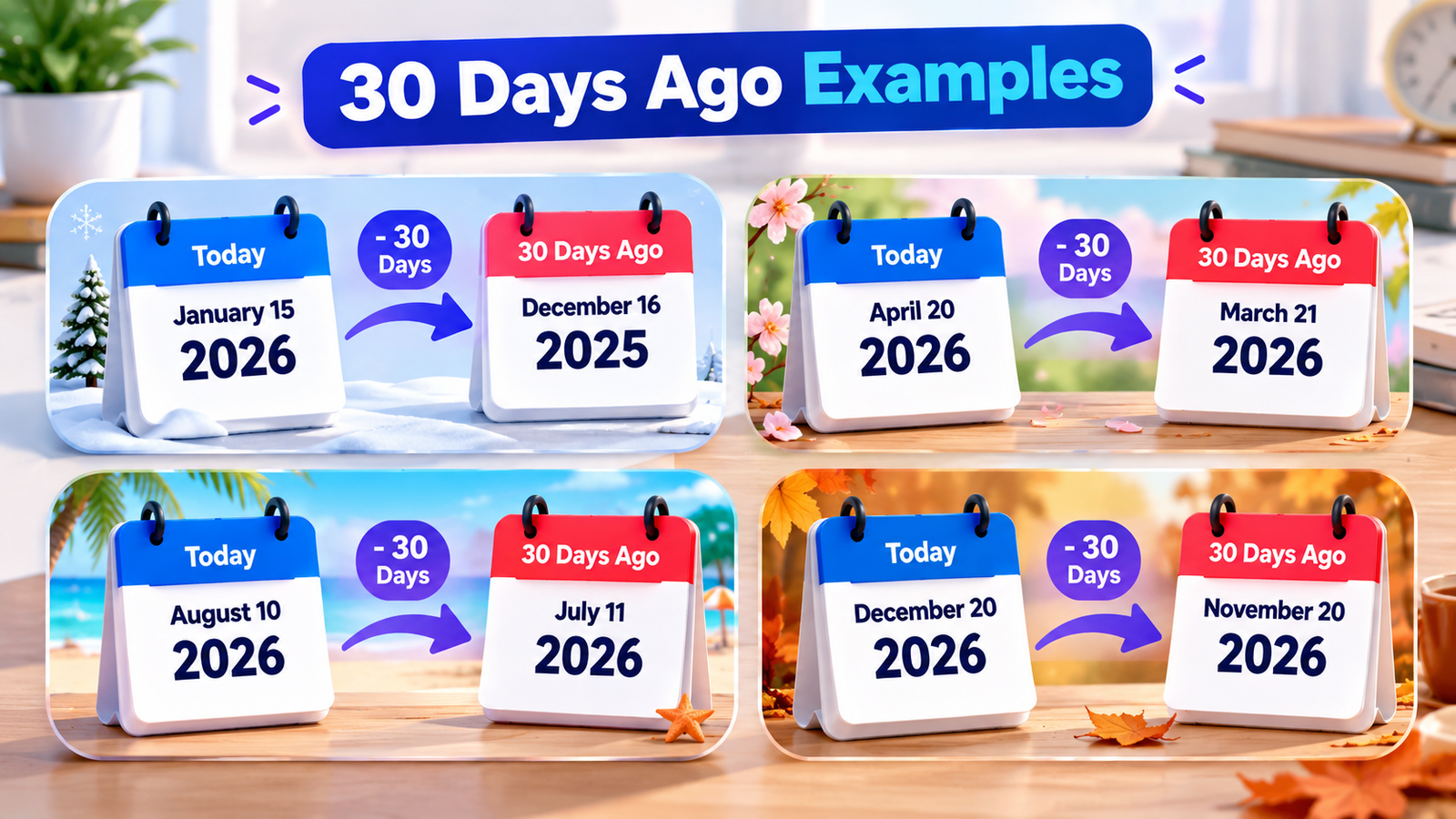
The result changes depending on the starting date. Here are several examples showing how subtracting exactly 30 days can produce dates in different months or even a different year.
| Starting Date | 30 Days Ago |
|---|---|
| January 15, 2026 | December 16, 2025 |
| April 20, 2026 | March 21, 2026 |
| August 10, 2026 | July 11, 2026 |
| September 25, 2026 | August 26, 2026 |
| December 20, 2026 | November 20, 2026 |
Why Can 30 Days Ago Be in a Different Year?
A 30-day calculation can cross a year boundary when the starting date is early in January. In that situation, moving backward 30 days takes the calculation into December of the previous year.
Example
If the starting date is January 15, 2026, subtracting 30 days results in December 16, 2025.
This happens because the 30-day period extends backward beyond January and into the previous calendar year.
Does February Affect a 30-Day Calculation?
Yes. February can affect where the calculation lands because it has fewer days than other months. February has 28 days in a common year and 29 days in a leap year.
However, the calculation itself does not change: 30 days still means exactly 30 days. What changes is the calendar date reached after those 30 days are subtracted.
You do not need to manually determine the month length when using the calculator. The date calculation automatically handles month and year changes.
How Many Weeks Are 30 Days?
Thirty days can also be expressed in weeks. Since one week contains seven days, 30 days equals four complete weeks plus two additional days.
30 Days = 4 Weeks + 2 Days
7 + 7 + 7 + 7 + 2 = 30 days
This also explains why the weekday changes by two days when moving exactly 30 days backward. Four full weeks return to the same weekday, while the additional two days move the weekday backward by two positions.
What Day of the Week Was 30 Days Ago?
The exact weekday depends on the starting date. Because 30 days equals four weeks and two days, a date that is 30 days earlier falls two weekdays before the starting date.
| Starting Weekday | Weekday 30 Days Earlier |
|---|---|
| Monday | Saturday |
| Tuesday | Sunday |
| Wednesday | Monday |
| Thursday | Tuesday |
| Friday | Wednesday |
| Saturday | Thursday |
| Sunday | Friday |
When Is Knowing the Date 30 Days Ago Useful?
Work and Deadlines
A 30-day calculation can help when reviewing previous deadlines, project activity, or work records based on a fixed 30-day period.
Subscriptions and Billing
People may need to compare a current date with a date 30 days earlier when reviewing billing cycles, renewals, or other time-based records.
Business Records
Businesses may use 30-day periods when reviewing transactions, customer activity, reports, or other dated information.
School and Projects
Students and project teams may need to determine when an event, assignment, or milestone occurred relative to a current date.
Personal Planning
A date 30 days earlier can help when reviewing appointments, purchases, events, reminders, or personal records.
Common Mistakes When Calculating 30 Days Ago
Mistake 1: Treating 30 Days as One Month
A month can have 28, 29, 30, or 31 days. Therefore, one month ago is not always exactly 30 days ago.
Mistake 2: Forgetting Month Lengths
Different months have different numbers of days. A calculation that crosses from one month to another must account for those differences.
Mistake 3: Forgetting February
February is shorter than the other months and can contain either 28 or 29 days.
Mistake 4: Forgetting a Year Change
A calculation made near the beginning of January can result in a date in December of the previous year.
Mistake 5: Counting the Starting Date Incorrectly
The goal is to find the date exactly 30 elapsed days before the starting date. Simply counting calendar labels without understanding the interval can produce an incorrect result.
Frequently Asked Questions
The exact date depends on the starting date. Enter your date in the calculator above to find the exact date 30 days earlier.
Not necessarily. Thirty days is a fixed number of days, while a calendar month can contain 28, 29, 30, or 31 days.
Start with the date you want to check and move backward exactly 30 calendar days. Remember to account for different month lengths and year changes.
Thirty days equals four weeks and two days because four weeks contain 28 days.
Yes. If the starting date is early in January, subtracting 30 days can result in a date in December of the previous year.
Yes. February has 28 days in a common year and 29 days in a leap year. The calculator automatically handles this difference when calculating the earlier date.
Thirty days equals four weeks and two days, so the weekday is two days earlier than the weekday of the starting date. The calculator can provide the exact weekday for the selected date.
Yes. Enter any starting date into the calculator. It will subtract 30 days from that date and show the corresponding earlier date.
Final Summary
“30 days ago” means exactly 30 calendar days before a selected starting date. It is a fixed 30-day period and should not automatically be treated as the same thing as one calendar month. The exact result depends on the starting date, month lengths, February, and whether the calculation crosses into a previous year.
Use the calculator above to find the exact date quickly. It can also show the corresponding day of the week, making it useful for planning, records, deadlines, billing periods, projects, and everyday date calculations.