
45 Days From Now

45 Days From Now: Find the Exact Future Date
Wondering what date it will be 45 days from now? Instead of counting through a calendar manually, you can use the calculator below to find the exact future date. Enter a starting date, and the tool adds 45 calendar days while also showing the resulting day of the week.
A 45-day period is a fixed number of calendar days. It includes weekends unless you specifically need a business-day calculation. Because months have different lengths, the resulting date depends on the starting point.
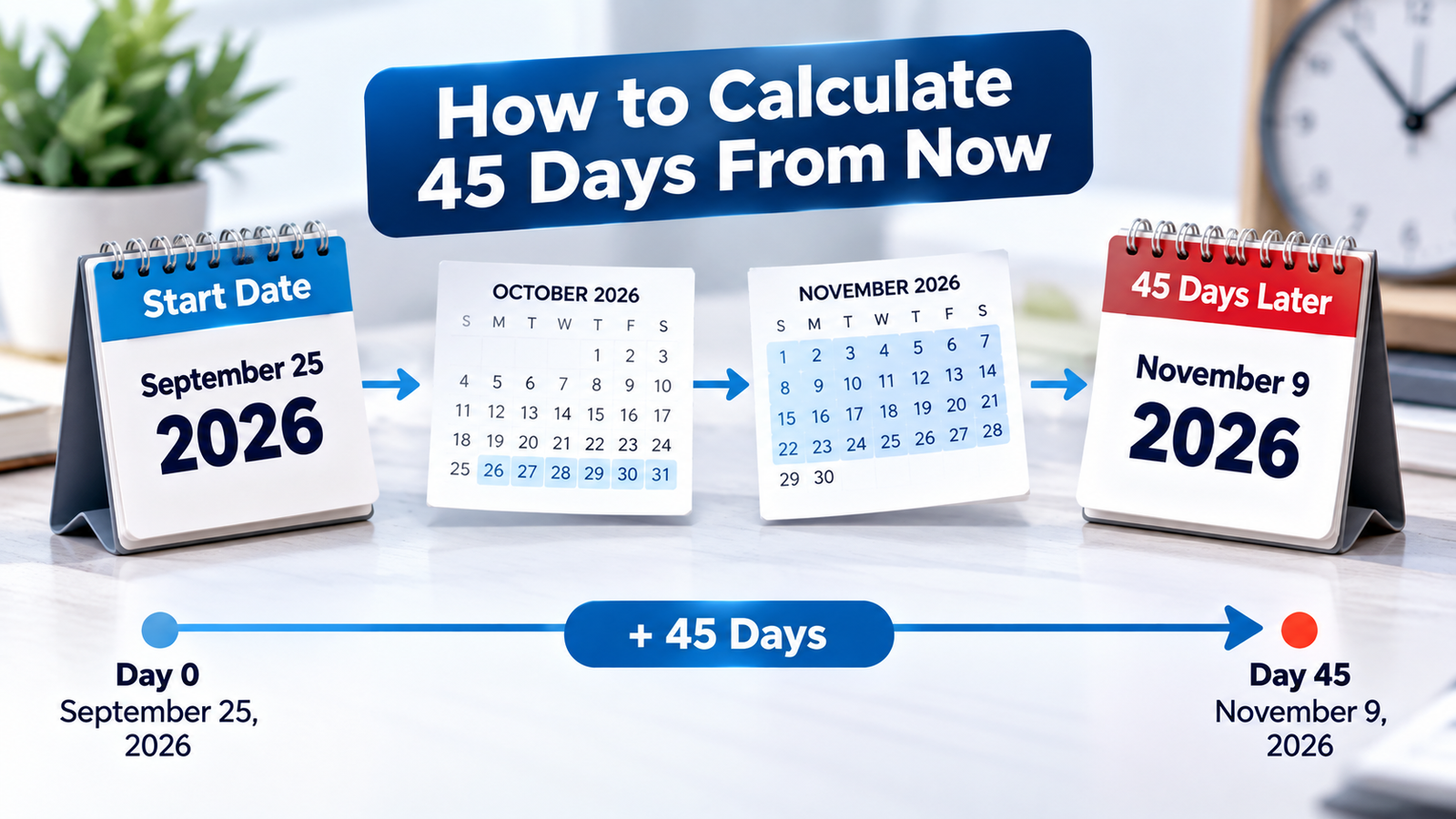
45 days from now means adding exactly 45 calendar days to today's date. The exact future date changes as the current date changes, so the calculator automatically uses the selected starting date.
45 Days From Now Calculator
Use this calculator to find a date 45 days in the future. The default starting date is today's date, but you can change it to any date you want.
What Does 45 Days From Now Mean?
“45 days from now” means a date exactly 45 calendar days after the starting date. When the starting point is today, the calculation begins with today's date and moves forward through the calendar.
The calculation does not simply add 45 to the day number. If the remaining days in the current month are not enough, the calculation continues into the next month. It can also pass through more than one month or cross into a new year.
45 Days Is a Fixed Period
A 45-day period always contains 45 calendar days. Saturdays, Sundays, and ordinary holidays are included unless a particular rule specifically says to count business days instead.
How Does the 45-Day Calculator Work?
The calculator uses the selected starting date as the reference point and adds the number of calendar days entered by the user. With the default setting, that number is 45.
The calculation treats the starting date as day zero. The following calendar day is day one, and the process continues until 45 days have been added.
Use today's date or select another date if you are calculating a future deadline, event, or milestone.
The default value is 45, but the calculator also allows a different number when you need another date calculation.
The calculator moves forward through the calendar and automatically handles month boundaries.
The final result shows the exact date and the corresponding day of the week.
How to Calculate 45 Days From Now Manually
You can calculate a future date manually by moving forward through a calendar. This works well for simple calculations, but it becomes easier to make a mistake when the 45-day period crosses several month boundaries.
Write down the date from which the 45-day period begins.
Determine how many days remain before reaching the end of the current month.
Subtract the days already counted from 45 and continue counting in the following month.
If the remaining number of days extends into another month, continue the process until all 45 days have been added.
The date reached after the complete 45-day period is the answer.

Is 45 Days the Same as One and a Half Months?
Not exactly. A month is a calendar period, while 45 days is a fixed number of days. Months can contain different numbers of days, so the phrase “one and a half months” does not identify one universal number of calendar days.
For an exact calculation, it is better to add 45 calendar days to the starting date. This avoids confusion caused by different month lengths.
45 Days vs. Calendar Months
January, March, May, July, August, October, and December have 31 days. April, June, September, and November have 30 days, while February has 28 days in a common year and 29 days in a leap year.
| Time Period | Meaning |
|---|---|
| 45 days | Exactly 45 calendar days |
| 6 weeks | 42 days |
| 6 weeks + 3 days | 45 days |
| 1 calendar month | Depends on the month |
How Many Weeks Are 45 Days?
Forty-five days can be broken down into weeks very easily. Six complete weeks contain 42 days, leaving three additional days.
42 days + 3 days = 45 days.
This breakdown is also useful for understanding the day of the week. Six complete weeks do not change the weekday, while the remaining three days move it forward by three days.
What Day of the Week Will It Be 45 Days From Now?
The exact weekday depends on the starting date. Because 45 days equals six weeks and three days, the future weekday will be three days later in the weekly cycle.
| Starting Day | Day 45 Days Later |
|---|---|
| Monday | Thursday |
| Tuesday | Friday |
| Wednesday | Saturday |
| Thursday | Sunday |
| Friday | Monday |
| Saturday | Tuesday |
| Sunday | Wednesday |

Examples of 45 Days From Different Dates
The result depends on the starting date. A 45-day calculation can remain within a nearby period, cross one or more month boundaries, or move into the following year.
| Starting Date | 45 Days Later |
|---|---|
| January 1, 2026 | February 15, 2026 |
| March 10, 2026 | April 24, 2026 |
| June 1, 2026 | July 16, 2026 |
| September 25, 2026 | November 9, 2026 |
| December 15, 2026 | January 29, 2027 |
Why the Examples Are Different
The number of days added remains 45 in every example, but the calendar position changes because each starting date falls in a different part of the year.
Does February Affect a 45-Day Calculation?
Yes. February has fewer days than every other month, so it can affect the final calendar date when a 45-day period passes through February.
February has 28 days in a common year and 29 days in a leap year. The calculator handles this automatically when calculating the future date.
The calculation is still exactly 45 days. Only the calendar position of the final date changes according to the actual calendar.
Can 45 Days From Now Cross Into Another Year?
Yes. A 45-day period starting late in December can extend into January of the following year. This is one reason manually adding 45 to the day number is not reliable.
For example, a starting date in December can move through the remaining days of December and continue into January. The calculator automatically handles the year transition.
When Is a 45-Day Calculation Useful?
Project Deadlines
Use a future date to plan a project milestone, review period, or scheduled deliverable.
Work Planning
A 45-day period can help organize tasks, campaigns, follow-ups, and other scheduled activities.
Travel Planning
Calculate a future date when preparing for a trip, event, booking, or travel-related deadline.
Subscription Dates
Compare activation dates, renewal periods, trial windows, or other calendar-based schedules.
School Planning
Students can calculate future dates for projects, assignments, study schedules, or important academic events.
Personal Planning
Use a 45-day date when organizing appointments, reminders, activities, and personal events.
Business Planning
Businesses can use fixed-day periods for campaign schedules, reporting checkpoints, reviews, and planning.
Future Reminders
A calculated future date can make it easier to set reminders for an upcoming task or event.
Common Mistakes When Calculating 45 Days
Mistake 1: Adding 45 to the Day Number
Calendar months do not all have the same number of days. Adding 45 directly to the day shown on a calendar can produce an incorrect result.
Mistake 2: Assuming 45 Days Is One and a Half Months
A month can contain 28, 29, 30, or 31 days. A fixed 45-day period should therefore be calculated using actual calendar days.
Mistake 3: Forgetting February
February has a different length from the other months and can contain 28 or 29 days.
Mistake 4: Forgetting a Year Transition
If the starting date is near the end of December, the result may occur in January of the following year.
Mistake 5: Confusing Calendar Days With Business Days
A normal 45-day calculation includes weekends. A business-day calculation follows different rules and may exclude weekends and sometimes holidays.
Frequently Asked Questions
The exact date depends on today's date. The calculator automatically adds 45 calendar days to the selected starting date and displays the resulting date.
Start with today's date and add exactly 45 calendar days. The calculator above performs the calculation automatically and accounts for month and year changes.
Not exactly. Forty-five days is a fixed number of calendar days, while months have different lengths. For an exact result, calculate 45 days directly from the starting date.
Forty-five days equals 6 full weeks and 3 additional days.
Yes. February has 28 days in a common year and 29 days in a leap year. The calculator automatically accounts for this when calculating the future date.
Yes. A standard 45-day calculation uses calendar days, so Saturdays and Sundays are included. A business-day calculation uses different counting rules.
Yes. Select any starting date in the calculator and leave the number of days set to 45. The tool will calculate the corresponding future date.
Because 45 days equals six weeks and three days, the weekday will move forward by three days from the starting weekday. The calculator shows the exact day for the selected date.
Calendar days include every day of the week. Business-day calculations generally exclude weekends and may also use specific holiday rules. If a deadline specifies business days, use the counting method required by that particular rule.
Final Summary
45 days from now means exactly 45 calendar days after the starting date. The calculation can cross month boundaries and, depending on the starting date, may also cross into a new year.
Forty-five days equals 6 weeks and 3 days. Because calendar months have different lengths, 45 days should not simply be treated as one and a half months.
Use the calculator above whenever you need an exact future date for planning, deadlines, projects, travel, subscriptions, school activities, business schedules, or personal events.