
How Many Weeks Are in a Year? Exact Answer and Calendar Breakdown
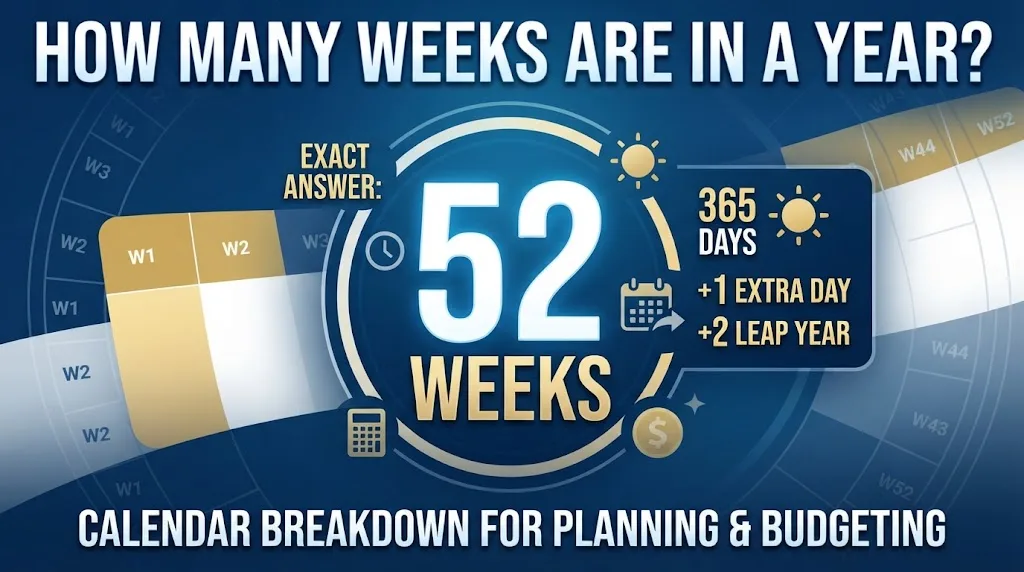
A standard year has 52 weeks and 1 day. A leap year has 52 weeks and 2 days. Here’s the simple math, a month-by-month view, and what it means when you plan.
The short answer
Standard year · 365 days
52 weeks + 1 day
Leap year · 366 days
52 weeks + 2 days
If you need one dependable number for a yearly timeline, use 52 weeks. Strictly speaking, however, a calendar year is slightly longer than 52 complete seven-day periods. A common year contains 365 days, while a leap year contains 366; dividing either total by seven leaves a small remainder. That extra day or two is why recurring schedules, payroll calendars, and week-numbering systems can occasionally feel less tidy than the headline number suggests. In practical terms, 52 weeks is the right starting point for most planning, while the remainder matters when exact dates or repeating cycles are involved.
The exact calendar math
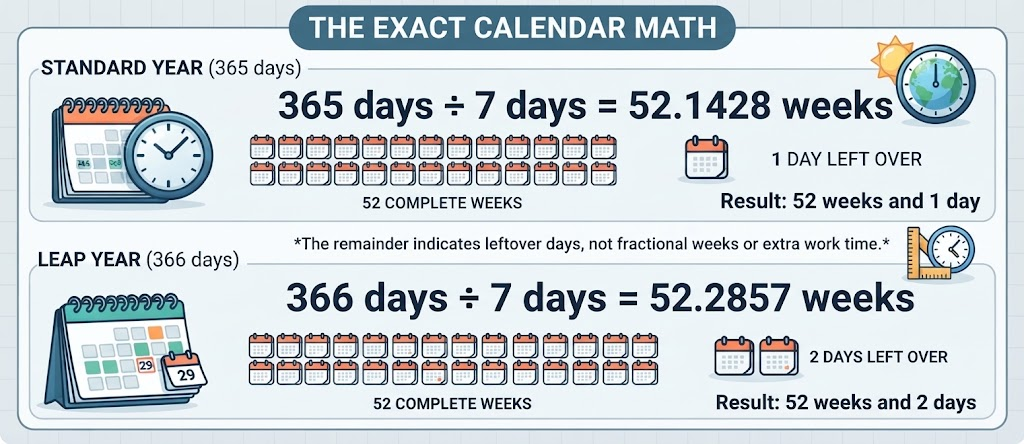
A week always contains 7 days, so the calculation is simply the length of the year divided by seven. In the Gregorian calendar, the usual 365-day year gives 52 complete weeks with 1 day left over. Every fourth year is generally a leap year, adding February 29 and producing 366 days: 52 complete weeks with 2 days left over. Century years are an exception unless they are divisible by 400, which keeps the calendar broadly aligned with the solar year. The remainder does not make a year a fractionally longer workweek; it is simply the number of days that remain after counting 52 full seven-day periods.
365 days ÷ 7 = 52.1428 weeks = 52 weeks and 1 day
366 days ÷ 7 = 52.2857 weeks = 52 weeks and 2 days
How many weeks are in each month?
Months do not divide into whole weeks as neatly as years do. Every month has at least four complete weeks, then one, two, or three additional days. February is the shortest month, while the 31-day months contain four weeks and three extra days.
| Months | Days in each | Equivalent |
|---|---|---|
| January, March, May, July, August, October, December | 31 days | 4 weeks + 3 days |
| April, June, September, November | 30 days | 4 weeks + 2 days |
| February · standard year | 28 days | Exactly 4 weeks |
| February · leap year | 29 days | 4 weeks + 1 day |
A calendar month can display five or even six rows in a monthly planner because the first day may fall late in the first week and the final day may spill into another week. That layout does not mean the month contains five or six complete weeks.
How to calculate weeks between dates
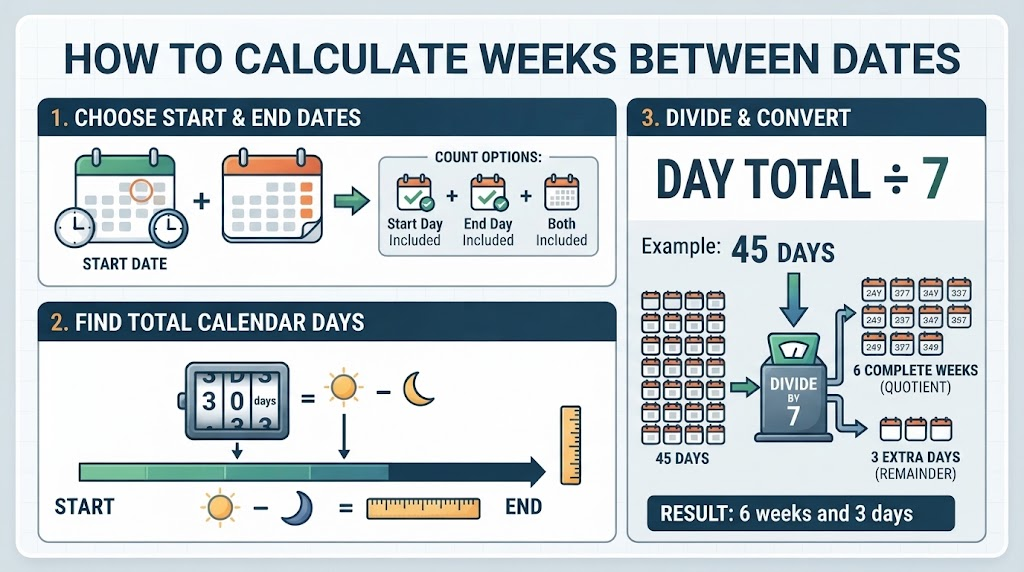
To find the number of weeks remaining in a year—or between any two calendar dates—count the total number of days in the interval and divide by seven. The quotient gives complete weeks, while the remainder tells you how many extra days are left.
- Choose the start and end dates, and decide whether your count includes the starting day, ending day, or both.
- Find the total number of calendar days between those dates.
- Divide the day total by 7. For example, 45 days equals 6 complete weeks and 3 days.
Why do people sometimes mention 53 weeks?
The extra day or two does not automatically create a 53rd full seven-day period. The phrase “53 weeks” usually refers to a numbering convention or to a particular business calendar. Under ISO 8601, weeks begin on Monday and Week 1 is the week containing the year’s first Thursday. Because the ISO week year can begin in late December or extend into early January, some Gregorian years contain dates labeled Week 53. Retailers and other organizations may also use 4-4-5 calendars, which divide quarters into repeating blocks of four, four, and five weeks. In those systems, an occasional 53rd week may be added so the business calendar stays aligned with the seasons and reporting year.
Calendar systems and business weeks
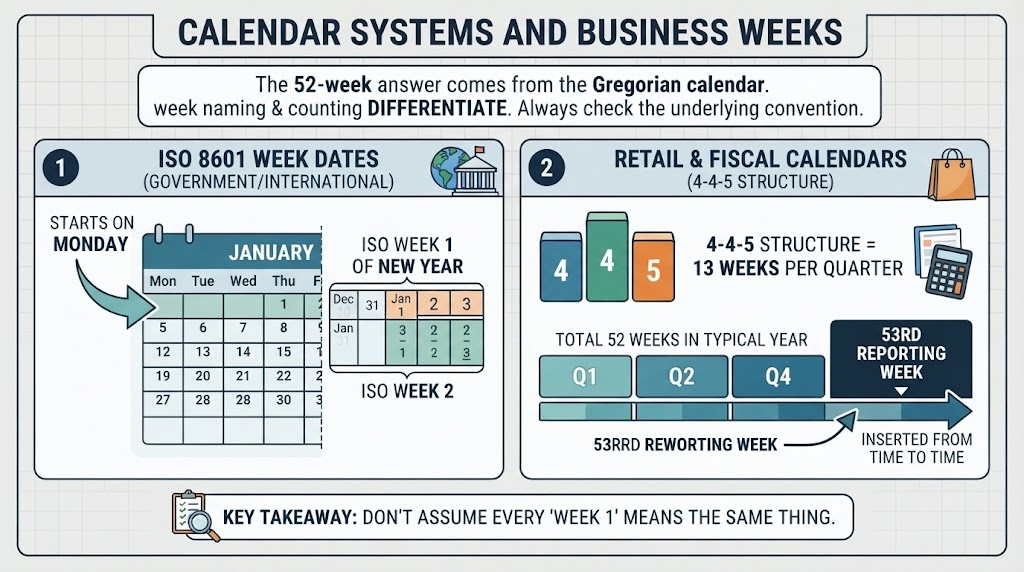
The 52-week answer comes from the Gregorian calendar used for civil dates in much of the world. But the way a week is named, counted, or used can differ between organisations and calendar traditions. Before comparing a schedule, check the underlying convention rather than assuming every “week 1” means the same thing.
- ISO week dates: ISO 8601 starts weeks on Monday and can assign the first few days of January to the previous ISO week year.
- Retail and fiscal calendars: a 4-4-5 structure contains 52 weeks in a typical year, with a 53rd reporting week inserted from time to time.
What this means for planning
Use the convention that fits the decision you are making. For a high-level annual plan, 52 weeks is a clean and useful baseline. For a dated schedule, count the actual days between the start and end dates, then account for weekends, holidays, leave, and closures. The difference between 52 weeks and 52 weeks plus one or two days matters most when a repeating schedule runs for years, when pay dates are calculated on a fixed cadence, or when a deadline falls near the end of December or beginning of January.
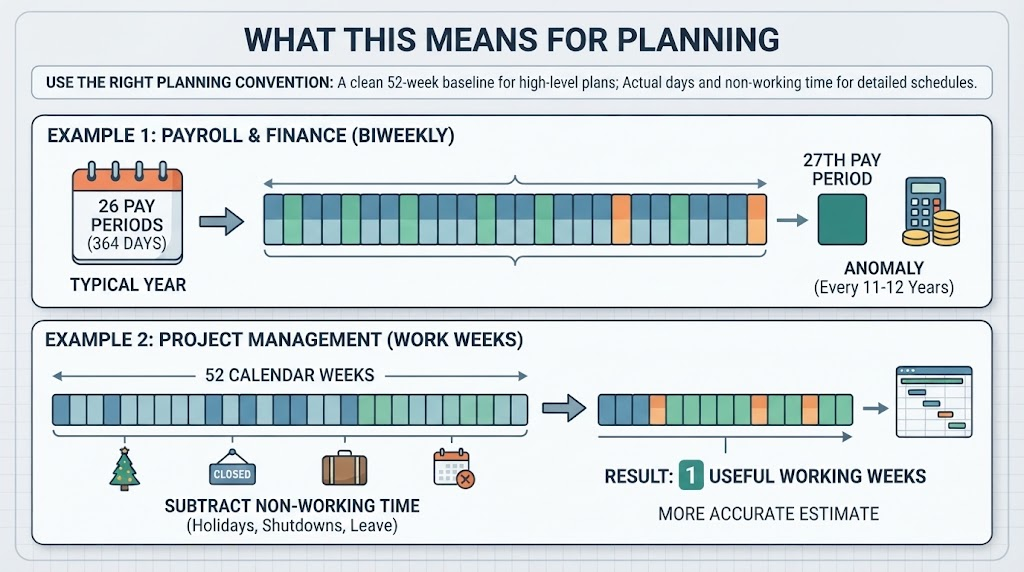
- Payroll and finance: biweekly payroll usually creates 26 pay periods in a year. Because 26 periods cover 364 days, some payroll calendars eventually include a 27th biweekly payday, often every 11 or 12 years depending on the pay-date pattern.
- Project management: start with 52 weeks for a year-long project, then subtract holidays, shutdowns, approved leave, and other non-working time. This produces a more useful working-week estimate than calendar weeks alone.
Weeks in a year: FAQ
Is there ever exactly 52 weeks in a year?
No Gregorian calendar year is exactly 52 complete weeks long. A 365-day common year is 52 weeks plus 1 day, and a 366-day leap year is 52 weeks plus 2 days. February in a standard year, however, is exactly four weeks long.
How many working weeks are in a year?
There is no single answer because working weeks depend on your local work pattern, public holidays, paid leave, and business closures. A five-day workweek produces about 260 weekdays in a standard year before holidays, which is roughly 52 working weeks of five days each.
Does a leap year have 53 weeks?
No. A leap year has 52 complete weeks and 2 extra days. It may have dates labelled as Week 53 under some week-numbering systems, but that is a convention for labelling weeks rather than 53 complete seven-day periods inside the calendar year.
Why does a calendar sometimes show six weeks in a month?
Monthly calendars are arranged in rows of seven days. If a long month begins near the end of a week, its dates can stretch across six calendar rows. Those rows include days from neighbouring months, so they are not six complete weeks belonging to that month.