
What Is 1 Month From Today
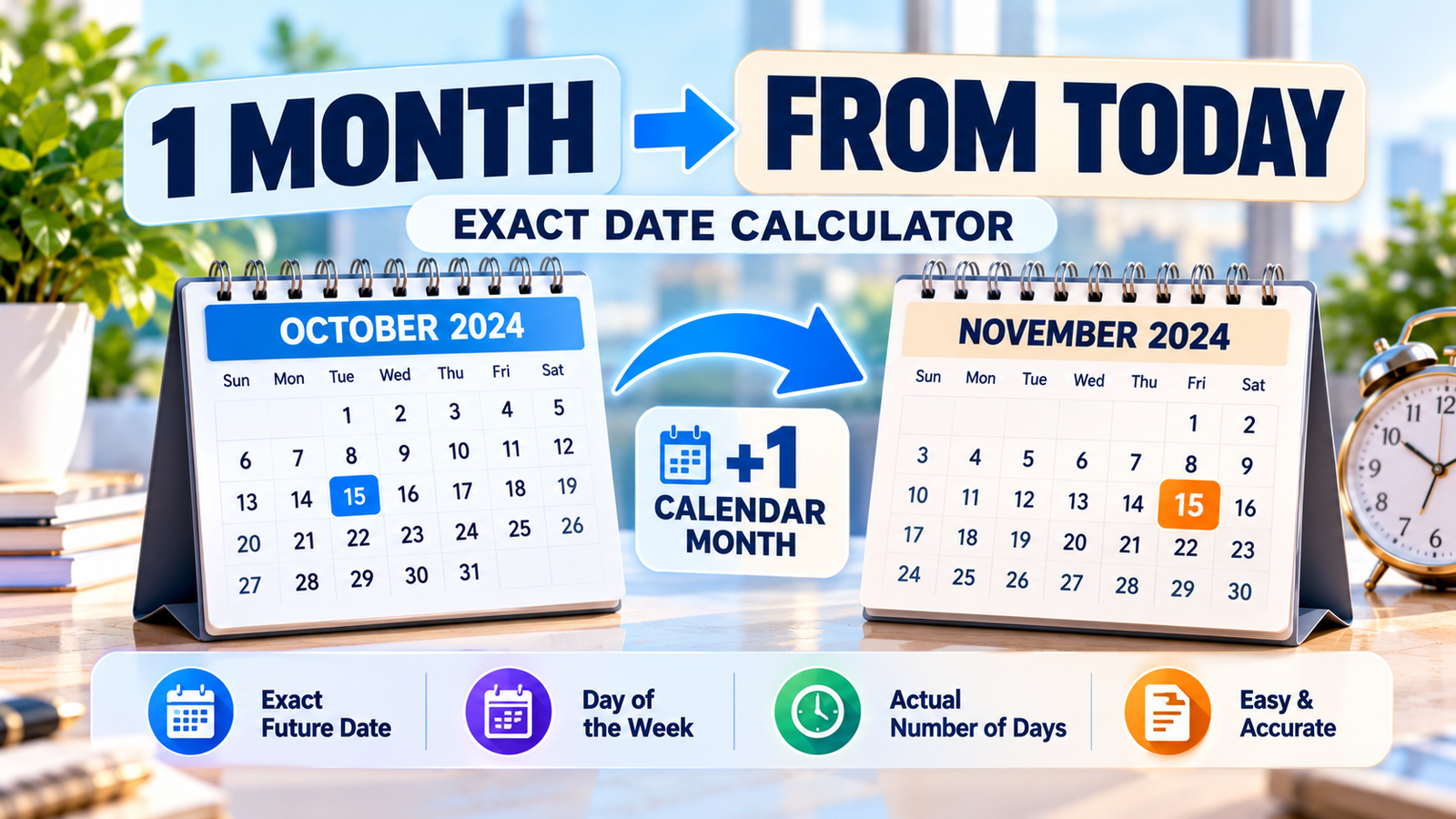
If you are searching for 1 month from today, you want to know the exact calendar date that occurs one month after today's date.
A calendar month is different from a fixed number of days. Depending on the months involved, one month can contain 28, 29, 30, or 31 days.
Quick answer: 1 month from today means moving forward one calendar month from today's date. When the same day exists in the following month, that calendar day is used.
1 Month From Today Calculator
Use the calculator below to find the exact date one month from today, or enter another starting date if you are calculating a future date from a specific day.
What Does 1 Month From Today Mean?
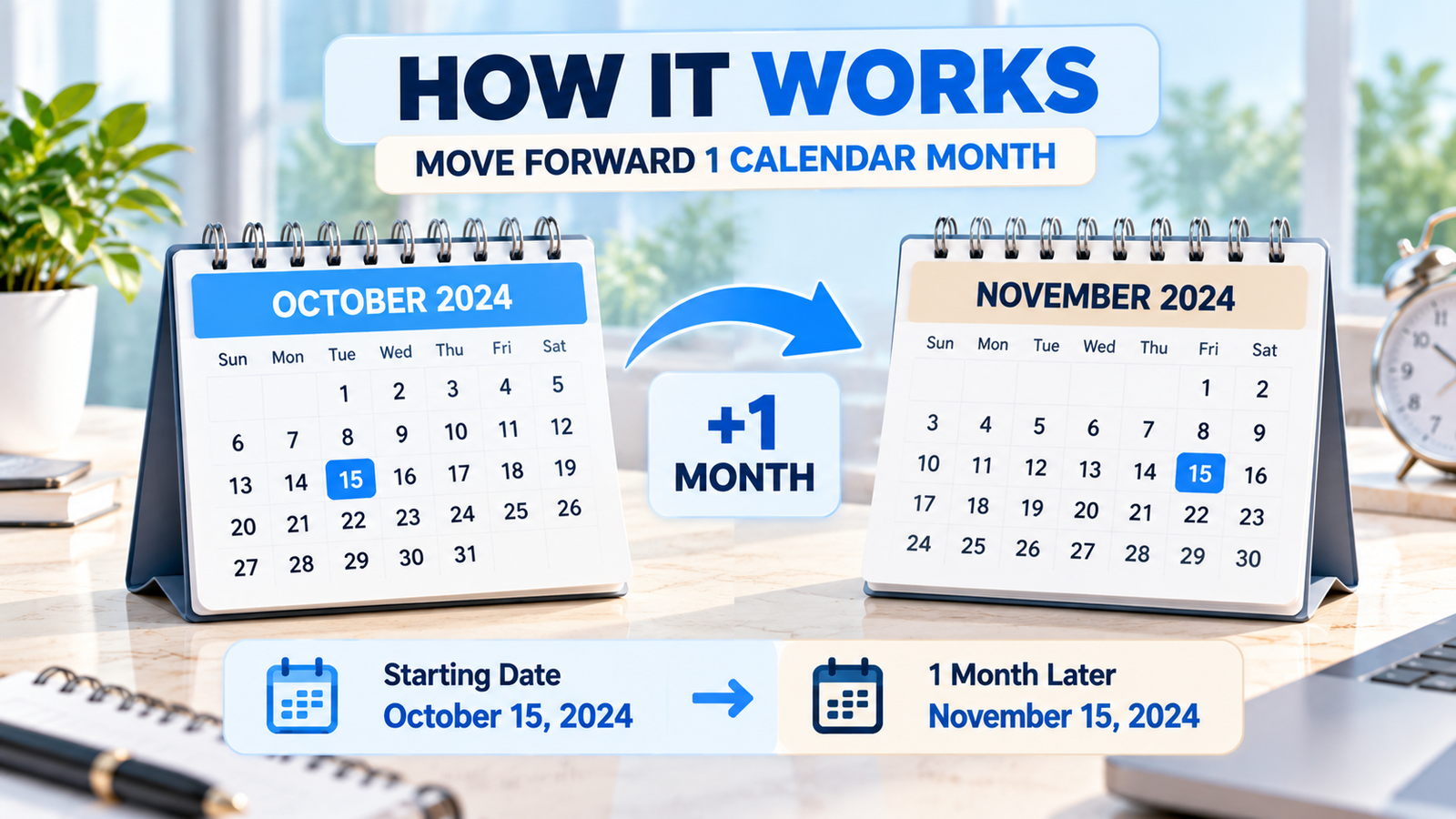
One month from today means the calendar date that occurs one calendar month after today's date.
For example, if the starting date is October 15, one calendar month later is November 15. The calculation follows the calendar rather than assuming that one month contains a fixed number of days.
Simple Example
Starting date: October 15
+ 1 calendar month → November 15
The day number remains the same because November contains a 15th.
How Do You Calculate 1 Month From Today?
The basic process is simple. Start with the date, move forward one calendar month, and check whether the destination month contains the same day number.
Use today's date or enter another date that you want to use as the starting point.
Move from the current calendar month to the following calendar month.
If the next month contains the same day number, keep that day.
The calculator shows the future date, weekday, and actual number of elapsed days.
A Simple One-Month Calendar Example
Suppose the starting date is October 15. Moving forward one calendar month produces November 15.
One calendar month means moving forward on the calendar. It does not automatically mean adding exactly 30 days.
Is 1 Month the Same as 30 Days?
No, not always. One calendar month and 30 days are two different ways of measuring time.
1 Calendar Month
Move one month forward on the calendar. The result depends on the starting date and destination month.
30 Days
Add exactly 30 calendar days to the starting date. This is a fixed duration rather than a calendar-month calculation.
Why Is 1 Month Not Always 30 Days?
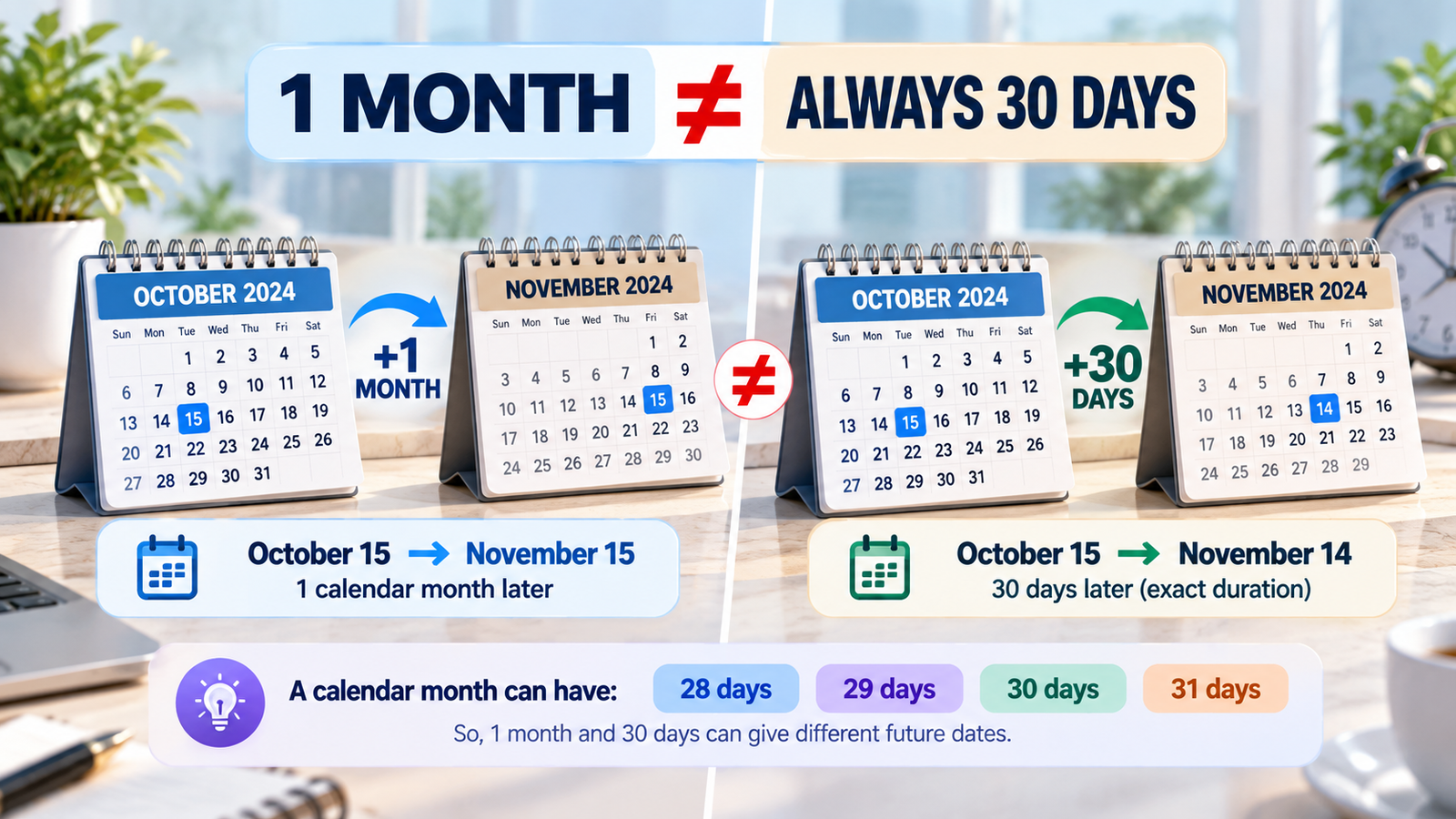
Calendar months have different lengths. Depending on the month, a calendar month can contain 28, 29, 30, or 31 days.
Simple Comparison
If October 15 is the starting date, one calendar month later is November 15.
But exactly 30 days after October 15 is November 14.
This is why a calendar-month calculation and a 30-day calculation can produce different future dates.
Is 1 Month the Same as 4 Weeks?
No. Four weeks is exactly 28 days, while a calendar month can have 28, 29, 30, or 31 days.
1 Calendar Month
The date advances by one month on the calendar.
4 Weeks
Four weeks always equals exactly 28 days.
Why This Matters
If a schedule specifically says “one month,” use a calendar-month calculation. If it says “four weeks,” use 28 days. These instructions can produce different dates.
What Happens If the Next Month Does Not Have the Same Date?
This is an important edge case for date calculations. Some calendar months do not contain every possible day number.
For example, February does not have a 30th or 31st day. A calculator therefore needs a clear rule for handling a date such as January 31.
End-of-Month Example
For this calculator, when the destination month does not contain the original day number, the result uses the last valid day of the destination month.
| Starting Date | Period | Result |
|---|---|---|
| January 31 | +1 month | February 28 or February 29 |
| May 31 | +1 month | June 30 |
| August 31 | +1 month | September 30 |
The calculator clearly applies the last-valid-day rule instead of silently producing an invalid calendar date.
What Day Will It Be 1 Month From Today?
The exact weekday one month from today depends on the starting date and the number of days between the two calendar dates.
Unlike four weeks, one calendar month does not always contain the same number of days. Therefore, the weekday can change by different amounts depending on the months involved.
The Calculator Shows the Weekday
After calculating the future date, the tool displays the corresponding day of the week so you do not need to calculate it separately.
Why Does 1 Month From Today Matter?
Knowing the exact date one calendar month ahead can make everyday planning easier when a schedule is based on a calendar month.
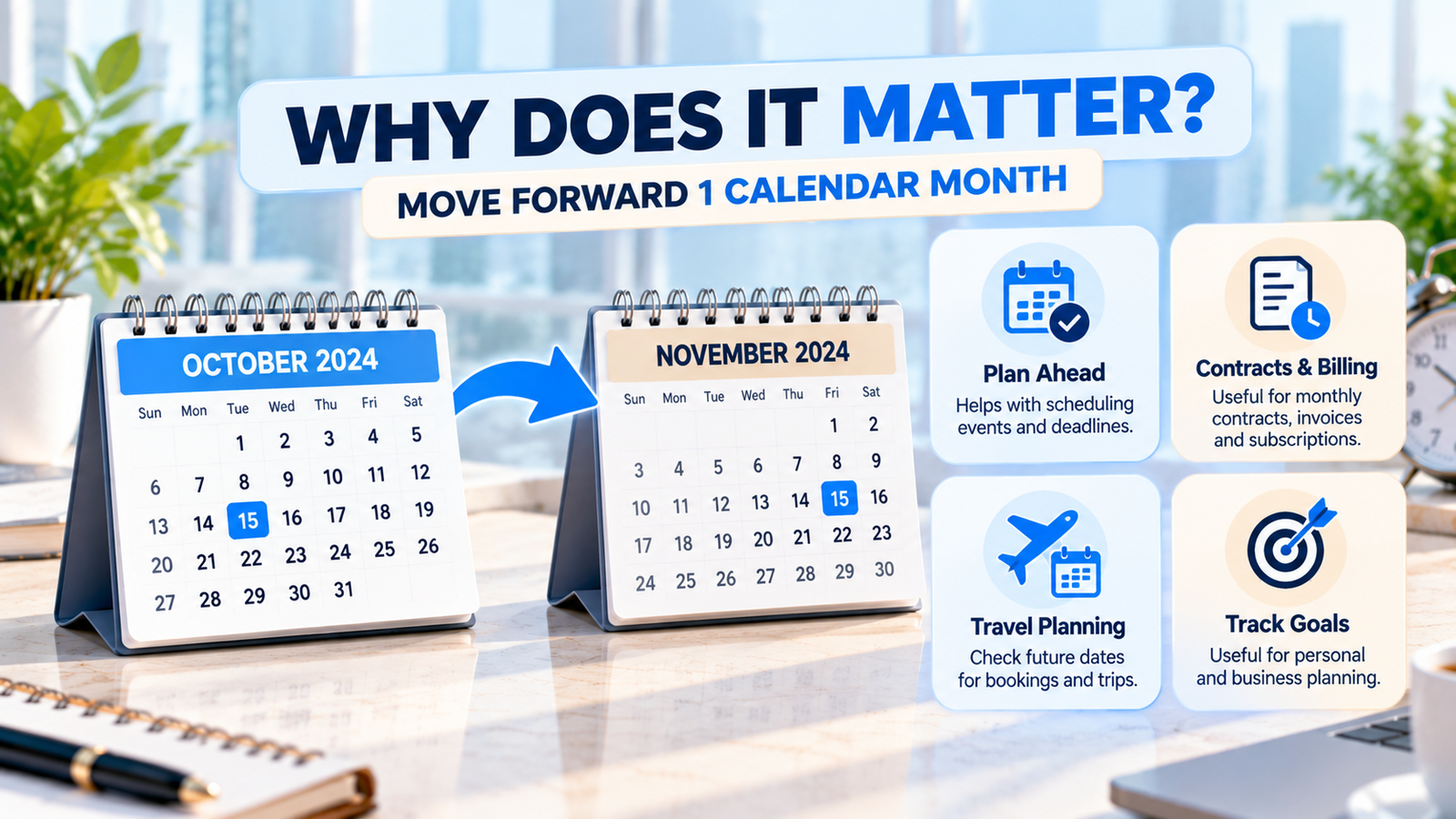
Plan Ahead
Find a future date for events, deadlines, meetings, or other scheduled activities.
Appointments
Calculate a follow-up appointment date scheduled one calendar month after an earlier visit.
Contracts & Billing
Check future dates for monthly invoices, contracts, subscriptions, and recurring schedules.
Travel Planning
Calculate future dates when planning bookings, trips, reservations, or other travel activities.
Track Goals
Create a one-month planning period for personal goals, routines, projects, or learning activities.
Project Milestones
Set a calendar-based milestone exactly one month after a project's starting date.
Common Mistakes When Calculating 1 Month From Today
Calendar months can have 28, 29, 30, or 31 days.
Four weeks is exactly 28 days, while most calendar months contain more than 28 days.
February has fewer days than other months and can affect calculations involving dates near the end of a month.
Some destination months do not contain those dates, so an end-of-month rule is required.
A live “from today” calculator should determine today's date dynamically instead of relying on an outdated date.
Frequently Asked Questions
What is 1 month from today?
One month from today is the calendar date one month after today's date. Use the calculator above to determine the exact future date.
Is 1 month the same as 30 days?
No. One calendar month is not always 30 days. A month can contain 28, 29, 30, or 31 days depending on the calendar month.
Is 1 month the same as 4 weeks?
No. Four weeks equals exactly 28 days, while a calendar month can contain more than 28 days.
How many days are in one month?
A calendar month can have 28, 29, 30, or 31 days. The exact number depends on the month and year.
How do I calculate one month from a specific date?
Start with the date you want to use, move forward one calendar month, and use the corresponding day when that day exists in the destination month.
What happens if the next month does not have the same date?
For this calculator, if the destination month does not contain the original day number, the result uses the last valid day of that destination month.
What is 30 days from today compared with 1 month from today?
Thirty days means adding exactly 30 days. One month means moving forward one calendar month. These calculations can produce different dates.
What day of the week will it be one month from today?
The weekday depends on the starting date and the number of days in the calendar-month interval. The calculator displays the resulting weekday automatically.
Can I calculate one month from any date?
Yes. Enter any starting date into the calculator and set the number of months to one.
How does the one-month date calculator work?
The calculator takes the starting date, adds one calendar month, checks whether the destination month contains the original day, and adjusts to the last valid day when necessary.
Final Summary
1 month from today means one calendar month after today's date.
It is important not to automatically treat one month as 30 days or four weeks because calendar months have different lengths.
When the same day exists in the destination month, that day is used. If it does not exist, this calculator uses the last valid day of the destination month.
Use the calculator above whenever you need to find a future date for appointments, deadlines, billing, travel planning, projects, subscriptions, or personal goals.