
What Is 72 Hours From Now
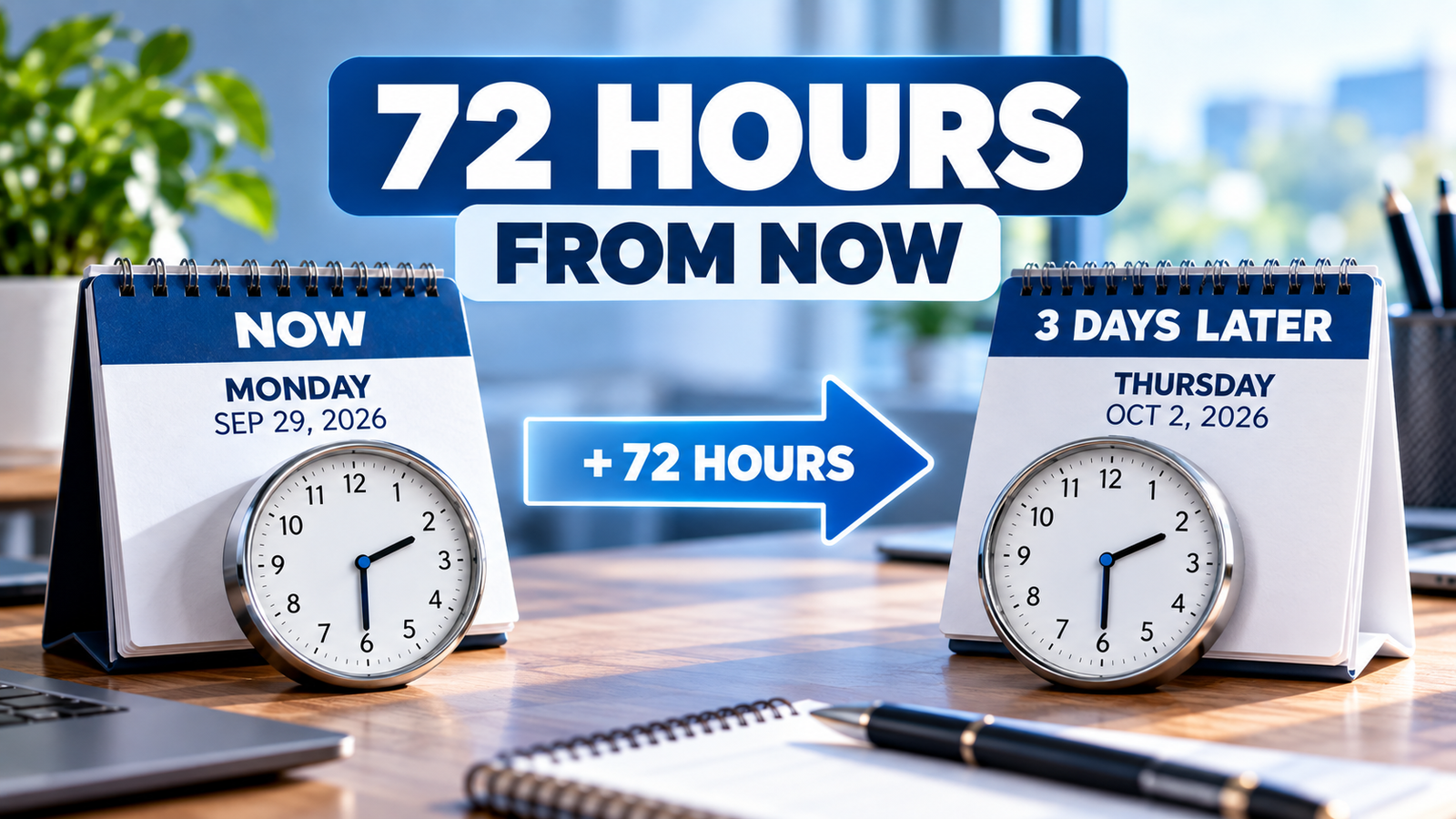
If you are searching for 72 hours from now, you may need to know the exact date and time when a three-day period will end. This can be useful for deadlines, appointments, travel plans, work schedules, reservations, projects, and short-term reminders.
Unlike a simple date calculation, a 72-hour calculation depends on both the starting date and the starting time. Exactly 72 hours means three complete periods of 24 hours.
72 hours from now means exactly 72 hours after the current moment. Because 72 hours equals three complete days, the result will normally be three days later at the same clock time.
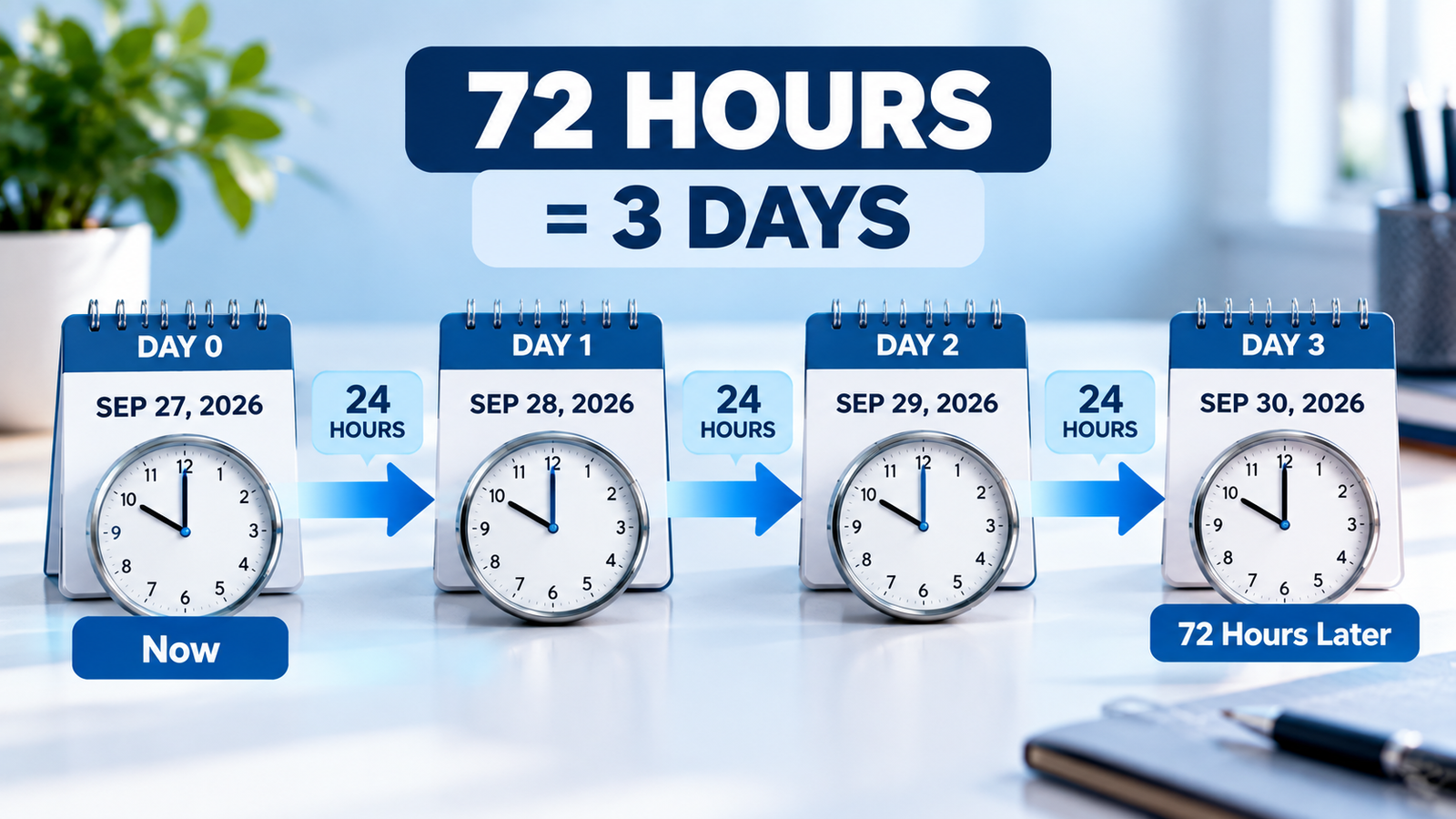
72 hours = 3 days. To find the exact result, start with the current date and time and add 72 complete hours. For example, Monday at 2:30 PM becomes Thursday at 2:30 PM.
72 Hours From Now Calculator
Use the calculator below to find exactly when 72 hours will have passed. The starting date and time are automatically set to the current time on your device.
What Does 72 Hours From Now Mean?
The phrase 72 hours from now means exactly 72 elapsed hours after the current moment. Since one day contains 24 hours, three days contain 72 hours.
The important difference is that a 72-hour period includes a specific starting time. If the period begins at 10:15 AM, exactly 72 hours later will normally be 10:15 AM three days later.
72 Hours Equals 3 Complete Days
24 hours × 3 = 72 hours. This means a full 72-hour period represents three complete 24-hour periods.
How Does a 72-Hour Calculation Work?
A 72-hour calculation starts from a specific moment and moves forward by 72 complete hours. The calculator handles the date and time together so you do not have to count each hour manually.
Use the current date and time or select another starting date and time.
The calculator starts with 72 hours. You can change the value if you need another time period.
The calculator moves forward through the clock and calendar until all 72 hours have been added.
The result shows the future date, time, and day of the week.
What Date and Time Will It Be 72 Hours From Now?
The exact answer depends on when the 72-hour period begins. Because the calculation uses elapsed hours, the starting time is just as important as the starting date.
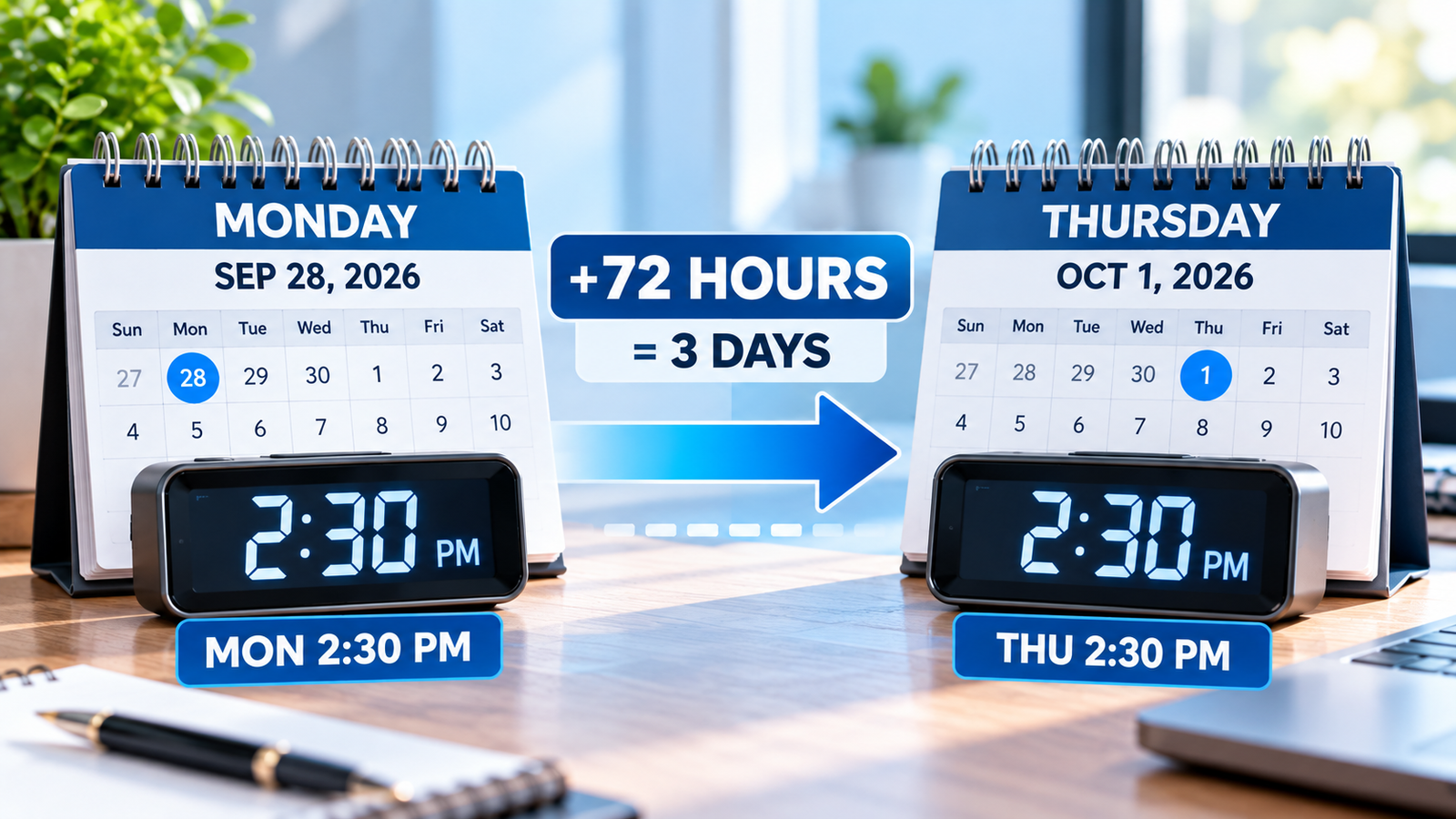
Example: Monday at 2:30 PM
Suppose a 72-hour period begins on Monday at 2:30 PM. After 24 hours it is Tuesday at 2:30 PM. After another 24 hours it is Wednesday at 2:30 PM. After another 24 hours it becomes Thursday at 2:30 PM.
Therefore, the result is Thursday at 2:30 PM.

How to Calculate 72 Hours From Now Manually
You can calculate a 72-hour period manually by breaking it into three 24-hour periods. This makes the calculation easier to follow without counting every individual hour.
For example, begin with Monday at 2:30 PM.
One complete day later is Tuesday at 2:30 PM.
Two complete days later is Wednesday at 2:30 PM.
Three complete days later is Thursday at 2:30 PM.
Breaking the period into three equal 24-hour blocks makes the calculation easier to understand.
Does 72 Hours Include Weekends?
Yes. A standard 72-hour calculation measures elapsed time, so weekends are included. If a period begins on Friday, the 72 hours continue through Saturday and Sunday.
72 Hours Is Not the Same as 3 Business Days
A 72-hour period continues continuously through the calendar. A business-day period may use working-day rules and exclude weekends or certain holidays.
If a deadline specifically says 72 hours, do not automatically interpret it as three business days.
Can 72 Hours Cross Midnight?
Yes. In fact, most 72-hour calculations cross several midnight boundaries. Midnight does not reset the calculation because the period is based on elapsed hours rather than the number shown on the calendar.
For example, if a countdown starts at 8:00 PM on Monday, the 72-hour period ends at 8:00 PM on Thursday.
The countdown continues from one hour to the next until all 72 hours have passed.
Is 72 Hours the Same as 3 Days?
Yes. In ordinary elapsed-time terms, 72 hours equals three complete 24-hour days.
| Period | Equivalent |
|---|---|
| 24 hours | 1 day |
| 48 hours | 2 days |
| 72 hours | 3 days |
| 96 hours | 4 days |
Examples of 72 Hours From Different Starting Times
The result changes depending on the starting date and time. These examples show the basic relationship between the starting moment and the moment 72 hours later.
| Starting Point | 72 Hours Later |
|---|---|
| Monday, 9:00 AM | Thursday, 9:00 AM |
| Tuesday, 1:30 PM | Friday, 1:30 PM |
| Wednesday, 6:00 PM | Saturday, 6:00 PM |
| Friday, 10:00 AM | Monday, 10:00 AM |
| Sunday, 8:15 PM | Wednesday, 8:15 PM |
Why Does the Starting Time Matter?
When someone says “72 hours from now,” the word now refers to a specific moment. Changing the starting time changes the exact ending time, even when the starting date remains the same.
Same Date, Different Starting Times
If one calculation starts at 9:00 AM and another starts at 4:00 PM on the same day, their 72-hour results will also be seven hours apart.
Can 72 Hours Cross Into Another Month or Year?
Yes. A 72-hour period can cross from one month into another, and a period that starts near the end of December can cross into the following year.
The calculation continues normally regardless of where the calendar changes. The important factor is that the complete 72 hours are added to the starting moment.
When Is a 72-Hour Calculation Useful?
Knowing the exact end of a 72-hour period can help when a task or event is tied to a specific amount of elapsed time.
Deadlines
Calculate when a time-sensitive submission or response period ends.
Travel
Plan trips, reservations, check-in windows, and other short-term travel activities.
Work
Track project windows, follow-ups, campaigns, and short-term business tasks.
Appointments
Find an exact future date and time for a scheduled follow-up or activity.
Events
Determine exactly when an event or countdown reaches the 72-hour point.
Projects
Set milestones that occur exactly three days after a project begins.
Reminders
Create a reminder for a task that needs attention after a fixed 72-hour period.
Short-Term Planning
Convert a three-day time period into a precise date and time.
Common Mistakes When Calculating 72 Hours
1. Counting the Starting Hour as Hour 1
A 72-hour calculation starts from a specific moment and adds 72 complete hours. The starting moment is the beginning of the period.
2. Ignoring the Starting Time
A date alone is not enough when you need the exact result of 72 hours from now. The starting time matters.
3. Confusing 72 Hours With 3 Business Days
72 elapsed hours continue through weekends. Business-day calculations can follow different rules.
4. Assuming Midnight Resets the Calculation
Midnight is simply another point on the clock. The 72-hour countdown continues through it.
5. Counting Calendar Dates Instead of Hours
The phrase “72 hours” refers to elapsed time. Simply counting three dates without considering the starting time can cause confusion.
Why Use a 72-Hour Calculator?
You can calculate three days manually, but an exact date-and-time calculator reduces the chance of overlooking the starting time or a calendar transition.
- Calculates the exact future date.
- Calculates the exact future time.
- Handles month changes automatically.
- Handles year changes automatically.
- Shows the resulting day of the week.
- Allows a custom starting date and time.
- Lets you calculate other numbers of hours as well.
Frequently Asked Questions
72 hours from now means exactly 72 elapsed hours after the current moment. Since 72 hours equals three days, the result is normally three days later at the same clock time.
Yes. One day contains 24 hours, so three days contain 72 hours.
The exact time depends on the starting time. In a normal 72-hour calculation, the ending time is the same clock time three days later.
Yes. A standard 72-hour period measures elapsed time continuously, so Saturdays and Sundays are included.
The starting moment is the beginning of the 72-hour period. The calculator adds 72 complete hours after that starting moment.
Yes. If the starting point is close to the end of a month, the 72-hour period can finish during the following month.
Yes. A 72-hour period that begins near the end of December can finish in January of the following year.
Not necessarily. Seventy-two hours is three complete 24-hour periods, while business days generally follow working-day rules.
Because 72 hours is an elapsed-time measurement. Changing the starting time changes the exact time when the 72-hour period ends.
Yes. Select your starting date and time in the calculator and leave the hours field set to 72.
72 hours is exactly 3 days and 0 additional hours.
Final Summary
72 hours from now means exactly 72 elapsed hours after the current moment. Because one day contains 24 hours, 72 hours equals 3 complete days.
The starting time matters because the exact result includes both a date and a time. For example, Monday at 2:30 PM becomes Thursday at 2:30 PM after 72 hours.
A normal 72-hour calculation includes weekends and can cross midnight, a month boundary, or a year boundary. It should not automatically be interpreted as three business days.
Use the calculator above whenever you need to determine the precise date and time at which a 72-hour period will end.