
Estimate Your Roth IRA Retirement Savings
Use the Roth IRA Calculator above to estimate your retirement savings, investment growth, and 2026 contribution eligibility.
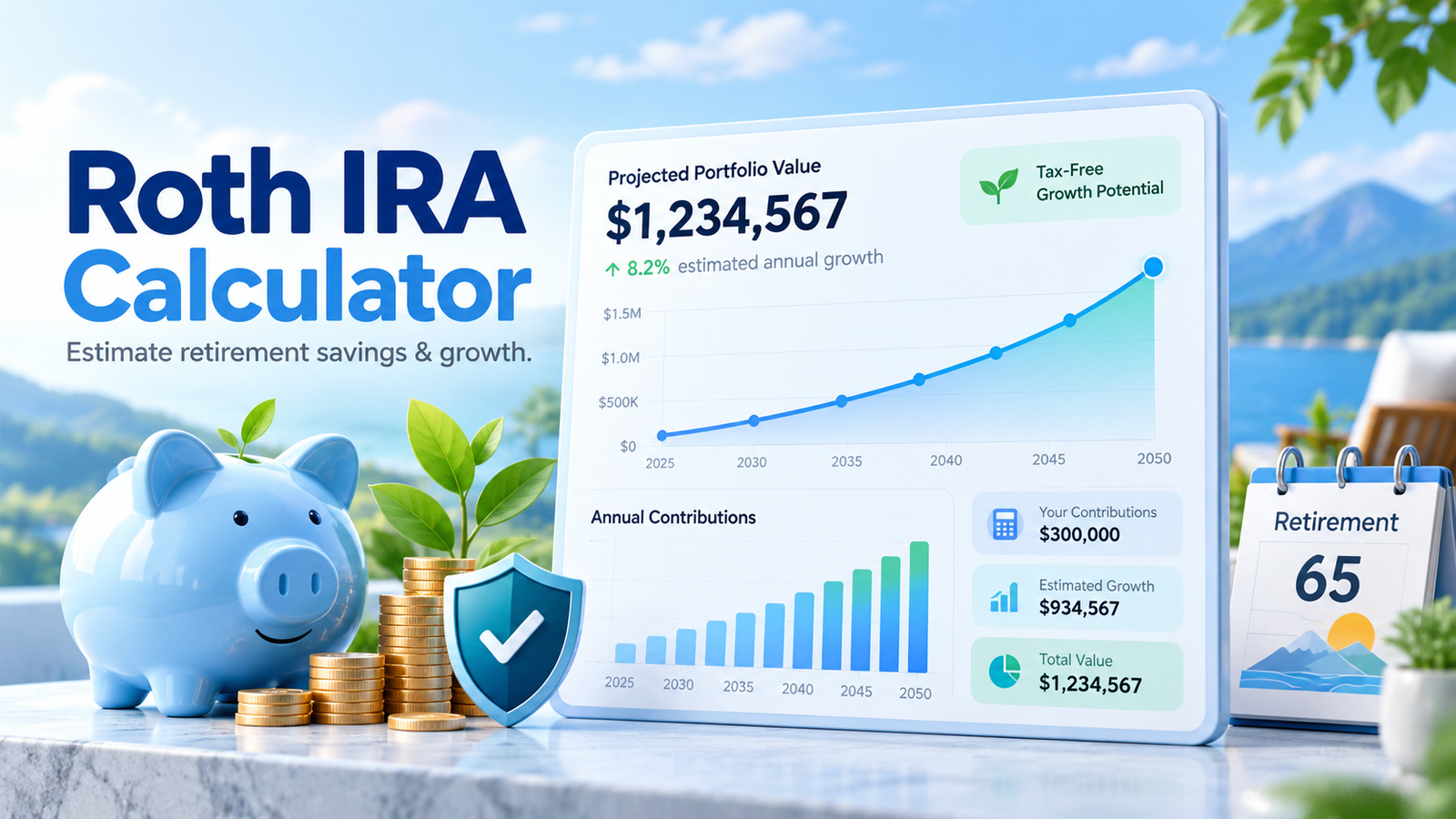
How to Use the Roth IRA Calculator
Our free Roth IRA Calculator helps you see how regular contributions and investment growth may affect your retirement savings over time.
Step 1: Enter Your Current Age
Enter your age today. The calculator uses this to determine how many years your savings may have to grow before retirement.
Step 2: Choose Your Retirement Age
Enter the age when you expect to retire, such as 60, 65, or 67. Your retirement age must be greater than your current age.
Step 3: Add Your Current Roth IRA Balance
Enter the amount already saved in your Roth IRA. If you're starting a new account, enter $0.
Step 4: Enter Your Regular Contribution
Choose how much you plan to contribute monthly or annually. You can switch between the two contribution frequencies.
Step 5: Set Your Expected Annual Return
Enter an assumed annual investment return. The default is 6%, but you can adjust it to explore different possibilities. Investment returns are not guaranteed.
Step 6: Review Your Results
The calculator displays your projected retirement balance, new contributions, estimated investment growth, and inflation-adjusted value.
You can also explore your savings chart, compare alternative contribution amounts, and check your estimated eligibility under 2026 Roth IRA rules.
What Is a Roth IRA?
A Roth IRA (Individual Retirement Account) is a US retirement account that allows eligible individuals to contribute money that has already been taxed.
Unlike contributions to a traditional IRA, Roth IRA contributions do not generally provide an upfront income tax deduction.
However, investments held in a Roth IRA can grow without annual federal income tax on gains inside the account, and qualified withdrawals can be tax-free.
This makes a Roth IRA an option for people who want to build long-term retirement savings while potentially reducing taxes on qualified withdrawals later.
A Roth IRA is an account type, not an investment itself. Depending on your provider, the account may hold investments such as mutual funds, exchange-traded funds (ETFs), stocks, or bonds.
Understanding Your Roth IRA Calculator Results
The calculator shows several values that explain your potential retirement savings.
| Result | What It Means |
|---|---|
| Projected Roth IRA Balance | Estimated account value at retirement |
| Starting Balance | Money already in your account |
| New Contributions | Additional money you plan to deposit |
| Investment Gain or Loss | Estimated return on your invested money |
| Today's-Dollar Value | Projected balance adjusted for assumed inflation |
| Years to Retirement | Number of years available for potential growth |
| 2026 IRA Limit | Current-year contribution reference amount |
Projected Roth IRA Balance
This is the estimated total value of your Roth IRA when you reach your selected retirement age.
It includes your current account balance, future contributions, and projected investment gains or losses.
Your actual retirement balance may be higher or lower because market returns change over time.
Total Contributions
New contributions represent the money you add to your Roth IRA during the projection period.
For example, contributing $500 monthly means depositing $6,000 over a full year, before considering eligibility and contribution limits.
Investment Growth
Investment growth is the difference between your projected account balance and the total amount invested, including your starting balance.
A positive result represents projected growth. A negative result represents a projected investment loss.
Inflation-Adjusted Value
Your Roth IRA may have a larger dollar balance in the future, but inflation can reduce the purchasing power of that money.
The calculator estimates what your projected retirement balance could be worth in today's dollars using the inflation rate entered in Advanced Settings.
Roth IRA Calculator Example
Suppose someone begins saving for retirement at age 32 with the following assumptions:
| Roth IRA Detail | Example |
|---|---|
| Current Age | 32 |
| Retirement Age | 65 |
| Starting Balance | $5,000 |
| Monthly Contribution | $500 |
| Expected Annual Return | 6% |
| Investment Period | 33 years |
Using the calculator's monthly growth model and contribution assumptions, the approximate results would be:
| Result | Estimated Value |
|---|---|
| Starting Balance | $5,000 |
| New Contributions | $198,000 |
| Total Invested | $203,000 |
| Investment Growth | $453,745 |
| Projected Roth IRA Balance | $656,745 |
In this illustration, investment growth makes up a substantial portion of the projected retirement balance.
The example assumes a constant 6% nominal annual return, monthly compounding, deposits at the end of each month, no fees or withdrawals, and continued contribution eligibility under the selected planning assumptions.
Actual investment performance will vary.
How Does Roth IRA Compound Growth Work?
Compounding occurs when investment gains remain in your account and have the opportunity to generate additional returns.
For example, an investment that earns a return may grow in value. If the gains remain invested, future returns may apply to a larger balance.
Over long periods, this process can create a meaningful difference between the amount contributed and the ending account value.
The calculator uses a monthly growth model for its projections.
For monthly contributions, the simplified calculation is:
Ending Balance = Starting Balance × (1 + Monthly Return) + Monthly Contribution
The assumed monthly rate is calculated as:
Monthly Return = Annual Return ÷ 12
This calculation repeats across the investment period.
When annual contributions are selected, the calculator applies monthly growth and adds the annual contribution at year-end.
The model assumes a constant rate for illustration, even though real investments experience changing returns, including negative periods.
Roth IRA Contribution Limits for 2026
The IRS sets annual contribution limits for traditional and Roth IRAs.
For the 2026 tax year, the general limits are:
| Age | Maximum Annual IRA Contribution |
|---|---|
| Under 50 | $7,500 |
| Age 50 or older | $8,600 |
The higher limit includes an additional $1,100 catch-up contribution for eligible individuals aged 50 or older by the end of the tax year.
These limits apply to combined contributions across traditional and Roth IRAs, not separately to each account.
Your actual allowed contribution may be lower because of your taxable compensation, modified adjusted gross income (MAGI), filing status, or contributions already made to other IRAs.
How Much Can You Contribute Monthly?
If you are eligible for the full annual limit, the equivalent monthly amounts are approximately:
| Age | Annual Limit | Monthly Equivalent |
|---|---|---|
| Under 50 | $7,500 | $625.00 |
| Age 50 or older | $8,600 | $716.67 |
These are simple monthly budgeting equivalents, not separate IRS monthly limits.
You do not necessarily have to contribute the same amount every month.
Roth IRA Income Limits for 2026
Your ability to contribute directly to a Roth IRA may be reduced or eliminated at higher income levels.
For 2026, the income phase-out ranges are:
| Filing Status | 2026 MAGI Phase-Out Range |
|---|---|
| Single | $153,000–$168,000 |
| Head of Household | $153,000–$168,000 |
| Married Filing Jointly | $242,000–$252,000 |
| Qualifying Surviving Spouse | $242,000–$252,000 |
| Married Filing Separately, lived with spouse during the year | $0–$10,000 |
For married taxpayers filing separately who lived apart from their spouse for the entire year, the applicable Roth IRA income treatment generally follows the single-filer range.
What Happens Within the Income Phase-Out Range?
If your modified adjusted gross income falls inside the applicable phase-out range, you may still be allowed to make a reduced direct Roth IRA contribution.
Once your MAGI reaches the upper threshold, your direct Roth IRA contribution limit generally becomes zero for that year.
The calculator's 2026 Contribution Eligibility section estimates your remaining contribution room using the entered tax information.
How to Check Your Roth IRA Contribution Eligibility
Open Check Your 2026 Roth IRA Contribution Eligibility beneath the retirement savings chart.
Enter your:
- Tax filing status
- Modified adjusted gross income (MAGI)
- Eligible taxable compensation
- Traditional IRA contributions already made in 2026
- Roth IRA contributions already made in 2026
The calculator estimates your remaining direct Roth IRA contribution allowance.
Important: MAGI is not necessarily the same as your salary or gross income.
The calculation also depends on how much eligible compensation is available and whether contributions have already been made to other IRAs.
Special situations, including spousal IRA rules and unusual contribution arrangements, may require professional tax guidance.
You can still project growth from an existing Roth IRA balance even when you are not eligible to make new direct contributions.
How Does the Age-50 Catch-Up Contribution Work?
Beginning with the tax year in which an eligible individual reaches age 50, an additional IRA catch-up contribution may be available.
For 2026, that catch-up amount is $1,100.
The calculator's long-term default projection uses the 2026 base and catch-up limits as fixed planning assumptions. It adds the catch-up amount in projected years when your age reaches 50.
For example, someone beginning at age 45 may have five years of projected contributions under the base-limit assumption before the age-50 catch-up allowance begins.
Actual future IRS limits may change. The calculator does not predict future contribution limits or future income eligibility.
Monthly vs. Annual Roth IRA Contributions
You can choose to contribute monthly or annually in the calculator.
Monthly Contributions
Monthly contributions spread your planned deposits across the year.
For example:
$500 × 12 months = $6,000 annually
This approach may be convenient for someone saving regularly from each paycheck.
Annual Contributions
Annual contributions model a single deposit at the end of each projected year.
For example:
$6,000 once per year
Because the tool assumes monthly deposits are made at month-end and annual deposits at year-end, the projected balances can differ even when the annual contribution total is the same.
Actual results depend on when money is invested and how the investments perform.
How Much Could Saving More Change Your Roth IRA?
The calculator includes a What If You Save More? section that compares three contribution scenarios:
- Save 25% less
- Continue your current plan
- Save 25% more
For example, if your regular contribution is $500 monthly, the calculator compares $375, $500, and $625 per month.
Using the earlier example of a 32-year-old saving until age 65 with a $5,000 starting balance and a constant 6% annual return:
| Monthly Contribution | Projected Retirement Balance |
|---|---|
| $375 | Approximately $501,568 |
| $500 | Approximately $656,745 |
| $625 | Approximately $811,923 |
These examples assume contributions remain within the selected planning limits and that the person remains eligible to contribute.
Even relatively small contribution differences can produce substantial differences over a long investment period, although investment outcomes are not guaranteed.
What Is the Best Annual Return to Use?
There is no guaranteed annual return for a Roth IRA.
Your actual returns depend on the investments held in the account, market performance, fees, and other factors.
Rather than assuming an investment return is guaranteed, compare several hypothetical scenarios.
For example:
| Annual Return Assumption | Interpretation |
|---|---|
| 3% | Lower-growth illustration |
| 5% | Moderate-growth illustration |
| 6% | Calculator's example assumption |
| 8% | Higher-growth illustration |
These figures are scenarios, not forecasts or promises.
A stronger retirement plan considers the possibility of lower returns, market declines, and changing personal circumstances.
How Inflation Affects Roth IRA Retirement Savings
A projected balance of $500,000 in the future will not necessarily purchase the same amount of goods and services as $500,000 today.
Inflation reduces purchasing power over time.
The calculator includes an annual inflation assumption in its advanced settings.
The inflation-adjusted calculation is:
Today's-Dollar Value = Future Balance ÷ (1 + Inflation Rate) ^ Years
For example, a projected Roth IRA balance of approximately $656,745 after 33 years would have an estimated present purchasing-power equivalent of approximately $290,743, assuming constant annual inflation of 2.5%.
This does not mean the account loses the difference in dollars. It illustrates how the purchasing power of money may change over time.
Roth IRA vs. Traditional IRA
Both Roth IRAs and traditional IRAs are retirement savings accounts, but they have different federal income tax characteristics.
| Feature | Roth IRA | Traditional IRA |
|---|---|---|
| Contributions | Made with after-tax money | May be tax deductible |
| Investment growth | Tax-deferred while inside the account | Tax-deferred while inside the account |
| Qualified withdrawals | Generally tax-free | Generally taxable to the extent attributable to pretax amounts and earnings |
| Income restrictions | Direct contribution eligibility depends on MAGI | Deductibility may depend on income and workplace retirement plan coverage |
| Contribution limits | Shared annual IRA limit | Shared annual IRA limit |
The more suitable account depends on your tax situation, expected future tax rates, retirement goals, and eligibility.
Some savers use both types of accounts as part of a broader retirement strategy.
Are Roth IRA Withdrawals Tax-Free?
Roth IRA contributions are generally made with after-tax money, and qualified distributions can be free from federal income tax.
However, not every Roth IRA withdrawal is automatically a qualified distribution.
For investment earnings to be distributed tax-free under the usual qualified-distribution rules, the account must generally satisfy the applicable five-tax-year requirement and an additional qualifying condition, commonly reaching age 59½.
Other qualifying circumstances may apply.
Nonqualified distributions of earnings can result in taxes and possibly additional tax penalties, depending on the circumstances.
The calculator projects account growth but does not determine the tax treatment of a future withdrawal.
Roth IRA vs. 401(k): What's the Difference?
A Roth IRA is an individually established retirement account, while a 401(k) is typically offered through an employer.
A 401(k) may provide employer matching contributions, which can add to retirement savings.
A Roth IRA may provide different investment choices and account-management flexibility depending on the provider.
Contribution limits, income rules, and withdrawal requirements also differ between the two account types.
Someone may be able to contribute to both a 401(k) and a Roth IRA if applicable eligibility and contribution rules are met.
How Accurate Is a Roth IRA Calculator?
A Roth IRA Calculator can accurately perform its mathematical projections based on the assumptions entered.
However, it cannot predict actual investment returns, future tax rules, or personal financial circumstances.
Your real retirement savings may be affected by:
- Market gains and losses
- Changes in contribution amounts
- Investment fees
- Inflation
- Changes in retirement age
- Years without contributions
- Changes in income eligibility
- Future IRS contribution limits
- Withdrawals before retirement
The calculator assumes a constant investment return and does not simulate market volatility, investment fees, or withdrawals.
Treat the results as planning estimates rather than guaranteed retirement balances.
Related Retirement & Savings Calculators
Explore these related Skills Elevate tools to understand other aspects of retirement planning, investments, and long-term savings.
- Retirement Savings Calculator — estimate retirement savings using your balance, regular deposits, and expected returns.
- 401k Calculator — project retirement savings from employee contributions, employer matching, and investment growth.
- Compound Interest Calculator — explore how initial investments and recurring deposits may grow with compounding.
- Savings Calculator — estimate future savings based on deposits, time, and growth assumptions.
- ROI Calculator — calculate investment return and annualized performance.
Frequently Asked Questions
What is a Roth IRA Calculator?
A Roth IRA Calculator estimates how much your Roth IRA could grow by retirement using your current balance, contribution amount, time horizon, and expected annual return.
Some calculators, including this one, also estimate current-year contribution eligibility and contribution limits.
How much can I contribute to a Roth IRA in 2026?
For 2026, the general IRA contribution limit is $7,500 for eligible individuals under age 50 and $8,600 for eligible individuals aged 50 or older.
These limits are shared across traditional and Roth IRAs and may be reduced by compensation or income restrictions.
Can I contribute $500 per month to a Roth IRA?
A contribution of $500 monthly equals $6,000 per year, which is below the general 2026 annual IRA contribution limit.
However, whether you can contribute the full amount still depends on your income, eligible compensation, filing status, and other IRA contributions.
How much will my Roth IRA grow in 30 years?
The projected balance depends on your starting amount, regular contributions, assumed returns, and contribution eligibility.
Enter your own values in the calculator to see a personalized illustration over your chosen investment period.
Is a 6% annual return guaranteed in a Roth IRA?
No. A Roth IRA does not offer a guaranteed return simply because it is a retirement account.
Investment performance depends on the assets held inside the account. The calculator's 6% default is an adjustable planning assumption.
Can I use the calculator with a $0 starting balance?
Yes. Enter $0 as your current balance and choose a contribution amount. The tool will estimate how regular future contributions could grow.
What happens to my Roth IRA when I turn 50?
Eligible individuals aged 50 or older may be able to make additional catch-up IRA contributions.
The 2026 catch-up allowance is $1,100, bringing the general maximum to $8,600, subject to other applicable rules.
What if my income is too high for Roth IRA contributions?
Your direct Roth IRA contribution eligibility may be reduced or eliminated based on modified adjusted gross income and filing status.
You can still calculate potential growth from money already in your Roth IRA. Other retirement planning strategies may be available, but they require separate tax considerations.
Can I contribute to a Roth IRA and a 401(k)?
Yes, eligible individuals can generally contribute to both. Their contribution limits and rules are different.
The amount you can contribute directly to a Roth IRA still depends on the IRA-specific income and compensation requirements.
Can I increase my Roth IRA contributions every year?
Yes, subject to the applicable annual contribution limits and eligibility requirements.
The calculator has an Annual Contribution Increase option that lets you model gradually increasing deposits. The selected projection settings determine how contribution caps are applied.
Does the calculator automatically increase future IRS limits?
No. The default planning scenario holds the 2026 base and catch-up contribution limits constant.
You can select an uncapped what-if scenario for future years, but that is a mathematical illustration and does not mean those contributions will legally be permitted.
Can I withdraw Roth IRA contributions before retirement?
Regular Roth IRA contributions can generally be withdrawn without federal income tax or the 10% early-distribution penalty because they were made with after-tax funds, subject to the applicable distribution ordering rules.
Withdrawals involving investment earnings or conversion amounts may have different consequences.
Is Roth IRA investment growth tax-free?
Investment gains generally are not taxed annually while they remain inside the Roth IRA. Qualified distributions can be tax-free, but nonqualified withdrawals may have tax consequences.
How often should I recalculate my Roth IRA savings?
Review your projection whenever your savings amount, retirement age, income eligibility, or investment assumptions change.
It is also useful to revisit your plan when the IRS publishes new annual contribution limits.