
Body Fat Calculator
Estimate body fat percentage using the U.S. Navy tape-measure method.
What Is a Body Fat Calculator?
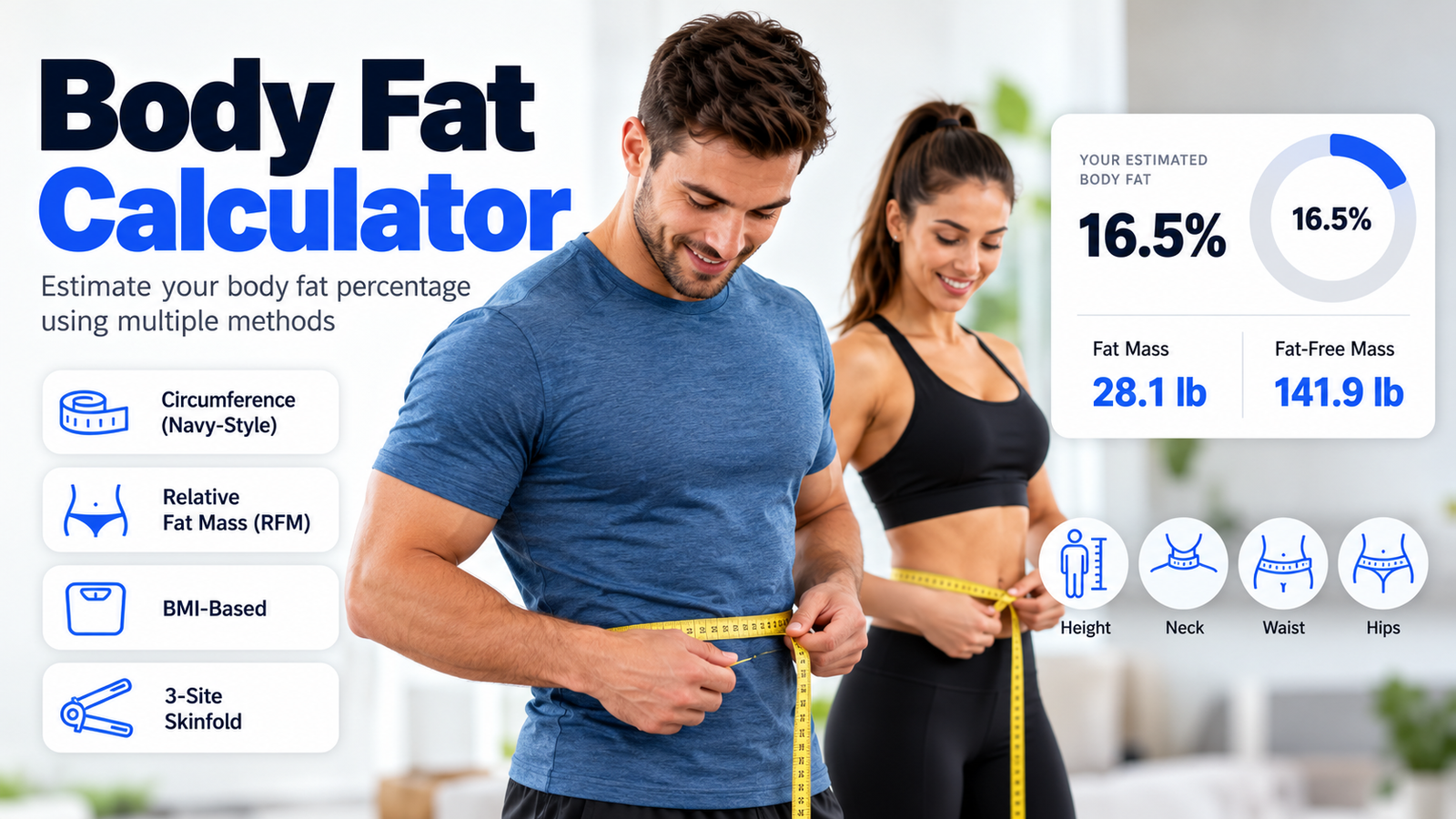
A Body Fat Calculator is an online tool that estimates the percentage of your body weight made up of fat. It helps you understand body composition using measurements such as height, weight, waist circumference, neck circumference, or skinfold thickness.
Unlike a regular weighing scale, which shows your total body weight, body fat calculations help explain how that weight may be distributed between fat and fat-free tissues.
Our free Body Fat Calculator supports four estimation methods:
- Traditional U.S. Navy-style Circumference Method
- Relative Fat Mass (RFM)
- BMI-Based Body Fat Estimation
- Jackson–Pollock 3-Site Skinfold Method
Select your preferred method, enter the required measurements, and calculate your estimated body fat percentage instantly.
The tool also provides estimated fat mass and fat-free mass when body weight is available.
Important: These calculations provide estimates, not direct body composition measurements or medical diagnoses.
How to Use the Body Fat Calculator
The calculator is designed for beginners and experienced fitness users who want a straightforward body composition estimate.
Step 1: Choose Your Measurement System
Select either:
US Units: Inches, feet, and pounds.
Metric Units: Centimeters and kilograms.
You can switch measurement systems without manually converting values.
Step 2: Select a Body Fat Calculation Method
Choose from Circumference, Relative Fat Mass, BMI-Based, or 3-Site Skinfold.
Each method uses different measurements. The calculator automatically displays the fields required for your selection.
Step 3: Select the Equation Coefficient
Choose the male or female equation option.
These settings correspond to coefficients used in the published prediction formulas. They cannot fully capture individual hormonal or body-composition differences.
Step 4: Enter Your Measurements
Depending on the selected method, you may need height, neck circumference, waist circumference, hip circumference, age, weight, or skinfold readings.
Use accurate measurements and follow the instructions in the How to Measure section.
Step 5: Calculate Your Body Fat
Click Calculate Body Fat to display your estimated body fat percentage.
The result includes a visual chart showing the estimated fat proportion.
Step 6: Review Body Composition
If body weight is supplied, you can view:
- Estimated fat mass
- Estimated fat-free mass
- Body fat percentage
Step 7: Explore Formula Details
Open the Formula & Calculation section to review the selected method and understand how the result was calculated.
Use Copy Result to save the estimate, or Reset to start again.
Body Fat Calculation Methods Explained
There are several ways to estimate body fat percentage. Different methods use different measurements and assumptions, meaning results may vary even for the same person.
The SkillsElevate Body Fat Calculator includes four methods to make body composition estimation more accessible.
1. Traditional U.S. Navy-Style Circumference Method
The traditional circumference method uses body measurements to estimate fat percentage without requiring specialized equipment.
It is useful for people who have a flexible measuring tape and want a convenient at-home estimate.
Required measurements for the male equation:
- Height
- Neck circumference
- Abdomen circumference at navel level
Required measurements for the female equation:
- Height
- Neck circumference
- Natural waist circumference
- Hip circumference
Male Circumference Formula
Body Fat % = 86.010 × log10(Abdomen − Neck) − 70.041 × log10(Height) + 36.76
Female Circumference Formula
Body Fat % = 163.205 × log10(Waist + Hips − Neck) − 97.684 × log10(Height) − 78.387
All measurements must be expressed in inches for these formulas.
The calculator automatically converts metric measurements before applying the equations.
Important distinction: These are traditional circumference equations. They should not be confused with current official U.S. military body-composition assessment procedures, which have changed over time.
2. Relative Fat Mass (RFM) Method
Relative Fat Mass is a body fat estimation method based on height and waist circumference.
It requires fewer measurements than the traditional circumference method.
Required measurements:
- Height
- Waist circumference
- Equation coefficient
Male RFM Formula
RFM = 64 − 20 × (Height ÷ Waist)
Female RFM Formula
RFM = 76 − 20 × (Height ÷ Waist)
Both measurements must use the same units.
For example, if you enter height and waist in centimeters, the ratio can be calculated directly.
RFM was developed as an alternative anthropometric estimator of body fat percentage. Research has found that it can perform better than BMI in some validation datasets, although individual accuracy varies.
Best suited for: Adults who want a simple waist-and-height-based estimate without measuring their neck or hips.
3. BMI-Based Body Fat Calculation
The BMI-Based method estimates body fat percentage using Body Mass Index, age, and a sex-based coefficient.
Unlike the circumference methods, it does not require waist, neck, or hip measurements.
Required measurements:
- Age
- Height
- Weight
- Equation coefficient
BMI Formula
BMI = Weight (kg) ÷ Height (m)²
The calculator then applies the adult Deurenberg equation:
Body Fat % = 1.20 × BMI + 0.23 × Age − 10.8 × Sex − 5.4
Where:
- Male equation: Sex = 1
- Female equation: Sex = 0
For example, a person with a BMI of 25, aged 30, using the male equation:
Body Fat % = (1.20 × 25) + (0.23 × 30) − (10.8 × 1) − 5.4
Body Fat % = 30 + 6.9 − 10.8 − 5.4
Estimated Body Fat = 20.7%
This is a statistical prediction, not a measurement of fat tissue.
Best suited for: Adults who know their height, weight, and age but do not have a measuring tape or skinfold calipers.
4. Jackson–Pollock 3-Site Skinfold Method
The Jackson–Pollock 3-Site method estimates body fat using skinfold measurements taken at specific locations.
It requires skinfold calipers and careful measurement technique.
The measurement locations differ by equation.
| Male Equation | Female Equation |
|---|---|
| Chest | Triceps |
| Abdomen | Suprailiac |
| Thigh | Thigh |
All skinfold measurements are entered in millimeters.
The calculator combines the three readings with age to estimate body density.
It then uses the Siri equation:
Body Fat % = (495 ÷ Body Density) − 450
Because this method depends on precise skinfold measurements, inconsistent caliper technique can significantly affect the estimate.
The selected equations were developed using adult research populations. This calculator restricts the skinfold method to the age ranges associated with those original models.
Best suited for: Fitness professionals, trained users, and adults familiar with skinfold measurements.
Which Body Fat Calculation Method Should You Choose?
There is no universally best formula for every person.
Your preferred method depends on available equipment, measurement experience, and the type of estimate you need.
| Method | Equipment Required | Main Advantage |
|---|---|---|
| Traditional Circumference | Measuring tape | Accessible home calculation |
| Relative Fat Mass | Measuring tape | Requires fewer measurements |
| BMI-Based | Scale and height measurement | No circumference measurements |
| 3-Site Skinfold | Skinfold calipers | Uses measured subcutaneous skinfold thickness |
For beginners, the traditional circumference or RFM method can be convenient starting points.
If you only know your height, weight, and age, the BMI-Based method is easier.
If you have training and access to calipers, you may prefer the Jackson–Pollock method.
Remember that switching methods can produce different results. Differences do not necessarily indicate that one method is correct and the others are wrong.
How to Measure Body Fat at Home
Accurate measurements are essential for obtaining a useful estimate.
Use a flexible, non-stretch measuring tape and follow a consistent procedure.
How to Measure Neck Circumference
Place the measuring tape around your neck just below the larynx.
Keep your head facing forward and your neck relaxed.
The tape should fit snugly without pressing into the skin.
Avoid pulling the tape excessively tight.
How to Measure Abdomen Circumference
For the traditional male circumference equation, measure around your abdomen at navel level.
Stand upright with your abdomen relaxed.
Keep the tape horizontal and measure after a normal exhalation.
Do not hold your breath or pull your stomach inward.
How to Measure Natural Waist Circumference
For the traditional female circumference equation, measure around the narrowest part of your natural waist.
Keep the tape level and avoid compressing the skin.
For the RFM equation, follow the waist-measurement guidance associated with that method, which uses the region of the upper border of the hip bone.
These measurement locations are not interchangeable.
How to Measure Hip Circumference
Wrap the measuring tape around the fullest part of your hips and buttocks.
Stand with your feet together and keep the tape parallel to the floor.
Avoid twisting or tilting the measuring tape.
How to Take Skinfold Measurements
Use appropriate skinfold calipers at the three locations required by your selected equation.
Measurements must be entered in millimeters.
Standardized landmark identification and proper technique are important, so guidance from a trained professional may improve measurement consistency.
How to Calculate Body Fat Percentage: Example
Suppose an adult using the traditional male circumference equation has these measurements:
| Measurement | Value |
|---|---|
| Height | 5 ft 10 in (70 in) |
| Neck | 15.5 in |
| Abdomen | 34 in |
| Body Weight | 170 lb |
First, subtract neck circumference from abdomen circumference:
34 − 15.5 = 18.5 inches
Then apply the circumference equation:
Body Fat % = 86.010 × log10(18.5) − 70.041 × log10(70) + 36.76
Estimated Body Fat = 16.5%
This value represents the estimated portion of total body weight attributed to fat.
The actual percentage may differ from the prediction.
What Is Fat Mass and Fat-Free Mass?
Body weight consists of fat mass and fat-free mass.
These measurements help explain body composition beyond the number shown on a weighing scale.
Fat Mass
Fat mass represents the estimated weight of fat tissue.
The formula is:
Fat Mass = Body Weight × (Body Fat Percentage ÷ 100)
For example, if a person weighs 170 pounds and has an estimated body fat percentage of 16.5%:
170 × 0.165 = 28.05 pounds
Estimated fat mass is approximately 28.1 pounds.
Fat-Free Mass
Fat-free mass includes everything that is not fat, including muscle, bones, organs, blood, and water.
The formula is:
Fat-Free Mass = Total Body Weight − Fat Mass
Using the previous example:
170 − 28.05 = 141.95 pounds
Estimated fat-free mass is approximately 142 pounds.
Importantly, fat-free mass is not the same as muscle mass.
Body Fat Percentage vs. BMI: What's the Difference?
Body fat percentage and Body Mass Index are related to body composition but measure different things.
Body Fat Percentage estimates the portion of total body weight attributable to fat.
BMI calculates weight relative to height.
| Feature | Body Fat Percentage | BMI |
|---|---|---|
| Main purpose | Estimate body fat proportion | Screen weight relative to height |
| Uses height | Depends on method | Yes |
| Uses weight | Optional for some methods | Yes |
| Estimates fat proportion | Yes | Not directly |
| Distinguishes muscle from fat | Estimates fat proportion, with uncertainty | No |
| Medical diagnosis | No | No |
For example, two adults with the same BMI may have different body fat percentages because of differences in muscle mass and other tissues.
Neither measurement alone fully describes health status.
What Is a Healthy Body Fat Percentage?
There is no single body fat percentage that is ideal for everyone.
Body composition varies with age, biological characteristics, genetics, muscle mass, and individual physiology.
Different organizations use different body fat classification systems, and their cutoff values are not universally interchangeable.
A body fat percentage should therefore be interpreted in context rather than treated as a definitive health score.
The SkillsElevate calculator intentionally avoids assigning judgmental labels such as "good," "bad," or "perfect" to its estimates.
For an individualized health assessment, a qualified healthcare professional can consider body composition alongside medical history and other relevant measurements.
How Accurate Is a Body Fat Calculator?
Online body fat calculators provide estimates based on mathematical models.
They do not directly measure the body's fat tissue.
The accuracy depends on the selected formula, the population used to develop it, and the quality of your measurements.
Several factors can affect the result:
- Incorrect tape positioning
- Inconsistent waist or neck measurements
- Differences in body composition
- Skinfold measurement technique
- Individual physiological variation
- Limitations of the prediction equation
Even a small difference in a circumference measurement can affect a calculated percentage.
For this reason, the calculator displays body fat percentage to one decimal place for readability, not because it can measure fat with that degree of certainty.
Other Ways to Measure Body Fat Percentage
Besides online calculators, body composition can be assessed using specialized equipment.
Bioelectrical Impedance Analysis (BIA)
BIA devices estimate body composition by measuring electrical impedance through the body.
Results can be influenced by hydration status, recent activity, device design, and testing conditions.
DXA (DEXA) Scan
Dual-energy X-ray absorptiometry estimates fat mass, lean soft tissue, and bone mineral content.
It is commonly used in research and clinical body-composition assessment, although results still involve measurement assumptions and limitations.
Skinfold Calipers
Calipers measure subcutaneous skinfold thickness at standardized anatomical locations.
Prediction equations estimate body composition from those measurements.
Hydrostatic Weighing
Hydrostatic weighing estimates body density using measurements taken in air and underwater.
Body density can then be used to estimate body fat percentage.
No assessment method is completely free from uncertainty.
Can You Track Changes in Body Fat Over Time?
You can repeat body measurements to observe trends, but individual calculator readings should not be treated as perfectly precise.
When repeating a calculation:
- Use the same estimation method.
- Measure at the same anatomical locations.
- Use similar measurement conditions.
- Follow the same measurement technique.
- Avoid overinterpreting very small changes.
Changes in measurement technique can produce differences even when actual body composition has not changed.
For more reliable comparisons, focus on consistent procedures and meaningful longer-term trends rather than isolated results.
Common Body Fat Calculation Mistakes
Using Incorrect Measurement Units
Traditional circumference equations require inches.
Entering centimeters directly into an inch-based formula without conversion produces incorrect results.
The SkillsElevate calculator handles these conversions automatically.
Measuring the Wrong Waist Location
The traditional circumference and RFM methods use different anatomical measurement instructions.
Follow the guidance for the specific method you selected.
Pulling the Measuring Tape Too Tight
A tape that compresses the skin can produce a smaller circumference and affect the estimate.
Keep the tape snug but not restrictive.
Treating Fat-Free Mass as Muscle Mass
Fat-free mass includes multiple tissues and body water, not just skeletal muscle.
Comparing Different Formulas as Exact Equivalents
Each estimation method uses different assumptions.
An RFM result should not be treated as directly interchangeable with a skinfold or BMI-based estimate.
Assuming the Result Is a Medical Diagnosis
A calculated body fat percentage cannot independently diagnose a medical condition or determine an individual's overall health.
Frequently Asked Questions
What is a Body Fat Calculator?
A Body Fat Calculator estimates the percentage of total body weight made up of fat using body measurements and mathematical prediction equations.
How can I calculate body fat percentage at home?
You can use a measuring tape with a circumference-based method or RFM. If you know your height, weight, and age, you can also use a BMI-based prediction equation.
What is the most accurate body fat calculator?
No single formula is guaranteed to provide the most accurate estimate for everyone. Accuracy depends on the method, measurements, and individual body composition.
Can I calculate body fat without a measuring tape?
Yes. The BMI-Based method uses height, weight, and age without requiring circumference measurements. However, BMI-based body fat estimates have limitations.
Is the Navy body fat method accurate?
The traditional circumference method can provide an accessible estimate, but its accuracy varies between individuals. It should not be confused with current official military assessment procedures.
What is Relative Fat Mass?
Relative Fat Mass is an anthropometric body fat estimation method that uses height and waist circumference.
How is body fat percentage calculated from BMI?
The Deurenberg adult equation uses BMI, age, and a sex-based coefficient to predict body fat percentage statistically.
What is the Jackson–Pollock 3-Site method?
It is a body density prediction method based on three skinfold measurements and age. Body density is then converted into an estimated body fat percentage.
Does the Body Fat Calculator work for women?
Yes. The calculator includes female equation options for all four supported methods, with different required measurements where applicable.
Does age affect body fat percentage calculations?
Age is included in the BMI-Based and Jackson–Pollock methods. The traditional circumference and RFM equations in this calculator do not require age.
Is body fat percentage the same as body weight?
No. Body weight includes fat and fat-free tissues. Body fat percentage estimates the fat proportion of total weight.
What is the difference between fat mass and fat-free mass?
Fat mass estimates the weight attributable to fat. Fat-free mass includes the body's remaining tissues and water.
Can I use this calculator in metric units?
Yes. The calculator supports centimeters and kilograms, converting units internally where the selected equation requires it.
Is the calculator suitable for children?
No. This calculator is intended for adults. Children and adolescents require appropriate age-specific assessment methods.
Can body fat percentage change without a change in weight?
Yes. Body composition can change even when total weight remains relatively stable because fat mass and fat-free mass are different components of total weight.
Why do different body fat methods give different results?
Different methods use different measurements, statistical models, and assumptions. Each has uncertainty and may perform differently across individuals.
Is the SkillsElevate Body Fat Calculator free?
Yes. The calculator is free to use and does not require account registration.
Scientific Methodology and References
The calculation methods are based on established anthropometric and body-composition research.
Traditional Circumference Method: Historical circumference-based body fat equations documented in U.S. military assessment materials.
Relative Fat Mass: Woolcott and Bergman (2018), Relative Fat Mass (RFM) as a New Estimator of Whole-Body Fat Percentage.
BMI-Based Prediction: Deurenberg, Weststrate, and Seidell (1991), Body Mass Index as a Measure of Body Fatness: Age- and Sex-Specific Prediction Formulas.
Jackson–Pollock Skinfold Method: Jackson and Pollock (1978), Generalized Equations for Predicting Body Density of Men, and Jackson, Pollock, and Ward (1980), Generalized Equations for Predicting Body Density of Women.
BMI Interpretation: Centers for Disease Control and Prevention (CDC), About Body Mass Index (BMI).
These sources support the methods and their scientific background. They do not establish that any single formula is perfectly accurate for every individual.
Related Tools
Explore other health and fitness calculators on SkillsElevate:
- BMI Calculator — Calculate Body Mass Index using height and weight.
- BMR Calculator — Estimate resting energy expenditure using established prediction equations.
- Calorie Calculator — Explore estimated daily maintenance calories based on body measurements and activity.
- Macro Calculator — Understand macronutrient calculations and how protein, carbohydrates, and fats contribute to dietary energy.
Understand Your Body Composition
The free Body Fat Calculator makes it easier to explore body composition using four established estimation methods.
Whether you prefer simple circumference measurements, Relative Fat Mass, a BMI-based estimate, or skinfold calipers, you can choose the method that best suits your measurements and experience.
Review your estimated body fat percentage, explore fat mass and fat-free mass, and use the calculation details to understand your result.
Remember that body fat percentage is only one part of understanding body composition and overall health. Treat the result as an estimate rather than a diagnosis or a personal health target.