
Ovulation Calculator
Estimate your next ovulation date and fertile window from your cycle.
What Is an Ovulation Calculator?
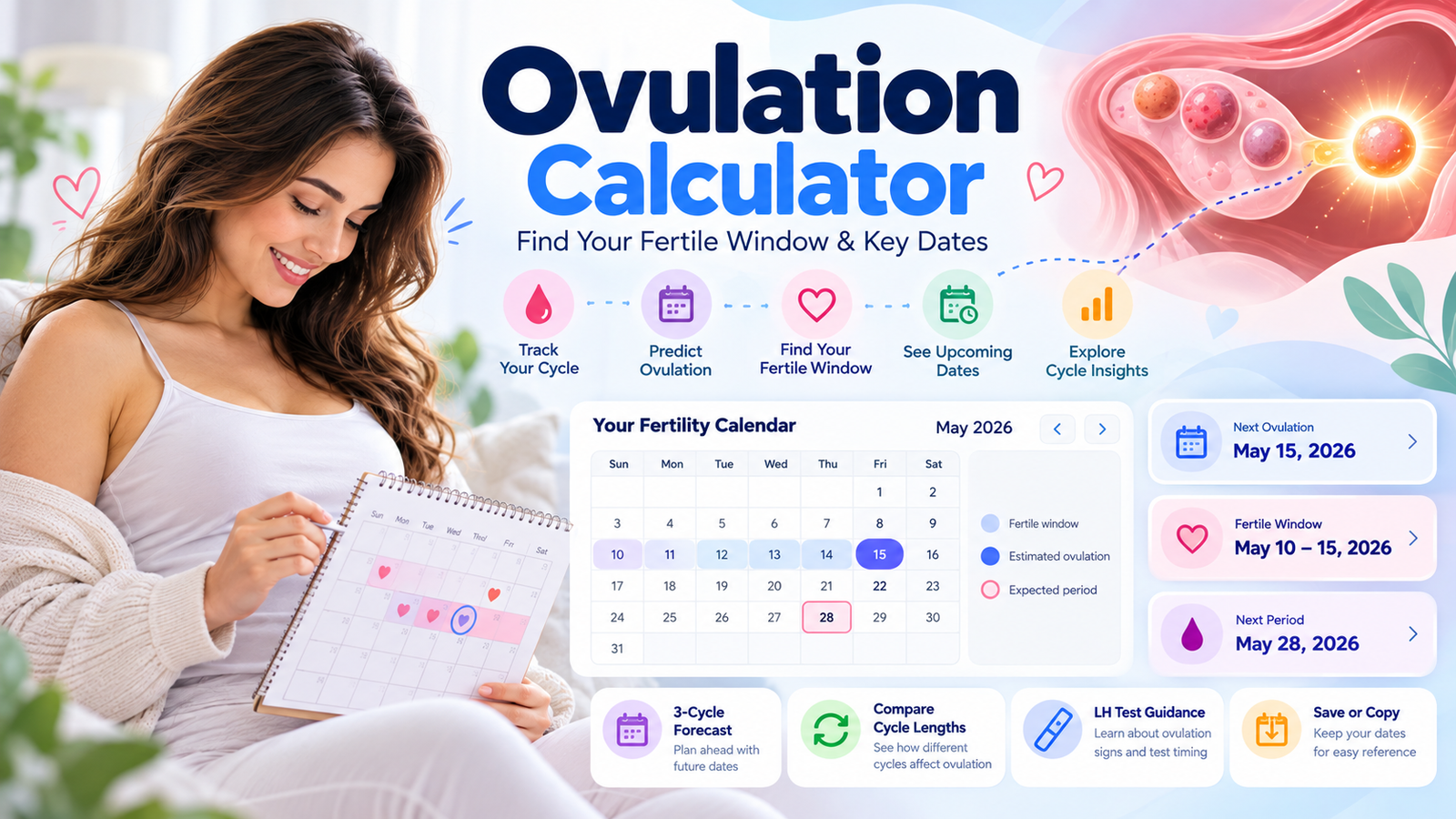
An Ovulation Calculator is a free online tool that estimates when ovulation may occur based on the first day of your last menstrual period and your average menstrual cycle length. It also helps you identify your predicted fertile window, calculate your next expected period, and explore upcoming menstrual cycles.
Ovulation happens when an ovary releases an egg. Understanding when ovulation may occur can help you learn about your menstrual cycle and plan around your possible fertile days.
Our free Ovulation Calculator includes an interactive cycle calendar, a three-cycle forecast, cycle-length comparisons, and educational information about ovulation predictor tests.
Simply enter your menstrual information to view your estimated fertility dates.
Important: Ovulation dates are predictions, not confirmed biological events. Actual ovulation timing can vary, even with regular menstrual cycles. This calculator should not be used to prevent pregnancy.
How to Use the Ovulation Calculator
The SkillsElevate Ovulation Calculator makes it easy to explore your estimated fertile days using just a few inputs.
Step 1: Enter the First Day of Your Last Period
Choose the first day of your most recent menstrual period using the date picker.
Use the day menstrual bleeding began, not the day your period ended.
Step 2: Enter Your Average Cycle Length
Select your usual menstrual cycle length in days.
The calculator supports cycle lengths from 21 to 40 days.
If you are unsure, count the number of days from the first day of one menstrual period to the first day of the next. You can average several recent cycles to understand your typical length.
Step 3: Select Your Cycle Pattern
Choose whether your cycles are usually regular or vary from month to month.
If you select irregular cycles, the calculator will explain that calendar-based predictions may be especially uncertain.
Step 4: Calculate Ovulation
Click Calculate Ovulation to view your next predicted ovulation date.
The calculator uses your menstrual information to estimate when ovulation may occur.
Step 5: Review Your Fertile Window
Your results include:
- Next predicted ovulation date
- Estimated six-day fertile window
- Next predicted period following ovulation
- Calendar-based prediction information
Step 6: Explore the Interactive Calendar
The calendar highlights predicted fertile days, estimated ovulation dates, and expected period start dates.
Select an individual date to view its predicted cycle status.
Step 7: Use Advanced Features
Explore the next three predicted cycles, compare different cycle lengths, or read about positive LH ovulation tests.
Step 8: Save Your Results
Use Copy Result to save your calculation as text.
You can also download a calendar file containing upcoming predicted fertile windows and ovulation dates.
How Does the Ovulation Calculator Work?
The calculator uses a calendar-based ovulation prediction method.
In a simplified menstrual cycle model, ovulation is estimated to occur approximately 14 days before the next menstrual period.
The calculation involves three steps.
Step 1: Estimate Your Next Period
Your average cycle length is added to the first day of your last menstrual period.
Next Period = Last Period Start Date + Cycle Length
For example, if your period started on May 1 and your cycle lasts 28 days, your next expected period would be May 29.
Step 2: Estimate Ovulation
The calculator subtracts 14 days from the expected period date.
Estimated Ovulation = Next Period Date − 14 Days
Using the same example:
May 29 − 14 days = May 15.
Your predicted ovulation date would be May 15.
Step 3: Calculate the Fertile Window
The estimated fertile window includes the five days before predicted ovulation and the ovulation day itself.
Fertile Window = Estimated Ovulation Date − 5 Days Through Ovulation Day
In this example, the estimated fertile window would be May 10–15.
This method provides an approximation. The time between ovulation and the next menstrual period is not exactly 14 days for everyone, and ovulation can occur earlier or later than expected.
What Is the Fertile Window?
The fertile window is the period of the menstrual cycle when pregnancy is most likely to occur.
For fertility planning, it is commonly defined as the six-day interval ending on the day of ovulation.
This window exists because sperm can survive in the reproductive tract for several days, while an egg remains capable of fertilization for a much shorter time after ovulation.
The fertile window generally includes:
- Five days before ovulation
- Four days before ovulation
- Three days before ovulation
- Two days before ovulation
- One day before ovulation
- Ovulation day
Research suggests that the days immediately before ovulation are especially important for conception.
However, the calculator estimates these dates using a mathematical model. It cannot identify the exact fertile window in an individual cycle.
What Are the Most Fertile Days to Get Pregnant?
The highest chances of conception generally occur during the days immediately preceding ovulation.
The American Society for Reproductive Medicine identifies the one to two days before ovulation as particularly favorable for conception.
For someone trying to conceive, having intercourse every one to two days during the fertile window is a commonly recommended approach.
You do not need to identify one perfect day or guarantee that intercourse occurs on the precise day of ovulation.
Other factors, including age, sperm health, reproductive conditions, and individual fertility, can also affect the likelihood of pregnancy.
Remember: A fertile-window estimate helps with timing but does not guarantee conception.
How to Calculate Ovulation Based on Cycle Length
Your average menstrual cycle length affects the estimated date of ovulation.
In the calculator's simplified model, a longer cycle produces a later predicted ovulation date, while a shorter cycle produces an earlier estimate.
Consider a menstrual period beginning May 1, 2027.
| Cycle Length | Predicted Ovulation | Estimated Fertile Window |
|---|---|---|
| 24 days | May 11 | May 6–11 |
| 26 days | May 13 | May 8–13 |
| 28 days | May 15 | May 10–15 |
| 30 days | May 17 | May 12–17 |
| 32 days | May 19 | May 14–19 |
These dates demonstrate the calculation formula, not confirmed ovulation.
Individual differences in the follicular and luteal phases can change the actual timing.
Understanding Your Menstrual Cycle
A menstrual cycle begins on the first day of menstrual bleeding and ends the day before the next period begins.
It is regulated by changing hormone levels and includes several overlapping physiological processes.
Menstrual Phase
The menstrual phase begins when the uterine lining is shed.
This marks day one of a new menstrual cycle.
Follicular Phase
During the follicular phase, ovarian follicles develop under hormonal stimulation.
Estrogen levels generally rise as a dominant follicle matures.
The duration of this phase contributes significantly to differences in menstrual cycle length.
Ovulation
Ovulation occurs when a mature egg is released from an ovary.
A surge in luteinizing hormone (LH) helps trigger this process.
The released egg generally remains capable of fertilization for approximately 12–24 hours.
Luteal Phase
After ovulation, the corpus luteum produces progesterone, which helps prepare the uterine lining.
If pregnancy does not occur, hormone levels fall and another menstrual period begins.
The luteal phase is often more consistent than the follicular phase, although it still varies between individuals.
Can You Calculate Ovulation With Irregular Periods?
You can use an Ovulation Calculator with irregular menstrual cycles, but the resulting dates may be less reliable.
Calendar methods assume that cycle timing follows a relatively predictable pattern.
If your cycle length changes significantly, the estimated ovulation date may not match when ovulation actually occurs.
Irregular menstrual cycles can be associated with several circumstances, including:
- Stress or major lifestyle changes
- Changes in body weight
- Intense physical activity
- Hormonal conditions
- Polycystic ovary syndrome (PCOS)
- Thyroid disorders
- Postpartum or breastfeeding changes
- Changes in hormonal contraception
Not every irregular cycle indicates a medical condition. However, persistent changes, missed periods, or concerns about fertility deserve professional assessment.
The SkillsElevate calculator includes a cycle-pattern selector so users with variable cycles receive additional accuracy guidance.
How to Recognize Signs of Ovulation
Some physical and hormonal changes may provide clues about ovulation timing.
These signs vary between individuals and do not always appear in the same way.
Changes in Cervical Mucus
As ovulation approaches, cervical mucus may become clearer, wetter, more slippery, and stretchier.
These changes can help sperm move through the reproductive tract.
Observing cervical mucus patterns may provide useful information about possible fertile days.
Positive LH Ovulation Test
Ovulation predictor kits detect an increase in luteinizing hormone.
An LH surge commonly occurs shortly before ovulation, making these tests useful for identifying a period of increased fertility.
However, a positive result does not guarantee that ovulation occurred.
Basal Body Temperature Changes
Basal body temperature is your body's temperature while fully at rest.
Progesterone typically causes a small sustained rise in temperature after ovulation.
Tracking this pattern may help you understand previous cycles, but it is generally more useful for recognizing that ovulation may already have occurred than predicting it in advance.
Mild Midcycle Discomfort
Some people notice mild one-sided lower abdominal discomfort around ovulation.
This symptom, sometimes called mittelschmerz, is not a reliable method for identifying the exact ovulation date.
Severe, persistent, or unusual pelvic pain should be assessed by a healthcare professional.
How Do LH Ovulation Tests Work?
An LH ovulation test, also called an ovulation predictor kit (OPK), checks urine for a rise in luteinizing hormone.
A positive test often suggests that ovulation may occur within roughly the next 24–48 hours.
This makes LH testing different from a standard Ovulation Calculator.
A calculator predicts dates using previous menstrual patterns, while an LH test detects a current hormonal signal.
Ovulation Calculator vs. LH Test
| Feature | Ovulation Calculator | LH Ovulation Test |
|---|---|---|
| Main input | Last period and cycle length | Urine hormone measurement |
| Predicts possible ovulation | Yes | Yes |
| Uses current hormonal data | No | Yes |
| Confirms egg release | No | No |
| Requires testing equipment | No | Yes |
| Useful for calendar planning | Yes | Helps refine timing |
Using the Optional LH Test Feature
The SkillsElevate calculator includes an educational LH test section.
Enter the date of a positive LH test to view a general estimate of when ovulation might follow.
This does not replace your main calendar prediction or establish that ovulation has occurred.
Certain hormonal conditions and medications can affect test interpretation, so consult a healthcare professional when results are unclear.
Understanding the Interactive Ovulation Calendar
The interactive calendar helps you visualize estimated fertility dates without manually counting days.
Predicted Ovulation Date
The primary-colored date represents estimated ovulation.
This is a model-based prediction, not confirmed egg release.
Fertile Window
The lightly highlighted dates represent the predicted fertile window.
The calendar includes the five days preceding estimated ovulation and the ovulation day.
Expected Period
An outlined date marks the predicted start of the next menstrual period.
This is based on the entered cycle length and may shift if the cycle changes.
Select a Calendar Date
You can select any calendar date to view its predicted cycle status.
Dates outside the highlighted fertile window should not be interpreted as guaranteed non-fertile days.
Predict Ovulation for Your Next Three Cycles
The Next 3 Cycles feature forecasts ovulation dates and fertile windows for three upcoming cycles.
It assumes that your entered average menstrual cycle length continues without substantial changes.
For example, if a menstrual cycle begins on November 1, 2026, and lasts 28 days:
| Cycle | Predicted Ovulation | Estimated Fertile Window |
|---|---|---|
| First | November 15, 2026 | November 10–15 |
| Second | December 13, 2026 | December 8–13 |
| Third | January 10, 2027 | January 5–10 |
These forecasts are useful for general planning, but uncertainty increases when menstrual cycles vary or the original period date becomes outdated.
Entering a recent menstrual period provides a more relevant calendar estimate.
Compare Different Menstrual Cycle Lengths
The Cycle Comparison feature shows how changing the assumed cycle length affects predicted ovulation.
You can compare several cycle lengths without repeatedly entering your period date.
This makes it easier to understand why a predicted fertile window may shift from one cycle to another.
For example, changing the average cycle length from 28 to 32 days moves the predicted ovulation date four days later within the same modeled cycle.
However, the comparison uses simplified cycle assumptions. It does not measure individual hormone changes or predict the exact day an egg will be released.
Can an Ovulation Calculator Help You Get Pregnant?
An Ovulation Calculator can help you identify possible fertile days and understand when pregnancy may be more likely.
It can be a useful starting point for people trying to conceive, especially when cycles are relatively regular.
However, pregnancy depends on more than timing.
Factors that influence fertility include age, ovulation, sperm health, fallopian tube function, reproductive health, and other individual circumstances.
An estimated fertile window is not a pregnancy guarantee.
For people who want additional information, LH testing and cervical mucus observations may help identify the days leading up to ovulation.
Can You Use an Ovulation Calculator to Avoid Pregnancy?
No. A calendar-based Ovulation Calculator should not be relied upon as contraception.
Ovulation can happen earlier or later than predicted, including in people who normally have regular periods.
That means pregnancy may be possible on dates the calculator does not highlight.
Formal fertility-awareness-based contraception methods involve specific instructions, regular observations, and appropriate training. They are not equivalent to simply using an online ovulation date estimator.
If you want to avoid pregnancy, use a suitable contraceptive method and discuss your options with a qualified healthcare professional.
How Accurate Is an Ovulation Calculator?
An Ovulation Calculator estimates dates based on the information supplied and an assumed menstrual pattern.
It does not measure hormone levels, observe egg release, or diagnose ovulatory function.
Several factors affect accuracy:
- Variation in menstrual cycle length
- Differences in ovulation timing
- Individual luteal-phase length
- Irregular or missed menstrual periods
- Hormonal changes
- Certain medications or medical conditions
- Inaccurate menstrual dates
Even people with consistent cycle lengths may ovulate on different cycle days.
For this reason, the calculator displays a predicted ovulation date and fertile window rather than claiming to determine exactly when ovulation will occur.
Common Ovulation Calculation Mistakes
Using the Last Day of Your Period
Always enter the first day of menstrual bleeding rather than the final day.
Assuming Ovulation Always Happens on Day 14
Day 14 is a simplified estimate for a typical 28-day cycle, not a universal biological rule.
Ignoring Cycle Variability
If your cycle changes significantly between months, a single average length may produce an unreliable prediction.
Treating a Positive LH Test as Confirmation
An LH surge suggests that ovulation may be approaching, but it does not guarantee egg release.
Assuming Every Non-Highlighted Day Is Safe
A calculator cannot reliably identify days when pregnancy is impossible.
Relying on Old Menstrual Dates
Future-cycle predictions become less dependable when the actual timing of intervening menstrual periods is unknown.
For better relevance, update the calculator using your most recent menstrual period.
When Should You Speak to a Healthcare Professional?
Consider consulting a healthcare professional if you have persistent menstrual irregularity, frequently missed periods, or concerns that ovulation may not be occurring.
If you are trying to conceive, fertility evaluation is generally recommended:
- After 12 months of regular unprotected intercourse when the person trying to conceive is younger than 35.
- After six months when they are 35 or older.
- Sooner when they are over 40 or have known conditions that may affect fertility.
Earlier assessment may also be appropriate for irregular or absent menstrual cycles, suspected endometriosis, known reproductive conditions, or concerns about sperm-related fertility.
These timeframes are general guidance. Individual medical circumstances may justify earlier evaluation.
Frequently Asked Questions
How do I calculate my ovulation date?
Enter the first day of your last menstrual period and your average cycle length. The calculator estimates your next period and subtracts approximately 14 days to predict ovulation.
How many days after my period do I ovulate?
Ovulation timing depends on your cycle length and the duration of bleeding. It often occurs approximately 10–16 days before the next menstrual period rather than a fixed number of days after bleeding stops.
What is the fertile window?
The fertile window is commonly defined as the five days before ovulation and the day of ovulation. It represents the period when conception is most likely.
What are the most fertile days?
The one to two days before ovulation are generally among the most fertile days. However, the exact timing cannot be established by a calendar calculation alone.
Can I get pregnant outside my predicted fertile window?
Yes. Calendar predictions can be inaccurate, and ovulation may occur earlier or later than expected. A predicted non-fertile day is not a guarantee that pregnancy cannot occur.
Is ovulation always on day 14?
No. Ovulation timing depends on cycle length and individual hormonal patterns. Day 14 is only a common approximation for a 28-day menstrual cycle.
Can I use the calculator with irregular periods?
Yes, but predictions may be especially uncertain. If your periods are irregular, consider discussing other ovulation-monitoring methods with your healthcare professional.
How accurate are ovulation prediction calculators?
They provide estimates based on average cycle patterns. They cannot confirm ovulation or guarantee the exact date when it will happen.
How long does an egg survive after ovulation?
An egg generally remains capable of fertilization for approximately 12–24 hours after ovulation.
How long can sperm survive before ovulation?
Sperm may survive inside the reproductive tract for up to five days under favorable conditions. This helps explain why intercourse before ovulation can result in pregnancy.
Does a positive LH test mean I am ovulating?
A positive LH test indicates a detected hormone surge that often occurs before ovulation. It does not confirm that an egg has been released.
Can the calculator predict my next period?
Yes. It adds your average cycle length to the modeled menstrual cycle start to estimate the next period. Actual timing may differ.
Can I calculate fertile days for future months?
Yes. The SkillsElevate Ovulation Calculator provides a three-cycle forecast based on your entered cycle length. These are projections rather than confirmed dates.
Can I use the calculator as birth control?
No. The calculator is not a reliable contraceptive method. Use appropriate contraception if you want to avoid pregnancy.
Is the SkillsElevate Ovulation Calculator free?
Yes. The calculator is free and requires no account registration. You can explore fertility estimates, copy results, and download a calendar file.
Scientific Methodology and References
The SkillsElevate Ovulation Calculator uses a simplified menstrual calendar prediction model.
It estimates ovulation approximately 14 days before the next period and identifies a six-day fertile window ending on the predicted ovulation date.
The scientific background and limitations are informed by:
- American Society for Reproductive Medicine (ASRM): Optimizing Natural Fertility — A Committee Opinion.
- American College of Obstetricians and Gynecologists (ACOG): Fertility Awareness-Based Methods of Family Planning.
- American Society for Reproductive Medicine (ASRM): Ovulation Detection — Patient Education.
- American Society for Reproductive Medicine (ASRM): Fertility Evaluation of Infertile Women — Committee Opinion.
- NHS: Guidance on menstrual cycles, ovulation, and natural family planning.
The tool's calendar model is intended for education and general fertility planning. It does not confirm ovulation, determine an individual's probability of conception, or provide contraception.
Related Tools
Explore other date and health calculators available on SkillsElevate:
- Pregnancy Due Date Calculator — Estimate pregnancy due dates using last-period, conception, IVF, or ultrasound information.
- Date Difference Calculator — Calculate the number of days or weeks between two calendar dates.
- Age Calculator — Calculate exact age in years, months, and days.
- Time Calculator — Add or subtract time intervals for everyday planning.
Understand Your Estimated Fertile Days
The free Ovulation Calculator provides a convenient way to explore your menstrual cycle and estimated fertile window.
Enter your latest period date, select your cycle length, and review your next predicted ovulation date, fertility calendar, and upcoming cycle forecasts.
You can also explore different cycle lengths, learn about ovulation signs, and save your estimated dates for future reference.
Remember that calendar predictions are only estimates. Use additional clinical guidance when ovulation timing is important for fertility care, and never rely on predicted non-fertile dates to avoid pregnancy.