
APR Calculator
Calculate the true annual percentage rate including fees.
What Is APR on a Loan?
APR (annual percentage rate) is an annualized measure of borrowing cost that combines the loan's interest rate with certain required finance charges. It can help you compare offers that advertise different rates and lender fees.
For example, a personal loan advertised at 9.5% interest could have a higher APR if the lender charges an origination fee. The interest rate determines the scheduled interest on the repayment balance, while APR also reflects eligible finance charges.
Use the APR calculator above for fixed-rate installment loans with equal monthly payments. It estimates APR, monthly payment, interest, required fees, cash received, and the total cost of borrowing.
How to Use the APR Calculator
- Enter the loan amount. Use the amount stated in the loan agreement before any origination fee is deducted.
- Add the annual interest rate. Enter the lender's stated rate, not its disclosed APR.
- Choose the loan term. Select months or years. Longer repayment terms usually reduce the monthly payment but can increase total interest.
- Enter the origination fee. Add the percentage quoted by your lender, or enter 0 if there is no fee.
- Review your results. Check estimated APR, monthly payment, cash received, total interest, and total borrowing cost.
If your offer includes other required finance charges, open Advanced Fee Options. You can specify whether the origination fee is deducted from the proceeds, paid separately, or financed into the repayment balance, and enter additional upfront or financed fees.
Helpful tip: An origination fee deducted from your loan can leave you with less cash than the amount you must repay. Always compare the cash you receive, not just the advertised loan amount.
APR vs. Interest Rate: What's the Difference?
The two percentages describe related but different costs. A loan's interest rate doesn't necessarily include lender fees. APR incorporates the stated rate plus certain finance charges and expresses their combined effect as an annual rate.
| Feature | Interest Rate | APR |
|---|---|---|
| What it measures | Cost of interest on the loan balance | Annualized cost of interest and eligible finance charges |
| Origination fees | Not included in the rate itself | Included when applicable under APR rules |
| Helps calculate payment | Yes, for the scheduled loan payment | Not normally used as the contractual payment rate |
| Useful for comparing lenders | Partly | Yes, particularly for similar loan types and terms |
With no included finance charges and the same monthly-payment assumptions, estimated APR can be approximately equal to the stated interest rate. Fees commonly make APR higher.
APR Calculation Example: $20,000 Loan
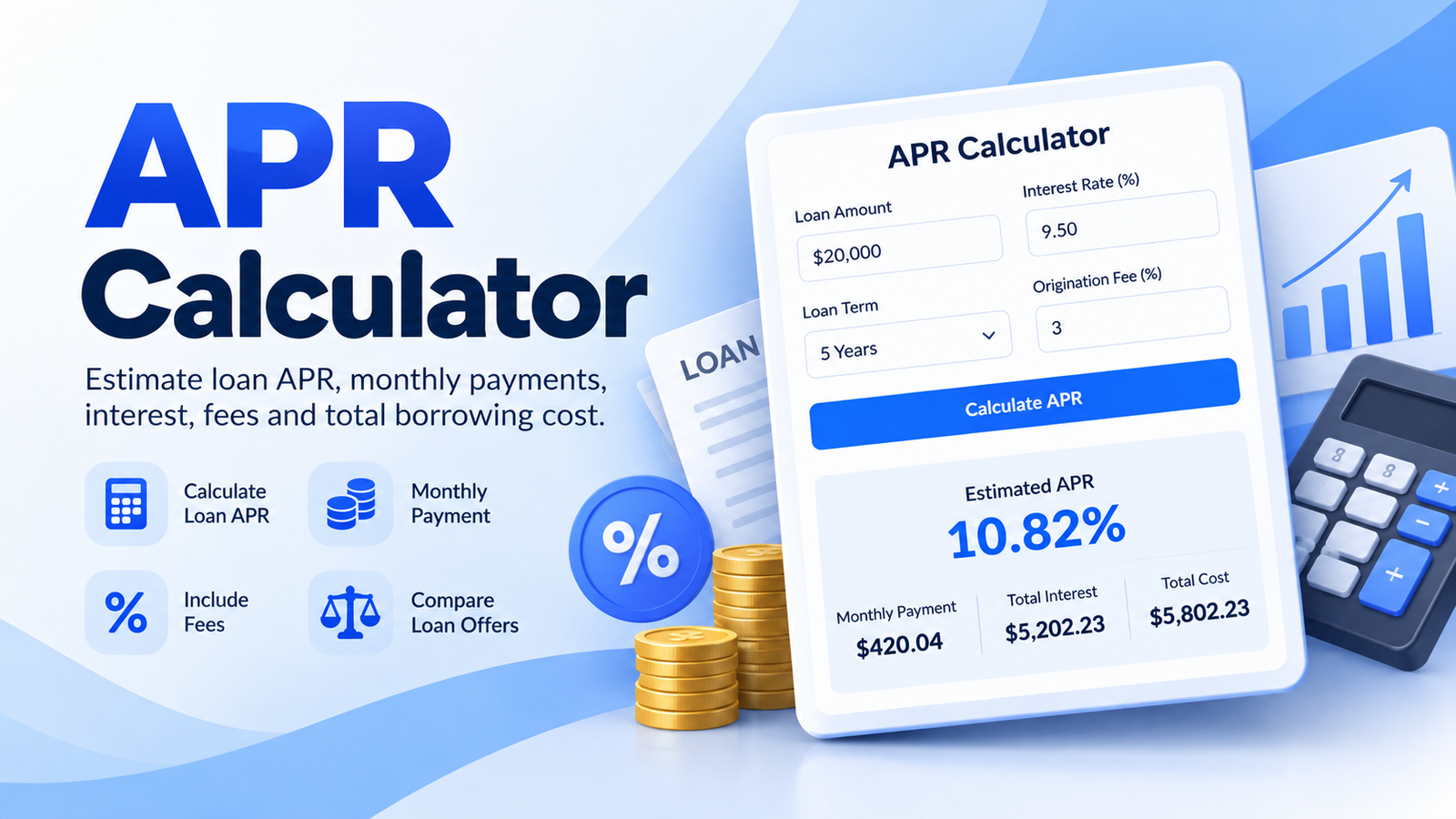
Suppose you borrow $20,000 at 9.5% annual interest for five years, and the lender deducts a 3% origination fee before disbursing the money.
Example Loan Details
| Loan Detail | Value |
|---|---|
| Loan amount | $20,000 |
| Interest rate | 9.50% |
| Loan term | 5 years |
| Origination fee | $600 |
| Cash received | $19,400 |
| Monthly payment | $420.04 |
| Estimated APR | 10.82% |
Over 60 scheduled payments, you repay approximately $25,202.23. That includes about $5,202.23 in interest. Including the $600 origination fee, the total borrowing cost is approximately $5,802.23.
The 3% fee raises the estimated APR from the stated 9.50% to about 10.82%. That difference matters when another lender offers the same loan with a different fee structure.
How Is APR Calculated?
For a fixed-rate, fully amortizing installment loan, the calculator first determines the monthly payment from the repayment balance, interest rate, and number of payments.
Monthly payment formula:
Monthly payment = P × r ÷ [1 − (1 + r)⁻ⁿ]
Where:
- P: Repayment balance
- r: Monthly interest rate
- n: Number of monthly payments
The calculator then finds the monthly discount rate that makes the present value of those payments equal to the net amount of credit provided after the applicable finance charges. That rate is annualized to estimate APR.
Because APR depends on the timing of repayment and the treatment of fees, simply adding the origination fee percentage to the interest rate does not produce an accurate loan APR.
How Loan Fees Affect Your APR
The way a fee is collected can change how much money you receive or how much you must repay. Our calculator provides three origination-fee options:
| Fee Treatment | What Happens |
|---|---|
| Deducted from proceeds | You receive less cash, but generally repay the stated loan amount. |
| Paid out of pocket | You pay the fee separately when the loan begins. |
| Financed into the loan | The fee increases the repayment balance, potentially adding interest on the fee. |
Only charges that qualify as finance charges should be entered for estimating a disclosed APR. Not every fee or expense associated with borrowing is necessarily included under applicable lending rules.
How to Compare Two Loan Offers
Use the calculator's Compare Another Loan Offer section to enter Offer B's rate, loan term, and fees. Compare the estimated APR and also review the dollars involved:
- Estimated APR: A useful starting point for comparing borrowing costs.
- Monthly payment: Make sure the scheduled payment fits your budget.
- Cash received: A fee deducted upfront may leave you short of the funds you need.
- Total borrowing cost: Check the cumulative interest and required fees, especially when terms differ.
A longer loan can have a lower monthly payment but cost more overall. If two offers have different loan terms or provide different net proceeds, compare those differences before treating the lower APR as the automatic winner.
Before accepting an offer: Compare the lender's actual APR disclosure, payment schedule, total finance charge, and any conditions that could change your costs.
What This APR Calculator Does and Doesn't Cover
This tool is best for estimating the APR of a fixed-rate loan with regular monthly payments, such as many personal or auto loans. It can also illustrate the effect of finance charges on a straightforward installment loan.
It doesn't model credit-card balances, revolving credit, adjustable-rate changes, irregular payment dates, introductory rates, late fees, optional products, or specialized mortgage disclosure calculations.
For mortgages, use the lender's official Loan Estimate to review disclosed APR and closing costs.
All results are estimates. The lender's legally required APR may differ because of fee classification, timing conventions, and other loan-specific rules. The calculator is educational and doesn't provide a loan offer or guarantee approval.
Frequently Asked Questions About APR
What does APR mean on a loan?
APR means annual percentage rate. It expresses the yearly cost of borrowing, taking into account the interest rate and certain applicable finance charges.
Why is my APR higher than my interest rate?
Required charges such as an eligible origination fee can increase the annualized cost of borrowing. That makes the APR higher than the stated interest rate even when your scheduled payment is calculated using the lower stated rate.
Does 0% interest mean 0% APR?
Not always. If the loan charges qualifying finance fees, its APR can be above 0% even when the stated interest rate is 0%. If no qualifying charges apply, the estimated APR may also be 0%.
Does a lower APR always mean a cheaper loan?
Not necessarily in total dollars. Loan amounts, terms, and cash proceeds matter. Two offers with different lengths can have very different total interest and repayment costs, even if one advertises a lower APR.
Does APR include origination fees?
APR generally includes origination charges and other applicable finance charges. The exact inclusion rules vary with the credit product and legal disclosure requirements. Use only relevant required fees in this calculator.
Can I use this APR calculator for a credit card?
No. This version is designed for fixed-rate installment loans with equal monthly payments. Credit-card interest depends on revolving balances, payment timing, and the card's terms, so a dedicated credit-card interest calculator is more suitable.
Is the APR calculated here the same as my lender's APR?
It may be close for a straightforward fixed-rate installment loan, but the official disclosed APR can differ because of which fees count as finance charges, exact payment dates, rounding, and applicable regulations. Always check the loan disclosure before agreeing to borrow.
APR (annual percentage rate) is an annualized measure of borrowing cost that combines the loan's interest rate with certain required finance charges. It can help you compare offers that advertise different rates and lender fees.
For example, a personal loan advertised at 9.5% interest could have a higher APR if the lender charges an origination fee. The interest rate determines the scheduled interest on the repayment balance, while APR also reflects eligible finance charges.
Use the APR calculator above for fixed-rate installment loans with equal monthly payments. It estimates APR, monthly payment, interest, required fees, cash received, and the total cost of borrowing.
How to Use the APR Calculator
- Enter the loan amount. Use the amount stated in the loan agreement before any origination fee is deducted.
- Add the annual interest rate. Enter the lender's stated rate, not its disclosed APR.
- Choose the loan term. Select months or years. Longer repayment terms usually reduce the monthly payment but can increase total interest.
- Enter the origination fee. Add the percentage quoted by your lender, or enter 0 if there is no fee.
- Review your results. Check estimated APR, monthly payment, cash received, total interest, and total borrowing cost.
If your offer includes other required finance charges, open Advanced Fee Options. You can specify whether the origination fee is deducted from the proceeds, paid separately, or financed into the repayment balance, and enter additional upfront or financed fees.
Helpful tip: An origination fee deducted from your loan can leave you with less cash than the amount you must repay. Always compare the cash you receive, not just the advertised loan amount.
APR vs. Interest Rate: What's the Difference?
The two percentages describe related but different costs. A loan's interest rate doesn't necessarily include lender fees. APR incorporates the stated rate plus certain finance charges and expresses their combined effect as an annual rate.
| Feature | Interest Rate | APR |
|---|---|---|
| What it measures | Cost of interest on the loan balance | Annualized cost of interest and eligible finance charges |
| Origination fees | Not included in the rate itself | Included when applicable under APR rules |
| Helps calculate payment | Yes, for the scheduled loan payment | Not normally used as the contractual payment rate |
| Useful for comparing lenders | Partly | Yes, particularly for similar loan types and terms |
With no included finance charges and the same monthly-payment assumptions, estimated APR can be approximately equal to the stated interest rate. Fees commonly make APR higher.
APR Calculation Example: $20,000 Loan
Suppose you borrow $20,000 at 9.5% annual interest for five years, and the lender deducts a 3% origination fee before disbursing the money.
Example Loan Details
| Loan Detail | Value |
|---|---|
| Loan amount | $20,000 |
| Interest rate | 9.50% |
| Loan term | 5 years |
| Origination fee | $600 |
| Cash received | $19,400 |
| Monthly payment | $420.04 |
| Estimated APR | 10.82% |
Over 60 scheduled payments, you repay approximately $25,202.23. That includes about $5,202.23 in interest. Including the $600 origination fee, the total borrowing cost is approximately $5,802.23.
The 3% fee raises the estimated APR from the stated 9.50% to about 10.82%. That difference matters when another lender offers the same loan with a different fee structure.
How Is APR Calculated?
For a fixed-rate, fully amortizing installment loan, the calculator first determines the monthly payment from the repayment balance, interest rate, and number of payments.
Monthly payment formula:
Monthly payment = P × r ÷ [1 − (1 + r)⁻ⁿ]
Where:
- P: Repayment balance
- r: Monthly interest rate
- n: Number of monthly payments
The calculator then finds the monthly discount rate that makes the present value of those payments equal to the net amount of credit provided after the applicable finance charges. That rate is annualized to estimate APR.
Because APR depends on the timing of repayment and the treatment of fees, simply adding the origination fee percentage to the interest rate does not produce an accurate loan APR.
How Loan Fees Affect Your APR
The way a fee is collected can change how much money you receive or how much you must repay. Our calculator provides three origination-fee options:
| Fee Treatment | What Happens |
|---|---|
| Deducted from proceeds | You receive less cash, but generally repay the stated loan amount. |
| Paid out of pocket | You pay the fee separately when the loan begins. |
| Financed into the loan | The fee increases the repayment balance, potentially adding interest on the fee. |
Only charges that qualify as finance charges should be entered for estimating a disclosed APR. Not every fee or expense associated with borrowing is necessarily included under applicable lending rules.
How to Compare Two Loan Offers
Use the calculator's Compare Another Loan Offer section to enter Offer B's rate, loan term, and fees. Compare the estimated APR and also review the dollars involved:
- Estimated APR: A useful starting point for comparing borrowing costs.
- Monthly payment: Make sure the scheduled payment fits your budget.
- Cash received: A fee deducted upfront may leave you short of the funds you need.
- Total borrowing cost: Check the cumulative interest and required fees, especially when terms differ.
A longer loan can have a lower monthly payment but cost more overall. If two offers have different loan terms or provide different net proceeds, compare those differences before treating the lower APR as the automatic winner.
Before accepting an offer: Compare the lender's actual APR disclosure, payment schedule, total finance charge, and any conditions that could change your costs.
What This APR Calculator Does and Doesn't Cover
This tool is best for estimating the APR of a fixed-rate loan with regular monthly payments, such as many personal or auto loans. It can also illustrate the effect of finance charges on a straightforward installment loan.
It doesn't model credit-card balances, revolving credit, adjustable-rate changes, irregular payment dates, introductory rates, late fees, optional products, or specialized mortgage disclosure calculations.
For mortgages, use the lender's official Loan Estimate to review disclosed APR and closing costs.
All results are estimates. The lender's legally required APR may differ because of fee classification, timing conventions, and other loan-specific rules. The calculator is educational and doesn't provide a loan offer or guarantee approval.
Frequently Asked Questions About APR
What does APR mean on a loan?
APR means annual percentage rate. It expresses the yearly cost of borrowing, taking into account the interest rate and certain applicable finance charges.
Why is my APR higher than my interest rate?
Required charges such as an eligible origination fee can increase the annualized cost of borrowing. That makes the APR higher than the stated interest rate even when your scheduled payment is calculated using the lower stated rate.
Does 0% interest mean 0% APR?
Not always. If the loan charges qualifying finance fees, its APR can be above 0% even when the stated interest rate is 0%. If no qualifying charges apply, the estimated APR may also be 0%.
Does a lower APR always mean a cheaper loan?
Not necessarily in total dollars. Loan amounts, terms, and cash proceeds matter. Two offers with different lengths can have very different total interest and repayment costs, even if one advertises a lower APR.
Does APR include origination fees?
APR generally includes origination charges and other applicable finance charges. The exact inclusion rules vary with the credit product and legal disclosure requirements. Use only relevant required fees in this calculator.
Can I use this APR calculator for a credit card?
No. This version is designed for fixed-rate installment loans with equal monthly payments. Credit-card interest depends on revolving balances, payment timing, and the card's terms, so a dedicated credit-card interest calculator is more suitable.
Is the APR calculated here the same as my lender's APR?
It may be close for a straightforward fixed-rate installment loan, but the official disclosed APR can differ because of which fees count as finance charges, exact payment dates, rounding, and applicable regulations. Always check the loan disclosure before agreeing to borrow.