
Calorie Calculator
Find your daily calorie target for weight loss, maintenance or muscle gain.
What Is a Calorie Calculator?
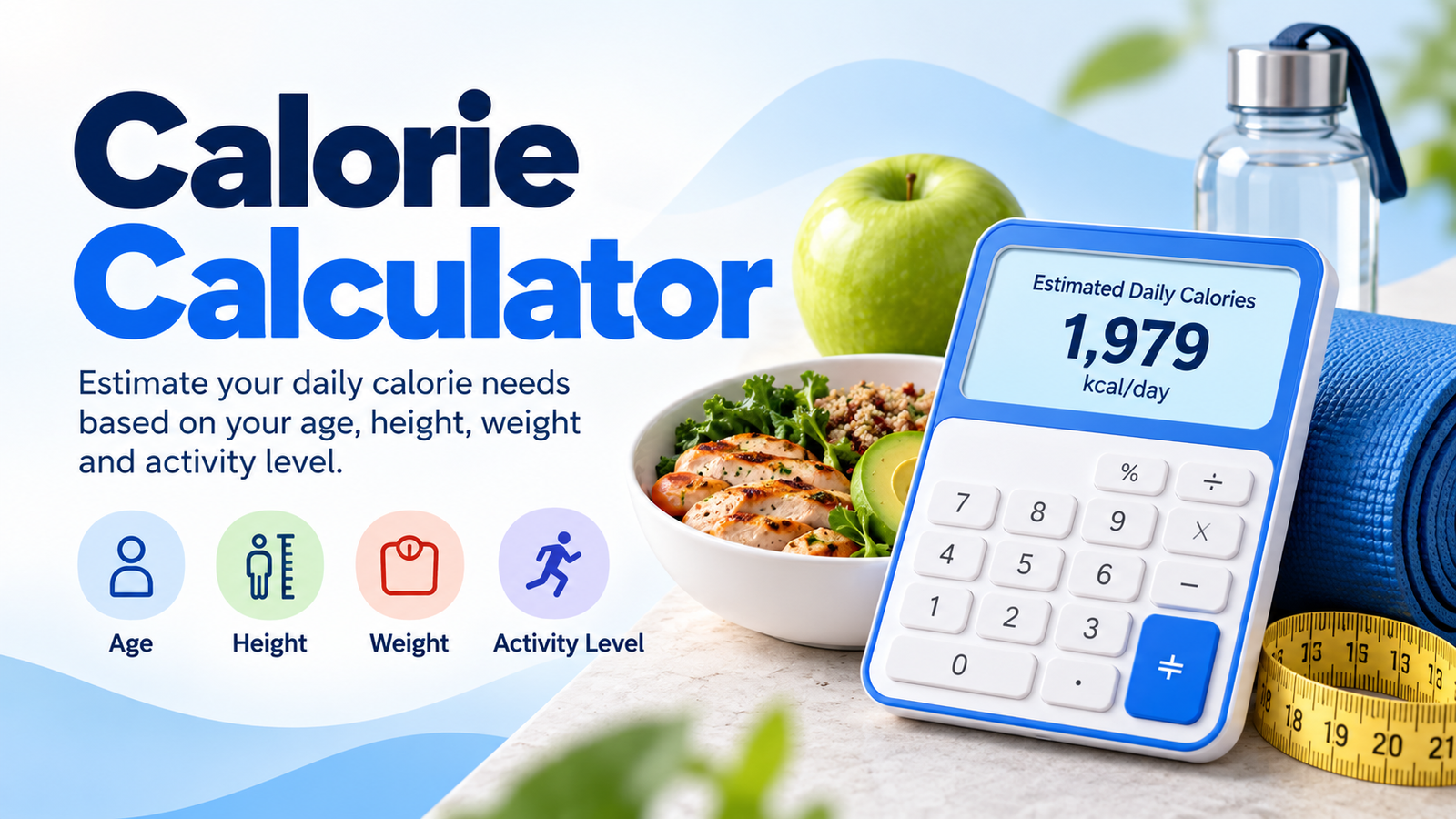
A Calorie Calculator is an online tool that estimates how many calories your body needs each day based on your age, height, weight, and physical activity level. It helps you understand your daily energy requirements without complicated calculations.
Your body uses energy throughout the day, even when you're resting. Breathing, circulating blood, digesting food, walking, and exercising all contribute to your total daily energy expenditure.
Our free Calorie Calculator uses the Mifflin–St Jeor equation and an activity multiplier to estimate your daily maintenance calories—the approximate amount of energy required to maintain your current weight.
You can also explore resting metabolic rate (RMR), compare different activity levels, and see exactly how your results are calculated.
These figures are estimates rather than exact measurements or personalized nutrition prescriptions.
How to Use the Calorie Calculator
Finding your estimated daily calorie needs takes only a few steps.
- Choose Your Measurement System: Select US Units for pounds, feet, and inches, or Metric for kilograms and centimeters.
- Enter Your Age: Provide your age in completed years. The calculator is designed for adults aged 18 and older.
- Select the Equation Coefficient: Choose the male or female coefficient used by the published Mifflin–St Jeor equation.
- Enter Your Height: Provide your height using your preferred measurement system.
- Enter Your Weight: Add your current body weight in pounds or kilograms.
- Choose Your Activity Level: Select the option that best describes your typical daily activity.
- Calculate Calories: Click Calculate Calories to see your estimated maintenance energy requirements.
- Explore Your Results: Review the resting energy estimate, activity multiplier, energy comparison, and formula details.
- Copy or Reset: Copy your calculation or reset the tool to its starting values.
The calculator updates automatically when you change your measurements or activity selection.
How Many Calories Do I Need Per Day?
Your daily calorie needs depend on several factors, including your age, body size, body composition, and physical activity.
There isn't one calorie amount that is suitable for every adult.
For example, two people of the same age may have different energy requirements if their height, weight, lean body mass, or daily routines differ.
The calculator estimates your daily energy needs using two steps:
Step 1: Estimate resting energy expenditure using your body measurements.
Step 2: Apply an activity multiplier to estimate total daily energy expenditure.
The resulting number represents an approximate maintenance-energy estimate.
It is not a guarantee of how many calories you personally burn or a prescribed amount you should eat.
What Are Maintenance Calories?
Maintenance calories are the estimated number of calories needed to balance the energy your body uses over time.
When average energy intake and expenditure are approximately equal, body weight may remain relatively stable, although normal short-term fluctuations still occur.
Maintenance calorie requirements are influenced by:
- Resting metabolic energy expenditure
- Daily movement and physical activity
- Exercise and other physical tasks
- Energy used during digestion
- Body size and composition
- Individual physiological differences
For example, someone who spends most of the day sitting may have different energy requirements from someone who regularly performs physically demanding work.
The calculator estimates these differences using simplified activity multipliers.
Example of Maintenance Calories
Consider a hypothetical adult with the following measurements:
| Measurement | Value |
|---|---|
| Age | 30 years |
| Height | 175 cm |
| Weight | 70 kg |
| Equation Coefficient | Male |
| Activity Level | Sedentary |
Using the Mifflin–St Jeor equation:
Estimated Resting Energy = 1,648.75 kcal/day
The sedentary activity multiplier is 1.20.
Therefore:
1,648.75 × 1.20 = 1,978.5 kcal/day
The estimated maintenance energy requirement is approximately 1,979 calories per day.
This example demonstrates the calculation method. An individual's actual energy expenditure may differ.
How Does the Calorie Calculator Work?
The calculator uses an established resting energy prediction equation followed by an activity adjustment.
Step 1: Calculate Resting Metabolic Rate
Resting metabolic rate (RMR) estimates the energy your body uses while resting.
The Mifflin–St Jeor equation uses weight in kilograms, height in centimeters, age in years, and a published sex-based coefficient.
Male equation:
RMR = (10 × Weight) + (6.25 × Height) − (5 × Age) + 5
Female equation:
RMR = (10 × Weight) + (6.25 × Height) − (5 × Age) − 161
These equations estimate resting energy expenditure rather than directly measuring metabolism.
Step 2: Adjust for Physical Activity
After calculating RMR, the tool applies your selected activity factor.
Estimated TDEE = RMR × Activity Multiplier
For example, if your estimated RMR is 1,600 kcal/day and your activity factor is 1.55:
1,600 × 1.55 = 2,480 kcal/day
Your estimated total daily energy expenditure would be approximately 2,480 calories.
Step 3: Display Your Results
The calculator presents:
- Estimated maintenance calories
- Resting energy expenditure
- Selected activity multiplier
- Difference between the two model estimates
- Estimated energy requirements for all five activity categories
- Calculation formula and measurement details
This allows you to understand the estimate rather than receiving a number without context.
BMR vs. TDEE: What's the Difference?
BMR and TDEE describe different aspects of energy expenditure.
BMR (Basal Metabolic Rate) refers to energy used under strictly controlled basal resting conditions.
TDEE (Total Daily Energy Expenditure) refers to all energy used across a day, including resting metabolism, physical activity, and digestion.
| BMR / RMR | TDEE |
|---|---|
| Energy used at rest | Total daily energy expenditure |
| Does not separately account for ordinary activity | Includes an activity adjustment |
| Estimated from body measurements | Estimated from resting energy and activity |
| Commonly expressed in kcal/day | Also expressed in kcal/day |
This calculator uses the Mifflin–St Jeor equation, which specifically predicts resting metabolic rate (RMR).
Although BMR and RMR are closely related, they are measured under different conditions and should not be considered identical.
How Physical Activity Affects Daily Calorie Needs
Physical activity can significantly influence total daily energy expenditure.
Someone with a physically demanding routine generally uses more energy than a similarly sized person who spends most of the day sitting.
The calculator includes five activity levels.
| Activity Level | Multiplier | Description |
|---|---|---|
| Sedentary | 1.20 | Little planned exercise |
| Light | 1.375 | Light exercise around 1–3 days weekly |
| Moderate | 1.55 | Moderate activity around 3–5 days weekly |
| Very Active | 1.725 | Frequent vigorous activity |
| Extra Active | 1.90 | Very demanding physical activity |
These multipliers are simplified estimation factors rather than precise measurements of your energy expenditure.
Example: Comparing Activity Levels
If your resting energy estimate is 1,600 calories per day:
| Activity Level | Estimated Daily Energy |
|---|---|
| Sedentary | 1,920 kcal |
| Light | 2,200 kcal |
| Moderate | 2,480 kcal |
| Very Active | 2,760 kcal |
| Extra Active | 3,040 kcal |
The difference comes from the activity multiplier used in the calculation.
This doesn't mean changing your activity selection instantly changes your actual metabolism. It shows how the model estimates energy requirements under different activity assumptions.
What Factors Affect Daily Calorie Requirements?
Your daily calorie requirements can vary for several reasons.
1. Age
Energy needs may change with age due to changes in body composition, physical activity, and other physiological factors.
Age is included directly in the Mifflin–St Jeor equation.
2. Height and Body Weight
Body size influences the amount of energy required to support essential functions and movement.
Larger bodies generally use more energy, although weight alone does not determine metabolism.
3. Muscle Mass and Body Composition
Lean tissues contribute significantly to resting energy expenditure.
Two people with similar height and weight may have different energy needs if their body composition differs.
4. Physical Activity
Walking, exercising, household tasks, and physically demanding jobs increase energy use.
The activity multiplier attempts to account for these differences.
5. Individual Metabolic Variation
People with similar measurements can have different resting energy expenditure due to genetics, physiology, health conditions, and other factors.
Prediction equations cannot capture every individual difference.
6. Physiological and Health Changes
Illness, recovery, pregnancy, breastfeeding, and certain medical treatments may change energy requirements.
A general-purpose adult calculator may not accurately represent these situations.
Calorie Intake vs. Calories Burned
Calories consumed and calories expended are related but different measurements.
Calorie intake refers to the energy provided by food and beverages.
Calorie expenditure refers to the energy your body uses during rest, movement, digestion, and other biological processes.
Energy balance describes the relationship between these two values over time.
However, energy balance is more complex than a fixed daily equation. Body weight, energy expenditure, appetite, activity, and other factors may change over time.
For this reason, the calculator focuses on estimated daily energy requirements rather than automatically prescribing calorie restrictions or surpluses.
Does Exercise Increase Your Daily Calorie Needs?
Physical activity contributes to energy expenditure, so more activity can increase total daily calorie requirements.
The effect depends on several factors, including:
- Exercise type
- Duration and intensity
- Body size
- Daily movement outside exercise
- Individual energy expenditure
For example, a person who exercises for 30 minutes but sits for most of the remaining day may have different total energy needs from someone whose occupation involves constant movement.
When choosing an activity level, consider your overall routine instead of focusing only on gym sessions.
How Accurate Is a Calorie Calculator?
A Calorie Calculator provides an estimate based on mathematical models.
It cannot measure your actual daily energy expenditure directly.
The accuracy of the result depends on the resting energy equation, the activity factor, and how closely those assumptions match your individual physiology.
Possible sources of variation include:
- Differences in muscle mass and body composition
- Inaccurate height or weight measurements
- Activity levels that do not match real-world movement
- Changes in daily routines
- Individual metabolic differences
- Medical or physiological factors
The formula may provide a useful starting point, but it should not be interpreted as an exact or guaranteed daily calorie requirement.
When greater precision is needed for clinical reasons, qualified professionals may use additional assessments and measurements.
Why Do Different Calorie Calculators Give Different Results?
You may notice that different websites produce different daily calorie estimates even when you enter the same measurements.
This can happen because calculators use different methods.
Some use Mifflin–St Jeor, while others use Harris–Benedict or alternative energy prediction equations.
Activity assumptions may also vary between tools.
For example, two calculators may agree on your resting energy estimate but use different activity multipliers, resulting in different TDEE estimates.
Neither result should automatically be considered exact.
A trustworthy calculator should identify its equation and explain how the estimate is produced.
Common Calorie Calculation Mistakes
Confusing Resting Calories With Maintenance Calories
Resting energy represents only part of daily expenditure.
Maintenance energy estimates include an adjustment for everyday activity.
Choosing the Wrong Activity Level
Selecting an activity level that does not reflect your usual routine can significantly change the result.
Consider your normal workday and physical activity patterns.
Entering Incorrect Measurements
Using pounds in a kilogram field or inches in a centimeter field can produce incorrect results.
The calculator supports both measurement systems and handles unit conversion automatically.
Treating the Result as a Fixed Calorie Prescription
Your calculated maintenance energy is a prediction.
Actual energy requirements may differ and can change over time.
Assuming All Calories Are Nutritionally Equivalent
Calories measure energy, but the nutritional quality of foods also matters.
Protein, carbohydrates, fats, fiber, vitamins, and minerals support different physiological functions.
A calorie estimate alone cannot determine whether a diet meets nutritional needs.
Ignoring Changes Over Time
Daily energy requirements may change as activity, body size, health, or physiology changes.
A single estimate should not be considered permanent.
Who Should Use a Calorie Calculator?
This general-purpose tool may be useful for adults who want to:
- Understand estimated daily energy requirements.
- Compare resting energy with total expenditure.
- Learn how activity influences calorie needs.
- Explore basic nutrition and metabolism concepts.
- Understand how common calorie equations work.
- Compare estimates across different routine activity levels.
It is intended for general educational use.
Children and adolescents, pregnant or breastfeeding individuals, and people with specialized medical or nutritional needs require age- or condition-appropriate guidance.
People with a history of disordered eating should consider whether numerical calorie tracking is appropriate for them and seek personalized professional support when needed.
Frequently Asked Questions
How many calories should I eat per day?
Daily calorie needs vary according to age, height, weight, body composition, activity, and individual circumstances. The calculator estimates maintenance energy but does not prescribe a personal daily intake.
What is a maintenance calorie calculator?
A maintenance calorie calculator estimates total daily energy requirements associated with maintaining approximately stable body weight over time.
How are daily calories calculated?
The calculator uses the Mifflin–St Jeor equation to estimate resting energy expenditure and multiplies that result by a selected activity factor.
What is the difference between a Calorie Calculator and a BMR Calculator?
A BMR Calculator focuses on estimated resting energy needs. A Calorie Calculator generally focuses on total daily energy requirements after accounting for activity.
Are maintenance calories the same as TDEE?
Estimated maintenance calories are commonly approximated using TDEE, although actual intake requirements and energy expenditure may differ from the calculation.
Does walking increase calorie expenditure?
Yes. Walking requires energy and contributes to total daily expenditure. The amount depends on duration, pace, body size, and other factors.
Why does my calorie estimate change when I select a different activity level?
The calculator multiplies your resting energy estimate by the selected activity factor. A higher multiplier produces a higher estimated TDEE.
Does age affect calorie needs?
Age is one input in common energy prediction equations. Actual energy requirements also depend on activity, body composition, and physiological characteristics.
Is the Calorie Calculator accurate?
It provides an estimate based on published prediction equations and simplified activity multipliers. It does not directly measure daily energy expenditure.
Can I calculate calories using pounds and inches?
Yes. Choose US Units and enter your weight in pounds and height in feet and inches. The tool converts these measurements for its calculation.
What does kcal mean?
Kcal stands for kilocalorie. One kilocalorie equals 1,000 small calories. In nutrition, the word "Calorie" with a capital C commonly means one kilocalorie.
What is an activity multiplier?
An activity multiplier is a numerical factor applied to a resting energy estimate to approximate total daily energy expenditure.
Can I use this calculator to set a weight-loss calorie target?
The calculator can help explain estimated maintenance energy, but it does not generate individualized weight-loss prescriptions. Appropriate nutritional plans depend on personal circumstances and may benefit from professional guidance.
Does the Calorie Calculator work for older adults?
The tool accepts adult ages up to 120, but accuracy can vary, particularly when body composition, health conditions, or activity patterns differ from the equation's underlying assumptions.
Can I copy my calorie calculation?
Yes. Click Copy Result to copy your estimated maintenance calories, resting energy estimate, activity level, and measurement details.
Is the SkillsElevate Calorie Calculator free?
Yes. The calculator is free to use and does not require account registration.
Scientific Methodology and References
The calculator uses the Mifflin–St Jeor resting energy prediction equation, introduced in a 1990 study published in the American Journal of Clinical Nutrition.
Its activity-adjusted estimates use commonly adopted simplified activity multipliers.
The following scientific resources provide background on resting energy expenditure and daily calorie requirements:
- Mifflin MD et al. (1990): A New Predictive Equation for Resting Energy Expenditure in Healthy Individuals. American Journal of Clinical Nutrition.
- National Institute of Diabetes and Digestive and Kidney Diseases (NIDDK): Body Weight Planner and supporting energy-balance information.
- USDA National Agricultural Library: Dietary Reference Intake Calculator for Healthcare Professionals.
These references support the broader scientific methodology; the activity multipliers used by this particular calculator are simplified assumptions and are not identical to every clinical energy-requirement model.
Related Tools
Explore more health and nutrition calculators available on SkillsElevate:
- BMR Calculator: Estimate resting energy expenditure and compare prediction equations.
- Macro Calculator: Explore how energy from carbohydrates, proteins, and fats contributes to nutrition.
- BMI Calculator: Calculate Body Mass Index using your height and weight.
- Age Calculator: Calculate your exact age in years, months, and days.
Understand Your Daily Calorie Needs
Our free Calorie Calculator provides a straightforward way to explore estimated daily energy requirements using your body measurements and physical activity.
You can calculate maintenance calories, compare activity levels, review resting energy expenditure, and understand the equation behind your result.
Remember that calorie requirements vary from person to person. The result is an educational estimate designed to improve your understanding of energy expenditure, not a substitute for individualized nutrition or medical advice.