
Calculate Your CD Interest and Maturity Value
Use the CD Calculator above to estimate your interest earned and maturity balance based on your deposit amount, APY, and certificate of deposit term.
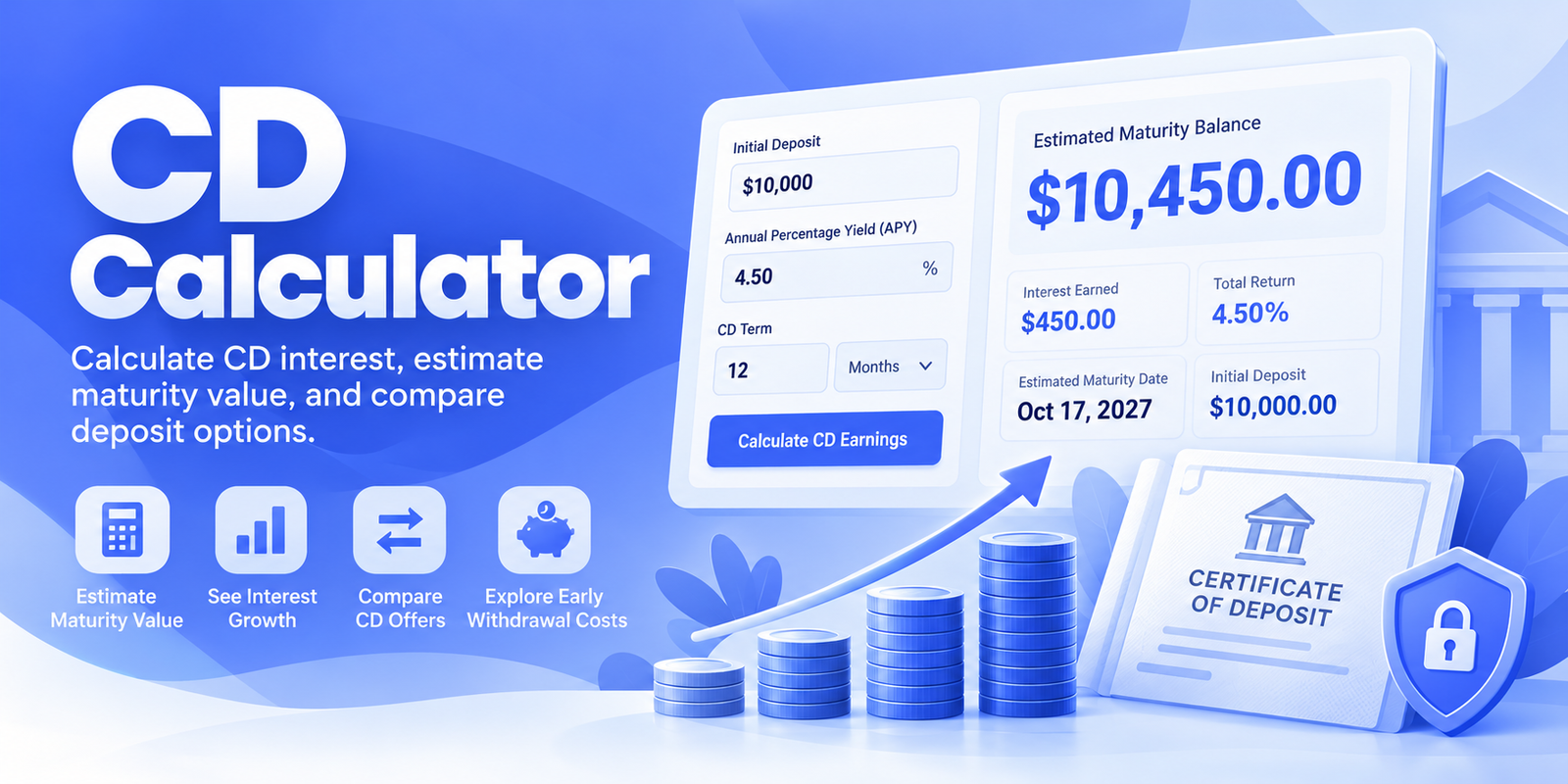
How to Use the CD Calculator
Our free CD Calculator helps you estimate how much your savings may earn in a certificate of deposit before you commit your money.
Step 1: Enter Your Initial Deposit
Enter the amount you plan to deposit into the CD. For example, enter $10,000 if you want to invest ten thousand dollars.
Step 2: Enter the Annual Percentage Yield (APY)
Enter the APY advertised by your bank or credit union. For example, enter 4.50 for an illustrative 4.50% APY.
Step 3: Select Your CD Term
Choose how long you plan to keep your money in the CD. You can enter the term in months or years.
Step 4: Calculate Your CD Earnings
Click Calculate CD Earnings to view your estimated maturity balance, total interest earned, maturity date, and percentage return.
Step 5: Explore Additional Features
You can also use the calculator to compare two CD offers, explore different compounding frequencies, estimate after-tax interest, and calculate a hypothetical early-withdrawal penalty.
What Is a Certificate of Deposit (CD)?
A certificate of deposit (CD) is a savings product offered by banks and credit unions that generally requires you to keep your money deposited for an agreed period.
In exchange, the financial institution pays interest according to the account's terms.
Traditional fixed-rate CDs typically offer a rate that remains unchanged during the agreed term.
Common CD terms include:
- 3 months
- 6 months
- 9 months
- 12 months
- 18 months
- 24 months
- 36 months
- 60 months
When your CD reaches its maturity date, you can generally access the deposit and accumulated interest according to your account agreement.
Withdrawing money before maturity may result in a penalty.
Understanding Your CD Calculator Results
The calculator displays several useful values to help you understand the potential return on your deposit.
| Result | What It Means |
|---|---|
| Maturity Balance | Estimated total value of your CD at the end of the term |
| Interest Earned | Additional money earned from interest |
| Initial Deposit | Original amount invested |
| Maturity Date | Estimated date when your CD term ends |
| Total Return | Percentage growth over the entire CD term |
| After-Tax Interest | Optional illustration of earnings after an assumed tax rate |
Estimated Maturity Balance
The maturity balance is the main result.
It represents your original deposit plus the estimated interest accumulated over the selected CD term.
For example, if you deposit $10,000 and earn $450 in interest, your estimated maturity balance is:
$10,000 + $450 = $10,450
This is a gross estimate before applicable taxes, fees, or early-withdrawal penalties.
Total Interest Earned
Interest earned is the amount your CD is projected to generate above the initial deposit.
Interest Earned = Maturity Balance − Initial Deposit
This figure helps you compare the actual dollar earnings of different CD offers.
Estimated Maturity Date
The maturity date is when your CD's agreed term ends.
The calculator estimates this date using your start date and selected term.
For example, a 12-month CD opened on October 17, 2026, would have an estimated maturity date of October 17, 2027.
Individual institutions may have different date, holiday, and maturity-processing rules.
Total Return
Total return represents the percentage increase in your deposit over the entire CD term.
For example, a $10,000 deposit earning $450 has a total return of 4.50%.
For CDs with terms shorter or longer than one year, total return may differ from the annual APY.
CD Interest Calculator Example
Suppose you open a CD with the following details:
| CD Detail | Example |
|---|---|
| Initial Deposit | $10,000 |
| Annual Percentage Yield | 4.50% |
| CD Term | 12 months |
| Additional Deposits | $0 |
| Estimated Interest Earned | $450.00 |
| Estimated Maturity Balance | $10,450.00 |
With a constant 4.50% APY over one year, your $10,000 deposit grows to approximately $10,450.
The calculation is:
$10,000 × (1 + 0.045) = $10,450
The interest earned is:
$10,450 − $10,000 = $450
This example assumes that the advertised yield remains applicable, earnings stay in the CD, and no money is withdrawn.
The 4.50% APY is hypothetical and does not represent a current bank offer.
How Is CD Interest Calculated?
CD interest depends on several factors:
- Initial deposit
- Annual percentage yield
- Length of the CD term
- Compounding method
- Whether interest remains deposited
The default calculator uses the APY formula:
[A=P(1+APY)^t]
Where:
| Symbol | Meaning |
|---|---|
| A | Estimated maturity balance |
| P | Initial deposit |
| APY | Annual percentage yield expressed as a decimal |
| t | CD term expressed in years |
For a six-month CD, the calculator uses 0.5 years.
For a 12-month CD, it uses 1 year.
For a 24-month CD, it uses 2 years.
This method provides a consistent estimate using the entered APY. Actual bank calculations for partial-year terms may use different day-count conventions.
How Much Interest Will a CD Earn?
The amount of interest earned changes with the deposit, APY, and length of time the money remains invested.
The following table shows hypothetical earnings on a $10,000 deposit at a constant 4.50% APY.
| CD Term | Interest Earned | Maturity Balance |
|---|---|---|
| 3 months | $110.65 | $10,110.65 |
| 6 months | $222.52 | $10,222.52 |
| 12 months | $450.00 | $10,450.00 |
| 24 months | $920.25 | $10,920.25 |
These examples use the calculator's constant-APY formula with no fees, taxes, withdrawals, or additional deposits.
Longer terms can produce more total interest when the APY remains unchanged, but actual market offers may have different yields for different CD terms.
What Is APY on a CD?
APY stands for Annual Percentage Yield.
It represents the effective annual return on a deposit when the applicable compounding assumptions are included.
Banks and credit unions commonly advertise APY to help consumers compare deposit products.
For example, a CD advertising 4.50% APY indicates an effective annual yield of 4.50% under the stated assumptions.
APY is useful because it provides a standardized measure that incorporates compounding.
However, APY does not tell you everything about a CD.
You should also consider the term, minimum deposit, early-withdrawal restrictions, and renewal conditions.
APY vs. Interest Rate: What's the Difference?
APY and a nominal annual interest rate are related, but they are not always equal.
| Feature | APY | Nominal Interest Rate |
|---|---|---|
| Meaning | Effective annual yield | Stated annual rate |
| Compounding included | Yes | Not necessarily |
| Useful for comparing CDs | Yes | Requires compounding details |
| Can differ by compounding frequency | Reflects its effect | Effective yield changes with frequency |
For example, a CD with a 4.50% nominal annual interest rate compounded monthly has an effective APY of approximately 4.59%.
This is slightly higher than the stated nominal rate because interest is compounded during the year.
How the Calculator Handles APY
When APY is selected, the calculator uses the entered yield directly.
It does not add a second compounding adjustment because APY already accounts for compounding.
How the Calculator Handles Nominal Interest Rates
If you select Nominal Annual Interest Rate under Advanced Settings, you can specify the compounding frequency.
The calculator supports daily, monthly, quarterly, semiannual, and annual compounding.
How Compounding Frequency Affects CD Earnings
Compound interest occurs when previously earned interest remains in the account and can earn additional interest.
Depending on the CD agreement, interest may compound at different intervals.
When comparing CDs with the same nominal annual interest rate, more frequent compounding generally produces a slightly higher effective annual yield.
The nominal-rate calculation is:
[A=P\left(1+\frac{r}{n}\right)^{nt}]
Where:
- P = initial deposit
- r = nominal annual interest rate
- n = compounding periods per year
- t = term in years
For example, $10,000 at a 4.50% nominal rate compounded monthly for 12 months produces an estimated maturity value of approximately $10,459.40.
This differs from entering 4.50% as APY, which produces $10,450.00 over the same year.
How to Calculate 6-Month CD Interest
A six-month CD may be suitable for someone who wants a relatively short savings commitment.
For example:
Initial deposit: $10,000
APY: 4.50%
Term: 6 months
Using the calculator's APY method:
[A=10000(1.045)^{6/12}]
The estimated results are:
Maturity balance: $10,222.52
Interest earned: $222.52
A six-month CD does not normally earn a full year's stated APY. The actual earnings depend on the shorter holding period and the account's calculation method.
How to Calculate 12-Month CD Interest
A 12-month CD provides a straightforward one-year savings period.
Suppose you deposit $15,000 at a hypothetical 4.00% APY for one year.
The estimated maturity value is:
$15,000 × 1.04 = $15,600
The interest earned is:
$15,600 − $15,000 = $600
This calculation assumes the stated APY applies throughout the full year and earnings remain in the account.
How to Compare Two CD Offers
Choosing between CD offers involves more than selecting the largest advertised percentage.
Our calculator includes a Compare CD Offers section to help you examine two options using the same initial deposit.
For example:
| Detail | CD Offer A | CD Offer B |
|---|---|---|
| Initial Deposit | $10,000 | $10,000 |
| APY | 4.50% | 4.00% |
| CD Term | 12 months | 12 months |
| Interest Earned | $450 | $400 |
| Maturity Balance | $10,450 | $10,400 |
Under these assumptions, Offer A earns $50 more interest.
However, the result does not automatically mean that Offer A is the better choice for every saver.
What If the CD Terms Are Different?
A 24-month CD may earn more total interest than a 12-month CD simply because the money remains deposited longer.
When terms differ, our calculator explains that maturity balances are not directly comparable without considering the different time horizons.
You should also compare how long your money will be unavailable and what could happen if you need it early.
What Happens If You Withdraw From a CD Early?
Many traditional CDs impose an early-withdrawal penalty when money is removed before maturity.
The penalty depends on the financial institution and account agreement.
Some banks express penalties in terms of days or months of interest, while others use different formulas or fees.
For example, a bank might specify a penalty equal to a certain number of days' interest.
There is no universal early-withdrawal penalty for all CDs.
The calculator lets you enter an assumed number of penalty days or a flat dollar penalty.
How to Use the Early Withdrawal Estimate
Enable Calculate an Early Withdrawal Scenario and enter the number of months you plan to keep the CD before withdrawing.
Next, choose your penalty method.
The calculator displays the estimated balance at withdrawal, the penalty amount, the net proceeds, and the gain or loss compared with the original deposit.
These results are hypothetical. Check the CD agreement for the actual penalty and any restrictions on early access.
Can an Early Withdrawal Penalty Reduce Your Principal?
Yes.
Depending on the bank's rules and how early you withdraw, a penalty can exceed the interest accumulated up to that point.
For example, imagine your CD has earned $75 in interest, but the applicable penalty is $120.
The penalty exceeds your earnings by $45.
Under this simplified example, your withdrawal proceeds would be $45 less than the original deposit.
The calculator highlights situations where an estimated penalty exceeds accumulated interest.
Are CD Earnings Taxable?
Interest earned on a CD held in a regular taxable account is generally subject to federal income tax in the United States.
The actual tax treatment and reporting year depend on the CD's terms and applicable tax rules.
Our calculator includes an optional After-Tax Interest Estimate to help illustrate how taxes may affect your earnings.
CD After-Tax Interest Example
Suppose your CD earns $450 and you apply a hypothetical 22% tax rate.
| Calculation | Amount |
|---|---|
| Gross Interest | $450.00 |
| Assumed Tax Rate | 22% |
| Illustrative Tax | $99.00 |
| After-Tax Interest | $351.00 |
| Deposit + After-Tax Interest | $10,351.00 |
This feature applies the entered tax percentage to total projected interest.
It does not determine your actual federal or state tax liability, tax brackets, deductions, or the year in which interest must be reported.
CD vs. Savings Account: Which Is Better?
Both CDs and savings accounts can help you earn interest on deposited money, but they serve different needs.
| Feature | Certificate of Deposit | Regular Savings Account |
|---|---|---|
| Interest Rate | Often fixed for the agreed term | Usually variable |
| Access to Money | May be restricted before maturity | Generally more flexible |
| Early Withdrawal Penalty | May apply | Typically no CD-style maturity penalty |
| Best Suited For | Savings with a known time horizon | Money that may be needed sooner |
| Interest Earnings | Depend on yield and term | Depend on balance and changing yield |
A CD may be useful when you have funds you do not expect to need during the selected term.
A savings account may be more suitable when access to money is a priority.
The better choice depends on your savings goal, available rates, and need for liquidity.
Are CDs FDIC Insured?
CDs held at FDIC-insured banks are generally eligible for deposit insurance within applicable limits.
The standard FDIC insurance amount is $250,000 per depositor, per insured bank, per ownership category.
Qualifying deposits in the same ownership category at the same institution may be combined when insurance coverage is calculated.
Eligible certificates at federally insured credit unions may instead be covered through NCUA share insurance.
The CD Calculator estimates interest and maturity values. It does not determine whether a particular institution is insured or calculate your individual insurance coverage.
What Happens When a CD Matures?
When a certificate of deposit reaches maturity, its agreed deposit term has ended.
Depending on your bank's policies, you may be able to withdraw the balance, move the funds into another account, or renew the CD.
Some CDs automatically renew unless you provide instructions within a specified period.
A renewed CD may have a different rate than the original account.
Check your maturity notice, automatic-renewal conditions, and any applicable grace period before the term ends.
How to Choose a CD Term
The most useful CD term often depends on when you expect to need your savings.
A shorter CD may suit a near-term savings goal, while a longer CD may suit money that can remain deposited for an extended period.
Before choosing, consider the following:
- When you will need the money
- Whether you have separate emergency savings
- The APY available for each term
- Early-withdrawal restrictions
- Automatic-renewal rules
- Whether the deposit is covered by applicable insurance
Using the calculator to compare different terms can help you see how much additional interest a longer commitment might provide.
Understanding the CD Interest Growth Chart
The CD Interest Growth chart illustrates how your estimated balance changes during the selected term.
It shows both your original deposit and projected account balance.
Because the calculator assumes that interest remains deposited, the balance can increase over time.
The chart updates when you change the deposit amount, APY, or CD term.
For longer terms, this provides a quick visual explanation of how interest accumulation affects the maturity balance.
How to Read the Interest Accumulation Schedule
The calculator also includes a month-by-month accumulation schedule.
Each row shows:
| Column | Meaning |
|---|---|
| Month | Number of months since the CD started |
| Opening Balance | Estimated amount at the beginning of the month |
| Interest Earned | Interest accumulated during that month |
| Total Interest | Cumulative estimated earnings |
| Ending Balance | Estimated CD balance at the end of the month |
The first 12 months appear initially.
Select Show All Months to view the complete schedule for the entered term.
The schedule uses the calculator's projection model rather than reproducing an individual bank's interest-crediting statement.
Important Limitations of the CD Calculator
The calculator is designed for educational estimates of traditional fixed-rate CDs.
It assumes:
- A single initial deposit
- A constant APY or nominal annual interest rate
- Interest remains in the CD
- No additional deposits during the term
- No regular interest withdrawals
- No unmodeled fees
- No early withdrawal unless the optional scenario is used
It does not fully model variable-rate CDs, callable CDs, brokered CDs, market-linked CDs, special promotional terms, or bank-specific day-count conventions.
Your bank's actual maturity amount may differ because of these account features.
Related Savings Calculators
These related Skills Elevate tools can help you explore other ways to estimate interest and long-term savings.
- Compound Interest Calculator — calculate how a deposit or investment grows through compounding.
- Savings Calculator — estimate future savings with regular deposits and accumulated interest.
- Simple Interest Calculator — calculate interest without compounding.
- Interest Rate Calculator — estimate the implied annual rate on a fixed-payment loan.
- Retirement Savings Calculator — estimate how contributions and investment growth could build retirement savings.
Frequently Asked Questions
What is a CD Calculator?
A CD Calculator estimates the interest earned and maturity balance of a certificate of deposit using your initial deposit, annual yield, and selected term.
How do I calculate CD interest?
Enter your deposit amount, APY, and CD term into the calculator.
The tool uses the selected yield and term to estimate the maturity balance, then subtracts the original deposit to calculate interest earned.
How much interest will $10,000 earn in a CD?
The amount depends on the APY and term. At a hypothetical 4.50% APY for 12 months, $10,000 would earn approximately $450, producing a maturity balance of $10,450.
How much will a $20,000 CD earn in one year?
At a hypothetical 4.00% APY for 12 months, a $20,000 deposit would earn approximately $800, assuming the yield applies throughout the year and all interest remains deposited.
Does a 6-month CD earn the full APY?
No. APY represents an annualized yield. A six-month CD generally earns interest for approximately half a year, not a full year.
Is APY the same as interest rate?
Not always. APY includes the effect of compounding over a year, while the nominal interest rate does not necessarily reflect the full effective annual yield.
Does daily compounding earn more than monthly compounding?
At the same positive nominal annual interest rate, daily compounding generally produces a slightly higher effective annual yield than monthly compounding.
If both CDs advertise the same APY, the compounding effect is already reflected in that annualized figure.
Can I calculate CD interest for three months?
Yes. Enter 3 as the CD term and select Months. The calculator estimates the interest and final balance for that duration.
Can I use the calculator for a five-year CD?
Yes. Enter 5 years or 60 months. The calculator can estimate the maturity balance and display the accumulation schedule.
How is my CD maturity date calculated?
The calculator adds the selected calendar-month term to your start date.
If the target month does not contain the original day number, the calculator uses the final day of that month. Actual bank maturity rules may differ.
What happens if a CD has 0% APY?
If the APY is 0%, the calculator shows no interest earned. Your estimated maturity balance equals your initial deposit.
Can I withdraw money from my CD early?
Many CDs allow early withdrawal but may impose penalties. Some products have different restrictions.
Check your bank's agreement before withdrawing funds.
How do I calculate a CD early-withdrawal penalty?
Open the Early Withdrawal Estimate, choose your withdrawal timing, and enter an assumed penalty expressed in days of interest or as a dollar amount.
The calculator estimates how the penalty may affect the funds received.
Can a CD withdrawal penalty exceed interest earned?
Yes. Depending on the terms and withdrawal timing, the penalty may be larger than the accumulated interest and reduce the original principal.
Are CD earnings taxable?
Interest earned on CDs in regular taxable accounts is generally taxable in the United States.
The reporting period and tax treatment depend on the CD and applicable rules. The optional calculator tax estimate is illustrative only.
Are certificates of deposit safe?
Traditional CDs at appropriately insured institutions can provide protection within applicable deposit-insurance limits.
However, early-withdrawal penalties, inflation, account terms, and institution-specific features still matter.
What is better: a CD or a high-yield savings account?
A CD may be attractive when you can keep money deposited for a fixed period and prefer a fixed rate. A high-yield savings account may offer more flexibility for funds you could need sooner.
Compare the actual yields, liquidity, and terms before choosing.
Does the calculator support additional monthly deposits?
No. This CD Calculator assumes one initial deposit with no additional contributions.
For savings plans involving regular deposits, use the Savings Calculator instead.
Does the CD Calculator use current bank rates?
No. You enter the APY or nominal annual rate yourself. The default rate is an illustrative example, not a live bank offer.
Is the CD Calculator free to use?
Yes. The Skills Elevate CD Calculator is free to use for estimating certificate of deposit interest, comparing hypothetical CD offers, and exploring savings outcomes.