
Gravel Calculator – Estimate Yards, Tons & Cost
Estimate how many tons of gravel you need for an area.
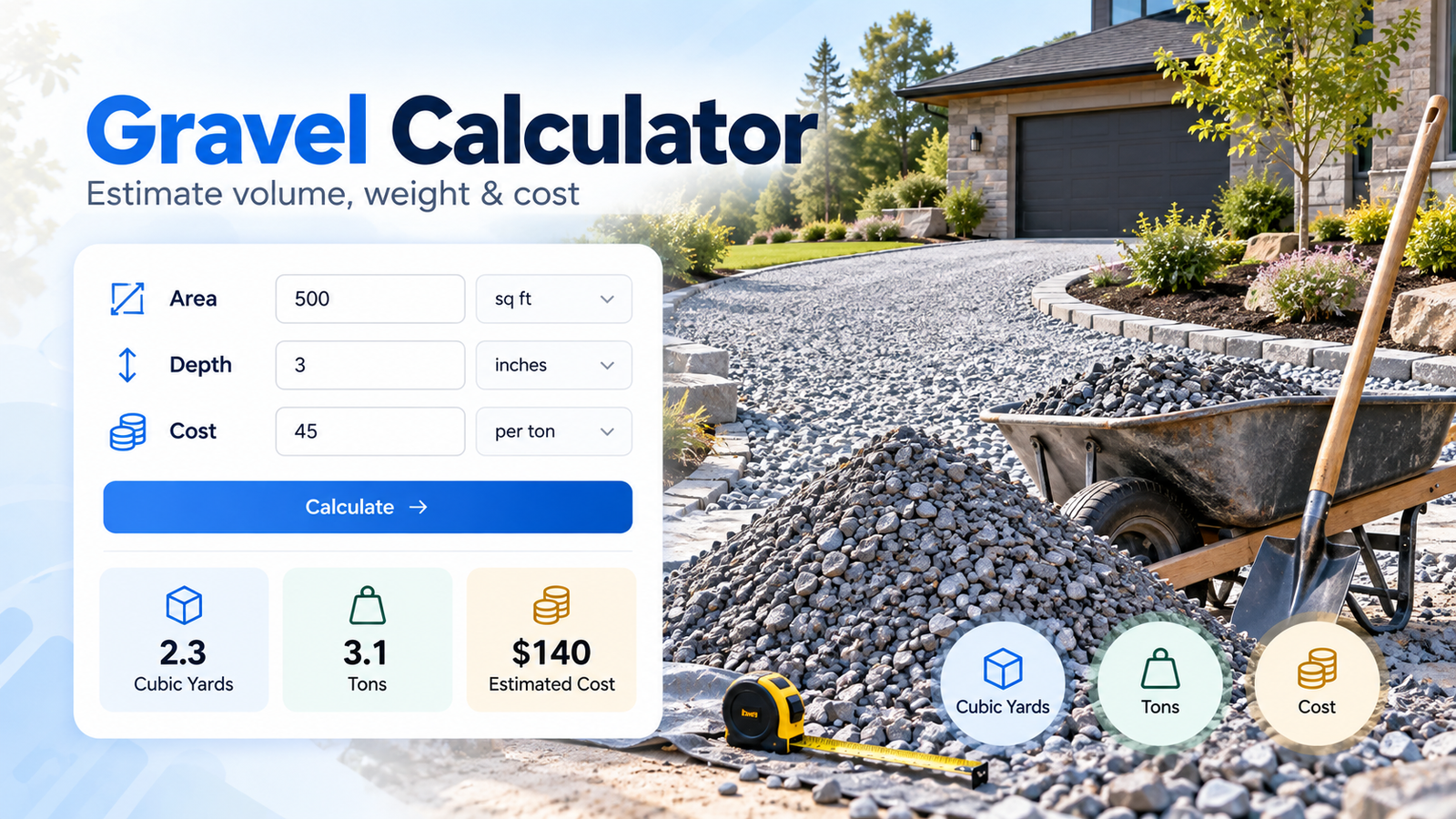
Use our Gravel Calculator to estimate how much gravel you need for a driveway, pathway, garden area, landscaping project, or construction job. Enter the size of the area, gravel depth, and material type to calculate the required cubic yards, cubic metres, tons or tonnes.
You can also add an extra allowance, enter your local gravel price, and estimate the number of bags needed.
How to Use the Gravel Calculator
Start by choosing your preferred unit system:
Imperial for feet, inches, cubic yards, and tons.
Metric for metres, centimetres, cubic metres, and tonnes.
Next, choose the shape of your area:
Rectangle, Circle, or Known Area.
Enter the required dimensions and your planned gravel depth. Then choose a gravel type or enter a custom material density if your supplier provides one.
The calculator automatically updates the estimated gravel quantity as you change the inputs.
How Much Gravel Do I Need?
The amount of gravel you need depends mainly on:
- Area size
- Gravel depth
- Shape of the area
- Material density
- Extra allowance
For a rectangular area, the basic calculation is:
Volume = Length × Width × Depth
The calculator then converts that volume into the units normally used when ordering gravel.
For Imperial measurements, this usually means cubic yards and tons.
For Metric measurements, results are shown in cubic metres and tonnes.
Gravel Calculator Example
Suppose your area is:
20 ft long
10 ft wide
and you want:
3 inches of gravel
The area is:
20 × 10 = 200 ft²
The gravel volume is approximately:
1.85 cubic yards
If you add a 10% extra allowance, the order quantity becomes approximately:
2.04 cubic yards
The estimated weight then depends on the selected gravel density.
Cubic Yards Gravel Calculator
Gravel is commonly sold by the cubic yard.
For rectangular areas using feet and inches, you can use:
Cubic Yards = Length(ft) × Width(ft) × Depth(in) ÷ 324
For example:
20 × 10 × 3 ÷ 324 = 1.85 yd³
The calculator performs this conversion automatically.
Gravel Calculator in Tons
Suppliers may sell gravel by weight rather than volume.
To estimate tons:
Tons = Cubic Yards × Material Density
For example, if your order requires:
2 cubic yards
and the gravel density is:
1.4 tons per cubic yard
then:
2 × 1.4 = 2.8 tons
Because gravel density varies by material, moisture, particle size, and compaction, weight should be treated as an estimate.
Gravel Calculator for Metric Measurements
If you use Metric units, enter your dimensions in metres and your gravel depth in centimetres.
The calculator shows results in:
m²
m³
and:
tonnes
For example, if an area measures:
6 m × 3 m
the total area is:
18 m²
The calculator then multiplies this by the selected depth to estimate the required gravel volume.
Gravel Depth
Gravel depth has a major effect on how much material you need.
For example, covering the same area with:
2 inches
requires less gravel than:
4 inches
The calculator includes quick depth options to make common estimates faster.
The correct depth depends on the project, ground conditions, gravel type, expected traffic, and construction method.
Gravel Types
Different gravel materials can have different bulk densities.
The calculator includes common options such as:
General Gravel
Pea Gravel
Crushed Stone
Crushed Limestone
Road Base / Crusher Run
River Rock
You can also edit the density value if your supplier gives you a more accurate figure.
Using supplier-specific density is the best option when you need a more precise weight estimate.
Pea Gravel Calculator
Pea gravel is commonly used for garden paths, landscaping, patios, play areas, and decorative surfaces.
Select Pea Gravel from the material list, enter your dimensions and depth, and the calculator will estimate the required volume and weight.
Crushed Stone Calculator
Crushed stone is often used for driveways, drainage, base layers, and construction projects.
To estimate crushed stone:
- Enter the project dimensions.
- Add the required depth.
- Select Crushed Stone.
- Add an extra allowance if needed.
The calculator will show the estimated order quantity in volume and weight.
Driveway Gravel Calculator
You can use the tool as a driveway gravel calculator by entering the driveway length, width, and planned gravel depth.
For example:
Length: 50 ft
Width: 12 ft
Depth: 4 in
The calculator estimates the cubic yards and tons required.
Actual driveway construction may require multiple layers or different materials, so this calculator should be used as a material estimate rather than a complete driveway design.
Circular Gravel Areas
For circular landscaping areas, select Circle and enter the diameter.
The calculator first finds the area using:
Area = π × Radius²
where:
Radius = Diameter ÷ 2
It then multiplies the area by the gravel depth to calculate the required volume.
This can be useful for circular garden beds, fire-pit areas, and decorative landscaping.
Known Area Calculator
If you already know the total square footage or square metres, choose Known Area.
Enter the area directly and then add the gravel depth.
This is useful when your measurements have already been calculated or when the project has an irregular shape but you already know its total area.
Extra Gravel Allowance
It is often useful to order slightly more gravel than the exact mathematical volume.
Extra material may help account for:
- Uneven ground
- Settling
- Compaction
- Spillage
- Small measurement differences
The calculator lets you choose an extra allowance such as:
0%
5%
10%
or:
15%
It shows both the base quantity and the final order quantity, so you can clearly see how much extra material has been added.
Gravel Cost Calculator
If you know your supplier's price, you can estimate the material cost.
Enter a price:
Per ton / tonne
or:
Per cubic yard / cubic metre
For example, if you need:
3 tons
and the price is:
$50 per ton
then:
3 × $50 = $150
Estimated material cost:
$150
This does not include delivery, labor, tax, excavation, or other project costs unless those are already included in your supplier's price.
Gravel Bag Calculator
For smaller projects, gravel may be purchased in bags.
Enter the volume of one bag and the calculator will estimate how many bags are required.
The final bag count is rounded up because you cannot normally purchase part of a bag.
For larger projects, ordering bulk gravel by cubic yard or ton is often more practical.
Why Gravel Weight Is Only an Estimate
Gravel does not have one fixed weight.
Its bulk density can change because of:
- Stone type
- Stone size
- Moisture
- Compaction
- Dust and fines
- Supplier grading
For this reason, the calculator provides an estimated weight based on the selected density.
Before placing a large order, confirm the expected density and final quantity with your gravel supplier.
Cubic Yards vs Tons
Cubic yards measure volume.
Tons measure weight.
Two gravel materials can fill the same volume but weigh different amounts.
That is why a gravel calculator needs a material density before it can estimate weight.
If your supplier sells by volume, focus on cubic yards or cubic metres.
If your supplier sells by weight, use the estimated tons or tonnes and confirm the material density.
Frequently Asked Questions
How do I calculate how much gravel I need?
Calculate the area, multiply it by the gravel depth, and convert the resulting volume into cubic yards or cubic metres.
How many cubic feet are in one cubic yard?
There are 27 cubic feet in one cubic yard.
How many tons are in a cubic yard of gravel?
It varies by gravel type and density. Many materials are roughly around 1.3–1.5 tons per cubic yard, but the actual value should be confirmed with your supplier.
Should I add extra gravel?
Adding a small allowance can help account for uneven ground, settling, compaction, and spillage. The amount depends on your project.
Can I calculate gravel in metric units?
Yes. Select Metric to calculate using metres, centimetres, cubic metres, and tonnes.
Can I calculate gravel cost?
Yes. Enter the supplier's price per ton, tonne, cubic yard, or cubic metre to estimate material cost.
Can I use the calculator for pea gravel?
Yes. Select Pea Gravel from the material options or enter your supplier's density.
Can I use it for crushed stone?
Yes. The calculator can estimate crushed stone volume, weight, allowance, and cost.
Estimate Your Gravel Order
Use the Gravel Calculator to estimate the amount of material needed before contacting your supplier.
Enter the project dimensions, gravel depth, material type, and optional allowance to quickly see your estimated:
Area
Volume
Cubic Yards or Cubic Metres
Tons or Tonnes
Extra Material
Estimated Material Cost
and:
Bag Quantity
For large or important projects, confirm the final quantity and material density with your supplier before ordering.