
Percent Error Calculator
Use this Percent Error Calculator to compare an experimental or measured value with an accepted or theoretical value. It instantly calculates the percent error, absolute error, signed error, and signe
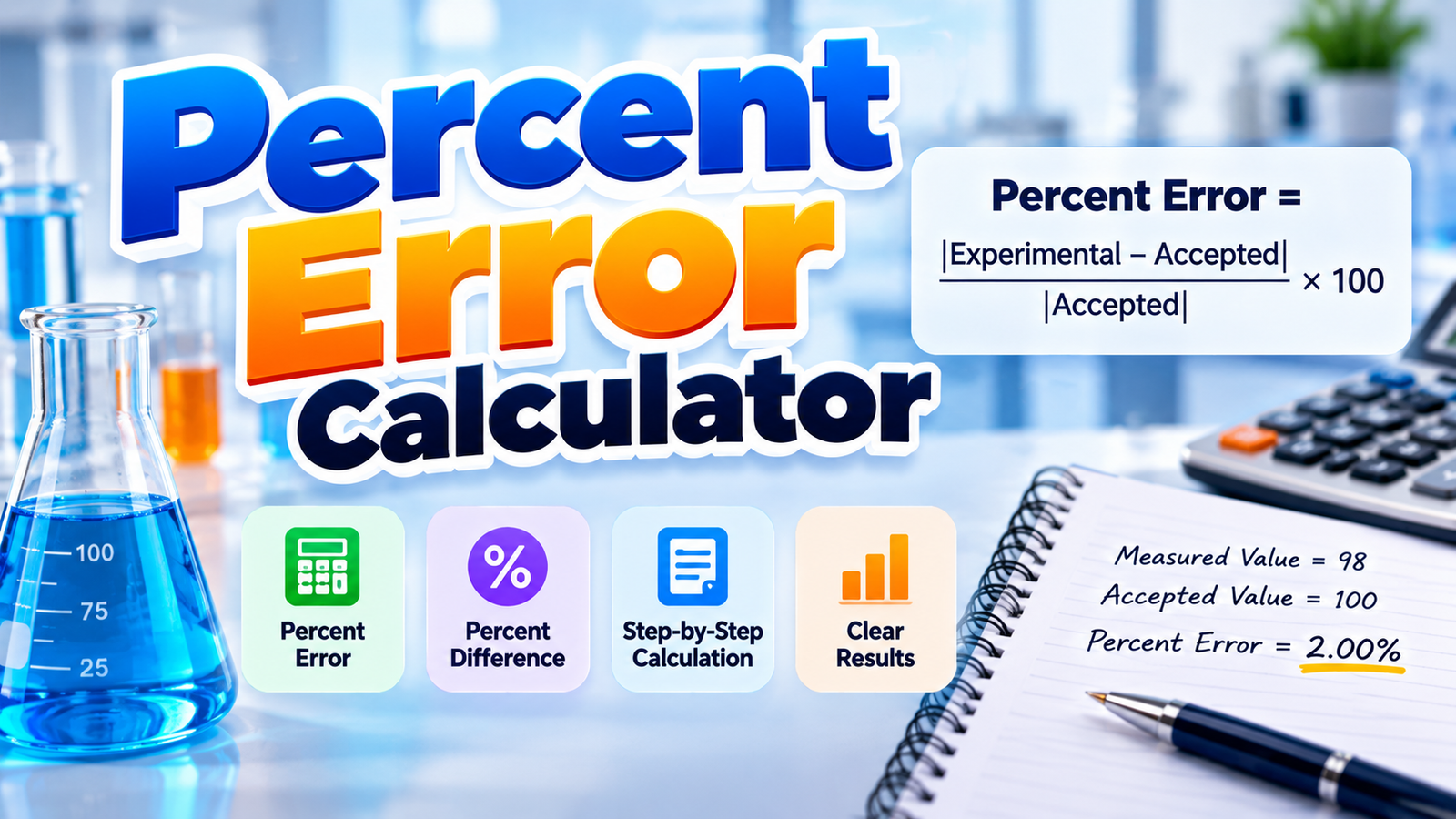
You can also switch to Percent Difference mode when you want to compare two measurements and neither value is considered the accepted reference.
How to Use the Percent Error Calculator
To calculate percentage error:
- Enter the Experimental Value you measured or observed.
- Enter the Accepted Value used as the reference.
- Add a unit if you want, such as
g,cm,m/s, or°C. - Click Calculate Percent Error.
- Review the percentage error and calculation breakdown.
For example:
Experimental Value: 98Accepted Value: 100
The result is:
Percent Error = 2.00%
The experimental value is 2 units below the accepted value.
Percent Error Formula
The standard percent error formula is:
Percent Error = |Experimental Value − Accepted Value| ÷ |Accepted Value| × 100
The absolute-value signs make the standard percent error non-negative.
For example:
Experimental Value = 98
Accepted Value = 100
First find the difference:
98 − 100 = −2
Take the absolute value:
|−2| = 2
Divide by the accepted value:
2 ÷ 100 = 0.02
Convert to a percentage:
0.02 × 100 = 2%
So:
Percent Error = 2%
What Does Percent Error Mean?
Percent error describes how far an experimental or measured value is from an accepted value relative to the size of the accepted value.
A smaller percentage means the two values are closer together.
For example:
Measured value: 99
Accepted value: 100
produces:
1% error
While:
Measured value: 90
Accepted value: 100
produces:
10% error
Whether a particular percentage is acceptable depends on the experiment, measurement method, and required accuracy.
Experimental Value vs Accepted Value
The two values have different roles.
Experimental value is the number you measured, observed, or calculated during an experiment.
Accepted value is the known, theoretical, expected, or reference value used for comparison.
For example, when measuring gravitational acceleration:
Experimental: 9.72 m/s²Accepted: 9.81 m/s²
The percent error is approximately:
0.92%
Absolute Error
The calculator also shows the absolute error.
Formula:
Absolute Error = |Experimental − Accepted|
Example:
98 vs 100
Absolute Error:
2
If units are entered, the difference uses those same units.
Signed Error
Signed error shows the direction of the difference.
Formula:
Signed Error = Experimental − Accepted
Examples:
108 − 100 = +8
The experimental value is above the accepted value.
92 − 100 = −8
The experimental value is below the accepted value.
This direction is useful because the normal percent-error result itself is always shown as a positive magnitude.
Signed Percent Error
The calculator can also display signed percentage error:
Signed % Error = (Experimental − Accepted) ÷ |Accepted| × 100
For example:
108 vs 100 = +8%
This indicates an overestimate.
92 vs 100 = −8%
This indicates an underestimate.
The standard Percent Error remains positive in both cases.
Percent Error vs Percent Difference
Percent error and percent difference are related, but they are used for different situations.
Percent Error
Use Percent Error when one value is considered the accepted or theoretical reference.
Example:
Experimental = 98
Accepted = 100
Percent Difference
Use Percent Difference when you are comparing two measurements and neither one is considered the true or accepted value.
The formula is:
Percent Difference = |A − B| ÷ ((|A| + |B|) ÷ 2) × 100
For example:
Value A = 92
Value B = 100
Difference:
8
Average magnitude:
96
Percent Difference:
8 ÷ 96 × 100 = 8.33%
Use the Percent Difference tab in the calculator when this type of comparison is more appropriate.
Percent Error Example
Suppose a laboratory experiment produces a measured value of:
9.72 m/s²
while the accepted value is:
9.81 m/s²
The difference is:
9.72 − 9.81 = −0.09
Absolute error:
0.09
Percent error:
0.09 ÷ 9.81 × 100
Result:
≈ 0.92%
This means the measured result differs from the accepted value by about 0.92%.
What If the Accepted Value Is Zero?
Percent error cannot be calculated when the accepted value is 0 because the formula would require division by zero.
For example:
Experimental = 5
Accepted = 0
The absolute error can still be calculated:
|5 − 0| = 5
But the percentage error is:
Undefined
The calculator displays a clear message when this occurs.
Can Percent Error Be Greater Than 100%?
Yes.
A percent error greater than 100% can occur when the difference between the experimental and accepted values is larger than the magnitude of the accepted value.
For example:
Experimental = 250
Accepted = 100
Absolute difference:
150
Percent error:
150 ÷ 100 × 100 = 150%
Can You Use Negative Values?
Yes. Negative experimental and accepted values can be used when they make sense for the measurement.
The calculator uses the magnitude of the accepted value in the denominator for the percent-error calculation.
The accepted value must still be non-zero.
Frequently Asked Questions
How do I calculate percent error?
Subtract the accepted value from the experimental value, take the absolute value of the difference, divide by the absolute accepted value, and multiply by 100.
What is the percent error formula?
Percent Error = |Experimental − Accepted| ÷ |Accepted| × 100
What does 0% error mean?
A percent error of 0% means the experimental value exactly matches the accepted value.
Is percent error always positive?
Standard percent error is normally shown as a non-negative value because the numerator uses an absolute difference.
What is the difference between percent error and signed percent error?
Percent error shows the size of the error. Signed percent error also shows whether the experimental value is above or below the accepted value.
Can the accepted value be zero?
No. Percentage error is undefined when the accepted value is zero because division by zero is not possible.
What is percent difference used for?
Percent difference is useful when comparing two measurements without treating either one as the accepted or true value.
Can I use decimal values?
Yes. The calculator supports decimal experimental and accepted values.
Can I enter units?
Yes. Units are optional and can be used to make the result easier to understand. They do not change the percentage calculation.
Calculate Percent Error Instantly
Use the Percent Error Calculator to quickly compare an experimental result with an accepted value and see:
Percent Error
Absolute Error
Signed Error
Signed Percent Error
Above or Below Accepted Value
Step-by-Step Calculation
and:
Percent Difference
The tool is useful for chemistry, physics, engineering, laboratory work, science assignments, and general measurement comparisons.