
Calculate Percentages Quickly and Accurately
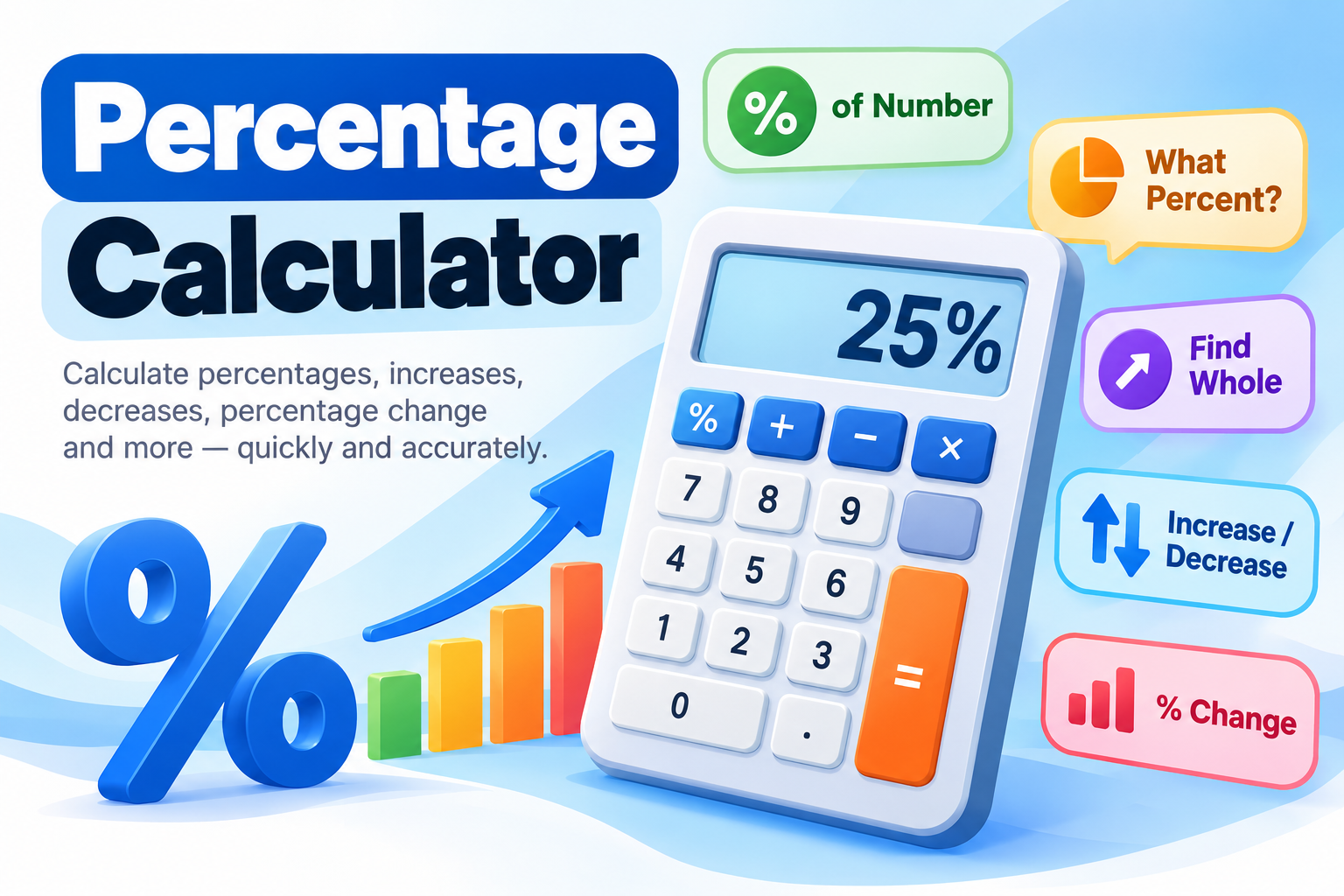
Our Percentage Calculator helps you solve common percentage problems without remembering complicated formulas. You can calculate a percentage of a number, find what percentage one value is of another, determine the original whole, increase or decrease a number by a percentage, and calculate percentage change.
The calculator updates automatically as you enter values, supports decimals, and shows both the answer and the formula used to calculate it.
How to Use the Percentage Calculator
Choose the calculation type that matches your question, enter your numbers, and the result appears instantly.
The calculator includes five useful calculation modes:
- % of Number – Find a percentage of any number.
- What Percent? – Find what percentage one number is of another.
- Find Whole – Find the total when you know a value and its percentage.
- Increase / Decrease – Add or subtract a percentage from a starting value.
- % Change – Calculate the percentage increase or decrease between two values.
You can also use the Quick Examples, adjust decimal precision, reset the current calculation, or copy the result.
What Is X Percent of Y?
Use the % of Number mode when you want to answer a question such as:
What is 20% of 500?
The formula is:
Percentage ÷ 100 × Number
Example:
20 ÷ 100 × 500 = 100
So, 20% of 500 is 100.
This calculation is useful for discounts, commissions, taxes, grades, tips, financial estimates, and many everyday percentage problems.
How to Find What Percent One Number Is of Another
Use What Percent? when you know two values and want to find their percentage relationship.
For example:
30 is what percent of 120?
Formula:
Part ÷ Total × 100
Calculation:
30 ÷ 120 × 100 = 25%
Therefore, 30 is 25% of 120.
You can also use the Swap Values button to quickly reverse the comparison.
How to Find the Whole From a Percentage
Sometimes you know a value and the percentage it represents but need to find the original total.
For example:
30 is 20% of what number?
Formula:
Known Value ÷ (Percentage ÷ 100)
Calculation:
30 ÷ 0.20 = 150
So, 30 is 20% of 150.
This can be useful when working backward from discounts, sales figures, grades, budgets, or other percentage-based values.
Percentage Increase and Decrease
The Increase / Decrease mode lets you apply a percentage change directly to a starting number.
For example, increasing 500 by 20%:
Percentage amount = 500 × 20 ÷ 100 = 100
New value = 500 + 100 = 600
So, a 20% increase on 500 gives 600.
If you choose Decrease instead:
500 − 100 = 400
This feature can help calculate discounts, price increases, salary changes, markups, reductions, and other adjustments.
How to Calculate Percentage Change
Use % Change when comparing an old value with a new value.
The formula is:
(New Value − Old Value) ÷ |Old Value| × 100
For example, if a value changes from 80 to 100:
(100 − 80) ÷ 80 × 100 = 25%
That means the value increased by 25%.
If the new value is lower than the old value, the calculator identifies it as a percentage decrease.
Percentage Calculator Examples
Here are a few common calculations:
| Calculation | Result |
|---|---|
| 10% of 200 | 20 |
| 25% of 80 | 20 |
| 50% of 120 | 60 |
| 30 is what % of 120? | 25% |
| 30 is 20% of what? | 150 |
| Increase 500 by 20% | 600 |
| 80 to 100 percentage change | 25% increase |
Why Use an Online Percentage Calculator?
Percentage calculations are simple once you know the correct formula, but it is easy to confuse similar calculations.
For example, 20% of 500 is a different question from 20 is what percent of 500.
This calculator separates each type into a clear mode, helping you choose the correct calculation and see how the answer was produced.
It can be useful for:
- Shopping discounts and sale prices
- School grades and test scores
- Business growth and performance
- Salary increases
- Markups and reductions
- Taxes and tips
- Financial planning
- Marketing and conversion rates
- General everyday math
Frequently Asked Questions
How do I calculate a percentage of a number?
Divide the percentage by 100 and multiply it by the number. For example, 25% of 200 is:
25 ÷ 100 × 200 = 50
How do I find what percentage one number is of another?
Divide the first number by the second number and multiply by 100.
For example:
30 ÷ 120 × 100 = 25%
How do I calculate a percentage increase?
Find the percentage amount and add it to the original value.
For example, increasing 100 by 20% gives:
100 + 20 = 120
How do I calculate a percentage decrease?
Find the percentage amount and subtract it from the original value.
For example, decreasing 100 by 20% gives:
100 − 20 = 80
Can the calculator use decimal percentages?
Yes. You can enter values such as 12.5%, 7.25%, or other decimal percentages.
What happens if I divide by zero?
Some percentage calculations are undefined when the comparison or original value is zero. The calculator detects these cases and displays an explanation instead of showing an incorrect result.
Can I change the number of decimal places?
Yes. Use the Decimal Precision option to display results with 0, 2, 4, or 6 decimal places.