
Pregnancy Due Date Calculator
Estimate your due date and current week of pregnancy from your last period.
What Is a Pregnancy Due Date Calculator?
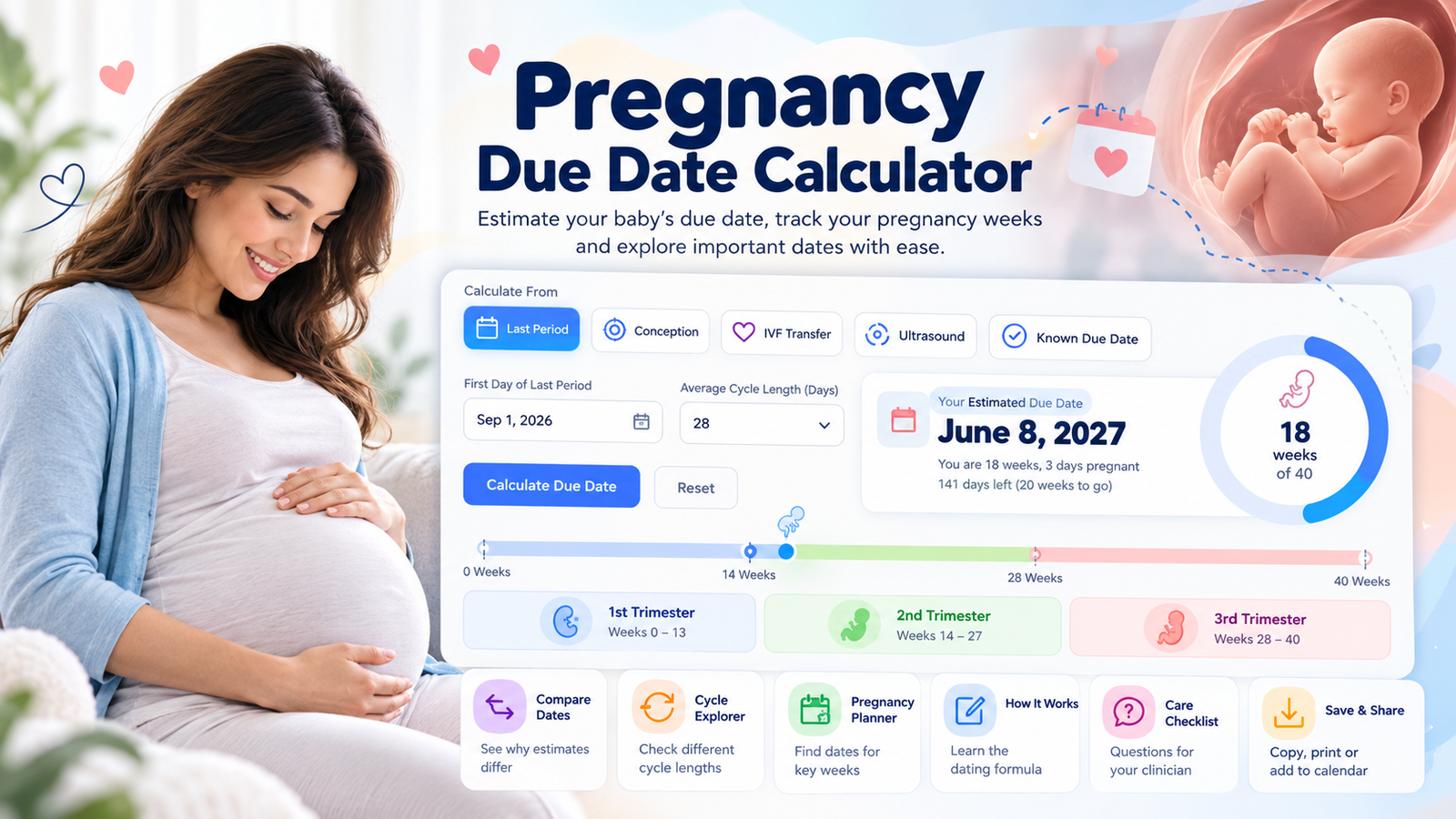
A Pregnancy Due Date Calculator is an online tool that estimates when your baby may be born based on pregnancy dating information. It can also help you understand how many weeks pregnant you are, identify your current trimester, and explore important dates throughout your pregnancy.
Pregnancy is conventionally dated as 40 weeks, or 280 days, from the first day of the last menstrual period. However, the estimated due date can vary depending on menstrual cycle length, conception timing, ultrasound findings, or IVF treatment details.
Our free Pregnancy Due Date Calculator supports five dating methods: Last Menstrual Period, Conception Date, IVF Transfer, Ultrasound Dating, and Known Due Date.
You can also compare due date estimates, explore different menstrual cycle lengths, calculate pregnancy weeks for specific dates, and save your results.
Important: Your due date is an estimate, not a guaranteed delivery date. Your prenatal healthcare professional can establish and confirm the most appropriate date for clinical care.
How to Use the Pregnancy Due Date Calculator
The calculator is designed to provide a clear result without complicated medical terminology or unnecessary inputs.
Step 1: Choose Your Calculation Method
Select the option that matches the information you have available.
- Last Period: If you know the first day of your last menstrual period.
- Conception: If you know or have an estimate of your conception date.
- IVF Transfer: If you know your embryo transfer date and embryo age.
- Ultrasound: If you have a scan date and the gestational age reported by your healthcare professional.
- Known Due Date: If your prenatal care professional has already established a due date.
Step 2: Enter Your Date Information
Choose your date using the calendar input.
Depending on the selected calculation method, additional fields may appear, including menstrual cycle length, embryo age, or gestational age at an ultrasound.
Only the relevant inputs are displayed.
Step 3: Calculate Your Due Date
Click Calculate Due Date to generate your estimated delivery date.
The calculator uses the selected dating formula and displays the result in a prominent calendar format.
Step 4: Review Pregnancy Details
Once the calculation is complete, you can explore:
- Estimated due date
- Gestational age in weeks and days
- Current trimester
- Days remaining until the estimated due date
- Progress along a conventional 40-week pregnancy timeline
Step 5: Explore Advanced Features
Use the interactive feature cards to compare dating estimates, explore menstrual cycle scenarios, review the calculation formula, or find a particular pregnancy week on the calendar.
Step 6: Save Your Result
You can copy your pregnancy date summary, print it or save it as a PDF through your browser, or download a calendar event for your estimated due date.
How Is a Pregnancy Due Date Calculated?
Pregnancy due dates are estimated using a combination of reproductive history, menstrual dates, ultrasound measurements, and, when relevant, assisted reproductive technology records.
The standard last-menstrual-period calculation assumes a pregnancy duration of 280 days.
Estimated Due Date = First Day of Last Menstrual Period + 280 Days
This convention assumes a 28-day menstrual cycle with ovulation around day 14.
However, not everyone ovulates on day 14, and menstrual cycles can vary.
That is why healthcare professionals may use an early ultrasound or IVF treatment information to establish a more appropriate due date.
The SkillsElevate calculator provides several methods to help you understand these differences.
Pregnancy Due Date Calculation Methods
1. Due Date From Last Menstrual Period (LMP)
The Last Menstrual Period method is a common starting point for estimating a pregnancy due date.
To use it, enter the first day of your last menstrual period—not the final day of bleeding.
For a regular 28-day cycle, the calculation is:
Due Date = LMP + 280 Days
Example
Suppose the first day of your last menstrual period was September 1, 2026.
Adding 280 days gives:
Estimated Due Date: June 8, 2027
This estimate assumes a regular 28-day menstrual cycle.
If your usual cycle is longer or shorter, the calculator can apply a simple cycle-length adjustment.
2. Due Date From Conception Date
If you have an estimated or known conception date, you can calculate the due date using the conventional 266-day interval.
Estimated Due Date = Conception Date + 266 Days
This calculation differs from the LMP method because conventional gestational age begins approximately two weeks before conception in a typical 28-day cycle.
Knowing the day of intercourse does not necessarily establish the exact day of fertilization. Sperm can survive in the reproductive tract for several days, and ovulation timing varies.
Therefore, a conception-based due date may still be approximate.
3. IVF Pregnancy Due Date Calculator
Pregnancies resulting from in vitro fertilization (IVF) can be dated using the embryo transfer date and the embryo's developmental age.
This method does not rely on the same menstrual cycle assumptions as a basic LMP calculation.
The calculator supports two commonly used transfer stages.
| Embryo Transfer Type | Due Date Calculation |
|---|---|
| Day-3 embryo transfer | Transfer date + 263 days |
| Day-5 embryo transfer | Transfer date + 261 days |
For example, if a day-5 embryo was transferred on a particular date, the tool adds 261 days to estimate the due date.
Why is IVF dating different?
IVF treatment records provide more specific information about embryo age and transfer timing than an estimated natural conception date.
For IVF pregnancies, your fertility clinic's records should be used to establish gestational age and the clinical due date.
4. Due Date From Ultrasound
Ultrasound-based pregnancy dating uses measurements and gestational age information recorded during a clinical examination.
The SkillsElevate calculator allows you to enter:
- Ultrasound examination date
- Gestational weeks reported at the scan
- Additional gestational days
The calculator then estimates the due date using the remaining days in the conventional 40-week pregnancy timeline.
Estimated Due Date = Ultrasound Date + (280 − Gestational Age in Days)
For example, if an ultrasound was performed when the pregnancy was dated at 12 weeks and 0 days, 196 days remain until the conventional 40-week due date.
First-trimester ultrasound is generally the most accurate ultrasound method for establishing or confirming gestational age. However, ultrasound dating is still an estimate, and its precision decreases later in pregnancy.
The calculator uses the gestational age you enter from a scan report. It does not analyze ultrasound images or independently interpret fetal measurements.
5. Known or Clinician-Confirmed Due Date
If your prenatal healthcare professional has already established your due date, you can enter that date directly.
The calculator uses it to display your corresponding pregnancy timeline, gestational age, and countdown.
It does not recalculate or replace the clinical date.
This method is particularly useful when your healthcare professional has already reviewed menstrual dates, ultrasound findings, or IVF records and documented an established estimated due date.
How Does Menstrual Cycle Length Affect Your Due Date?
A traditional LMP calculation assumes a 28-day menstrual cycle.
However, menstrual cycles can be shorter or longer, and the timing of ovulation may differ between individuals.
For regular cycles, a simplified adjustment can estimate how the expected due date shifts.
Adjusted Due Date = LMP + 280 Days + (Cycle Length − 28 Days)
For example, using September 1, 2026, as the LMP date:
| Average Cycle Length | Estimated Due Date |
|---|---|
| 26 days | June 6, 2027 |
| 28 days | June 8, 2027 |
| 30 days | June 10, 2027 |
| 32 days | June 12, 2027 |
These changes illustrate the formula's assumptions rather than a precise measurement of ovulation.
If your cycles are irregular or your LMP date is uncertain, this adjustment may be unreliable. Your healthcare professional may use ultrasound findings to establish a more appropriate date.
How Many Weeks Pregnant Am I?
Pregnancy weeks are usually counted from the first day of your last menstrual period or the equivalent dating established through clinical information.
This means your gestational age is not necessarily the same as the amount of time since conception.
For a typical 28-day cycle, conception may occur around the time a pregnancy is described as two weeks gestational age.
For example:
- At 8 weeks and 0 days, eight full gestational weeks have elapsed.
- At 12 weeks and 3 days, twelve full weeks and three additional days have elapsed.
- At 20 weeks and 0 days, the pregnancy has reached the 20-week point.
The calculator displays weeks and days based on the selected dating method.
It uses the current calendar date to estimate how far along the pregnancy is and updates the timeline accordingly.
Understanding the Three Pregnancy Trimesters
Pregnancy is conventionally divided into three trimesters.
Each trimester represents a different period of pregnancy, although the timing of individual development and medical care varies.
| Trimester | Gestational Age |
|---|---|
| First Trimester | 0 weeks through 13 weeks, 6 days |
| Second Trimester | 14 weeks through 27 weeks, 6 days |
| Third Trimester | 28 weeks onward |
First Trimester
The first trimester begins with the conventional start of pregnancy dating.
During this period, early embryonic development occurs, and major organ systems begin forming.
A healthcare professional may use first-trimester ultrasound measurements to help establish gestational age.
Second Trimester
The second trimester begins at 14 weeks.
During this period, fetal growth and development continue. Many people also begin noticing fetal movements, although the timing varies.
Third Trimester
The third trimester begins at 28 weeks.
Fetal growth continues as the pregnancy approaches delivery.
The estimated due date falls at 40 weeks, but childbirth does not necessarily occur on that exact day.
Explore Your Pregnancy Timeline
The Pregnancy Due Date Calculator includes an interactive timeline that displays progress toward the conventional 40-week estimated due date.
The visualization shows:
- Estimated gestational week
- Percentage of the 40-week reference period elapsed
- Current trimester
- Estimated due date countdown
The circular progress indicator and horizontal timeline update when you change your calculation information.
These features help make calendar-based pregnancy dating easier to understand.
Remember: The timeline represents elapsed gestational time. It does not measure fetal growth, confirm development, or predict exactly when labor will begin.
Advanced Pregnancy Due Date Calculator Features
Besides estimating a due date, SkillsElevate includes several interactive features to help you explore and understand pregnancy dates.
Compare Two Due Date Estimates
Have you received different due dates from your last period and an ultrasound?
The Compare Dates feature allows you to compare your primary estimate with another dating source.
For example:
| Dating Source | Example Due Date |
|---|---|
| Last Period | June 8, 2027 |
| Ultrasound | June 13, 2027 |
| Difference | 5 days |
The calculator identifies the difference in calendar days and indicates whether the second estimate is earlier or later.
Why might two due dates differ?
Differences may result from menstrual cycle variability, uncertain ovulation timing, inaccurate recollection of the LMP, or ultrasound measurement uncertainty.
The appropriate clinical due date depends on the reliability and timing of the available information.
A numerical difference alone cannot establish which date should replace an existing clinical due date.
Menstrual Cycle Length Explorer
The Cycle Explorer helps you examine how different regular menstrual cycle lengths affect an LMP-based estimate.
Instead of repeatedly entering the same information, you can compare several cycle-length scenarios.
This feature is useful for understanding the mathematical relationship between the assumed cycle length and the resulting due date.
However, adjusting cycle length does not determine the exact day of ovulation and should not replace clinical pregnancy dating.
Pregnancy Date Planner
The Pregnancy Date Planner allows you to explore dates in two directions.
Find gestational age on a selected date
Choose a date to see the gestational age associated with that point on your estimated pregnancy timeline.
For example, you can explore the estimated pregnancy week on a date several weeks from now.
Find when you will reach a specific pregnancy week
Enter a gestational week and, optionally, additional days.
The calculator displays the calendar date corresponding to that gestational age.
This is useful for general personal planning and understanding the pregnancy timeline.
Medical testing and prenatal appointment schedules should follow your healthcare professional's recommendations rather than dates calculated independently.
Formula and Calculation Details
If you want to understand how your estimated due date was calculated, open the How It Works feature.
The calculator explains the selected method and its underlying date calculation.
This makes it easier to distinguish between an LMP-based estimate, IVF dating, ultrasound-based dating, and an established clinical due date.
Care Discussion Checklist
The Care Checklist provides questions that may be useful when discussing pregnancy dating with your healthcare professional.
These include which date is documented as the established due date, whether early ultrasound measurements were considered, and whether your menstrual cycles or IVF records affect the dating information.
Save and Share Your Pregnancy Dates
You can save your calculation without manually writing down the result.
The calculator includes three convenient actions:
Copy Summary: Copy the estimated due date, dating method, gestational age, and calculation explanation.
Print or Save as PDF: Use your browser's printing feature to create a printable summary.
Add Calendar Date: Download an .ics calendar event for your estimated due date.
The calculations are performed in your browser, and the calculator widget does not require you to create an account or automatically save your entered pregnancy dates.
How Accurate Is a Pregnancy Due Date Calculator?
A pregnancy due date calculator provides an estimate based on the dating method and information supplied.
It cannot predict exactly when childbirth will occur.
The reliability of the estimate depends on factors such as:
- Accuracy of the last menstrual period date
- Regularity of menstrual cycles
- Timing of ovulation
- Reliability of a known conception date
- Timing and quality of ultrasound measurements
- Accuracy of IVF transfer and embryo-age records
According to the American College of Obstetricians and Gynecologists (ACOG), first-trimester ultrasound is generally the most accurate ultrasound approach for establishing or confirming gestational age.
After the best clinical due date has been established and documented, changes should usually be limited to appropriate clinical circumstances.
An online calculator can help explain the dates, but it cannot independently establish whether a clinically documented due date should change.
Why Is My Ultrasound Due Date Different From My Last Period?
It is possible for an ultrasound-based due date to differ from an LMP-based estimate.
The LMP method assumes a particular ovulation pattern. If ovulation occurred earlier or later than assumed, the menstrual calculation may not reflect the same gestational age as an ultrasound estimate.
Ultrasound dating uses measurements obtained during the examination. The precision of ultrasound dating also depends on when the examination takes place.
A healthcare professional considers these factors when establishing the best obstetric estimate.
If your ultrasound due date differs from the date you calculated using your last period, discuss the discrepancy with your prenatal care professional rather than automatically switching dates.
Can Your Pregnancy Due Date Change?
Yes, an initial due date estimate may be revised when more reliable clinical information becomes available.
For example, an early ultrasound may establish a different gestational age when the LMP date is uncertain.
However, once an appropriate clinical due date has been established, repeated changes are generally discouraged unless medically justified.
The documented estimated due date is important for interpreting pregnancy-related information and planning prenatal care.
Is Pregnancy Always 40 Weeks Long?
No. Forty weeks is a conventional reference point for estimating the due date, not a guarantee of pregnancy duration.
Pregnancy duration varies naturally.
An estimated due date is useful for understanding gestational age and planning prenatal care, even though most babies are not born on the exact estimated date.
The NHS explains that pregnancies commonly last between 37 and 42 weeks from the first day of the last menstrual period.
If you are still pregnant after your estimated due date, contact your prenatal care team for advice specific to your pregnancy.
Common Pregnancy Due Date Calculation Mistakes
Using the Last Day of Your Period
LMP dating uses the first day of the last menstrual period, not the day bleeding stopped.
Assuming Everyone Has a 28-Day Cycle
Cycle lengths vary, and a standard LMP calculation may be less reliable for irregular cycles.
Confusing Conception Age With Gestational Age
Gestational age is conventionally counted from the LMP or its clinical equivalent, not simply from the date of fertilization.
Entering the Wrong IVF Embryo Age
Day-3 and day-5 embryo transfers use different dating offsets.
Always verify embryo age and transfer date using your fertility clinic's records.
Treating a Late Ultrasound as More Accurate Than an Early Scan
Early ultrasound is generally more accurate for initial pregnancy dating. Later ultrasound estimates have greater uncertainty.
Assuming the Due Date Is a Guaranteed Delivery Day
The due date is a reference date. Labor and delivery may occur before or after it.
Changing a Clinician-Confirmed Due Date Yourself
A calculator comparison is educational. Decisions about clinical pregnancy dating should be made with your prenatal care professional.
Frequently Asked Questions
How do I calculate my pregnancy due date?
A common method is to add 280 days to the first day of your last menstrual period. Other methods use conception date, embryo transfer records, ultrasound gestational age, or a clinician-confirmed due date.
How many weeks pregnant am I based on my due date?
Gestational age can be estimated by counting backward 280 days from the established due date and measuring the elapsed time to the date being checked. The calculator displays the resulting weeks and days.
Can I calculate my due date with irregular periods?
You can obtain a preliminary estimate, but LMP-based dating may be unreliable when ovulation timing is unpredictable. Discuss appropriate dating with your prenatal care professional.
Is pregnancy counted from conception or the last period?
Pregnancy is conventionally dated from the first day of the last menstrual period or an equivalent gestational age established clinically. In a typical 28-day cycle, this is approximately two weeks before conception.
What is the difference between an LMP due date and an ultrasound due date?
An LMP estimate uses menstrual history and cycle assumptions. Ultrasound dating uses gestational age estimated from clinical measurements. The resulting dates can differ.
Is ultrasound more accurate than the last period?
First-trimester ultrasound is generally the most accurate ultrasound-based method for establishing or confirming gestational age, particularly when menstrual dating is uncertain. Clinical interpretation depends on the circumstances.
How do I calculate an IVF pregnancy due date?
For a day-3 embryo transfer, add 263 days to the transfer date. For a day-5 embryo transfer, add 261 days. Your fertility clinic should confirm the information used for clinical dating.
Does a 30-day cycle change my due date?
Under the calculator's simplified LMP adjustment, a regular 30-day cycle produces an estimate two days later than a 28-day cycle with the same LMP date. Actual ovulation timing may differ.
What trimester am I in at 20 weeks?
At 20 weeks of gestation, you are in the second trimester under the common convention that the second trimester spans 14 weeks through 27 weeks and 6 days.
Can I find the date when I will be 24 weeks pregnant?
Yes. Enter 24 weeks and 0 days into the Pregnancy Date Planner. It calculates the corresponding calendar date based on your selected due-date estimate.
Why does my doctor have a different due date?
Your healthcare professional may have used early ultrasound findings, IVF information, or other clinical dating details to establish a more appropriate date than a basic calculator.
Can my due date change after an ultrasound?
An initial estimate can change if a clinically appropriate ultrasound provides more reliable dating. Once a due date is established, subsequent changes should be uncommon and clinically justified.
How many babies arrive on their exact due date?
Only a small minority of babies are delivered on their exact estimated due date. ACOG's patient information describes this as roughly 1 in 20 births.
What happens if my due date has passed?
Passing the estimated due date does not by itself establish that something is wrong. Contact your prenatal care team to discuss appropriate monitoring and next steps for your circumstances.
Does the calculator predict when labor will start?
No. It estimates a due date and pregnancy timeline. It cannot predict the exact start of labor.
Can I save my pregnancy due date?
Yes. You can copy the calculation summary, print or save the result as a PDF through your browser, or download an estimated due-date calendar event.
Is the Pregnancy Due Date Calculator free?
Yes. The SkillsElevate Pregnancy Due Date Calculator is free to use and does not require account registration.
Scientific Methodology and Medical References
The calculator's date estimation methods and educational explanations draw on established obstetric dating guidance.
American College of Obstetricians and Gynecologists (ACOG): Methods for Estimating the Due Date. Committee Opinion No. 700, 2017, reaffirmed in 2025.
American College of Obstetricians and Gynecologists (ACOG): How Your Fetus Grows During Pregnancy. Patient education covering gestational age, trimesters, and estimated due dates.
Society for Maternal-Fetal Medicine (SMFM): Joint pregnancy dating recommendations with ACOG and the American Institute of Ultrasound in Medicine.
National Health Service (NHS): Pregnancy due date calculator and guidance on dating ultrasound examinations.
The cycle-length explorer and comparison features are educational calculations. They do not apply clinical redating criteria or independently determine the correct due date for medical care.
Related Tools
Explore other date and time calculators available on SkillsElevate:
- Date Difference Calculator — Calculate the number of days, weeks, or months between two dates.
- Age Calculator — Calculate an exact age in years, months, and days.
- Time Calculator — Add or subtract time values for scheduling and planning.
- 50 Weeks From Today — Calculate the calendar date 50 weeks from the current date.
Estimate Your Baby's Due Date With Confidence in the Method
The free Pregnancy Due Date Calculator helps you understand the estimated timing of pregnancy using five calculation methods and a clear, interactive timeline.
Whether you know your last period, have IVF transfer information, or want to understand an ultrasound-based estimate, the calculator provides a convenient way to explore the corresponding dates.
You can also compare different estimates, examine menstrual cycle scenarios, find specific pregnancy weeks, and save your results for future reference.
Use these calculations as educational planning tools, and follow the due date established by your prenatal healthcare professional for medical decisions.