
Surface Area Calculator
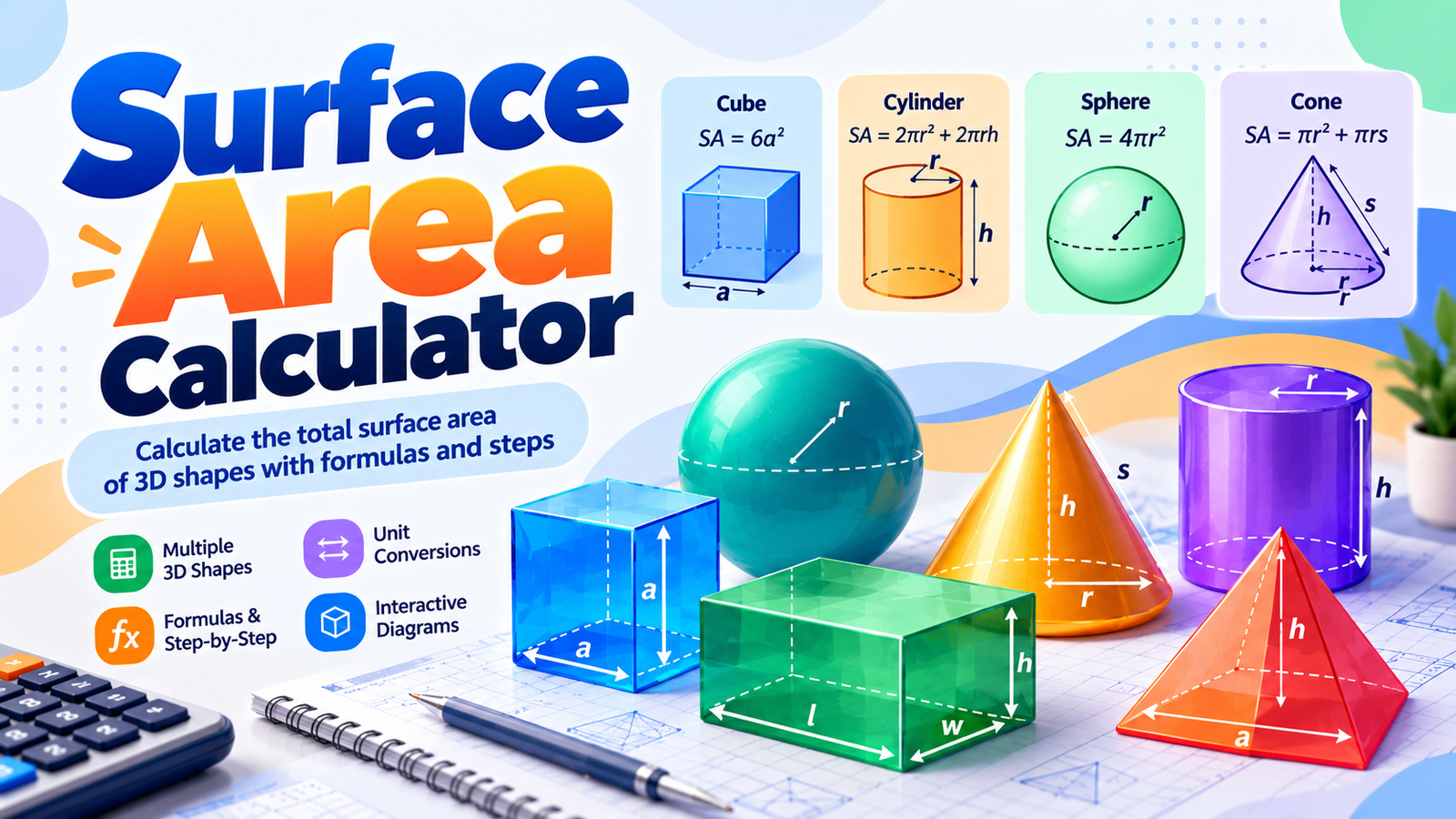
Use our Surface Area Calculator to find the total surface area of common 3D shapes quickly and accurately. Select a shape, enter its dimensions, choose a unit, and the calculator will show the total surface area, formula, component areas, calculation steps, diagram, and unit conversions.
The calculator supports common solids such as cubes, rectangular prisms, spheres, cylinders, cones, square pyramids, and triangular prisms, along with additional shapes including hemispheres, conical frustums, ellipsoids, and capsules.
How to Use the Surface Area Calculator
To calculate surface area:
- Select the 3D shape you want to calculate.
- Enter the required dimensions.
- Choose a length unit such as mm, cm, m, in, or ft.
- Click Calculate Surface Area.
- View the total surface area and calculation breakdown.
For example, for a cylinder with:
Radius = 5 cmHeight = 10 cm
the result is approximately:
471.24 cm²
The calculator also separates the curved surface from the circular bases.
What Is Surface Area?
Surface area is the total area covering the outside of a three-dimensional object.
Unlike volume, which measures the amount of space inside an object, surface area measures its exterior.
Surface area is expressed in square units, such as:
- mm²
- cm²
- m²
- in²
- ft²
For example, if dimensions are entered in centimeters, the resulting surface area is shown in square centimeters (cm²).
Surface Area Formulas
The formula depends on the shape you select.
Cube Surface Area
A cube has six identical square faces.
Formula:
SA = 6a²
Where:
- a = side length
Example:
If:
a = 4 cm
then:
SA = 6 × 4²
SA = 96 cm²
Rectangular Prism Surface Area
A rectangular prism has three pairs of equal rectangular faces.
Formula:
SA = 2(lw + lh + wh)
Where:
- l = length
- w = width
- h = height
Example:
Length = 8 cmWidth = 5 cmHeight = 3 cm
The calculator finds the area of each pair of faces and adds them together.
Sphere Surface Area
A sphere has one continuous curved surface.
Formula:
SA = 4πr²
Where:
- r = radius
For a sphere with:
r = 5 cm
the surface area is approximately:
314.16 cm²
Cylinder Surface Area
The total surface area of a cylinder includes its curved side and two circular bases.
Formula:
SA = 2πr² + 2πrh
Where:
- r = radius
- h = height
For:
r = 5 cmh = 10 cm
the calculator shows approximately:
Lateral Area: 314.16 cm²
Top + Bottom: 157.08 cm²
Total Surface Area: 471.24 cm²
Cone Surface Area
The total surface area of a cone includes its circular base and curved surface.
Formula:
SA = πr² + πrs
Where:
- r = radius
- s = slant height
If you enter the radius and vertical height, the calculator automatically finds the slant height using:
s = √(r² + h²)
You do not need to calculate it separately.
Square Pyramid Surface Area
A square pyramid consists of one square base and four triangular faces.
Formula:
SA = a² + 2as
Where:
- a = base side
- s = slant height
The calculator automatically determines the slant height from the base side and vertical height:
s = √((a ÷ 2)² + h²)
Triangular Prism Surface Area
A triangular prism has two triangular bases and three rectangular side faces.
The calculator uses:
SA = 2A + (a + b + c)L
Where:
- A = area of the triangular base
- a, b, c = triangle side lengths
- L = prism length
The triangular base area is calculated using Heron's formula.
The tool also checks whether the three entered sides can actually form a valid triangle.
For example, sides:
2, 3, and 10
cannot form a triangle, so the calculator will show an error instead of returning an incorrect result.
Hemisphere Surface Area
For a hemisphere including its circular base:
SA = 3πr²
This includes:
Curved Area = 2πr²
and:
Base Area = πr²
The calculator shows both parts separately.
Conical Frustum Surface Area
A conical frustum is formed when the top of a cone is cut off parallel to its base.
The calculator uses the top radius, bottom radius, and height to find its slant height and total surface area.
It then combines:
- Top circular area
- Bottom circular area
- Sloping lateral surface area
This makes it easier to solve frustum problems without manually calculating the slant height first.
Ellipsoid Surface Area
An ellipsoid is similar to a stretched or compressed sphere.
Unlike a sphere, a general ellipsoid does not have a simple elementary surface-area formula.
This calculator therefore uses a common approximation formula based on the three semi-axes.
The result is clearly treated as an approximate surface area rather than an exact elementary calculation.
Capsule Surface Area
A capsule consists of a cylindrical middle section with two hemispherical ends.
The calculator uses:
SA = 2πrh + 4πr²
Where:
- r = radius
- h = length of the cylindrical section
The result combines the curved cylinder area and the surface of the two hemispheres.
Total Surface Area vs Lateral Surface Area
Some 3D shapes have both total surface area and lateral or curved surface area.
For example, a cylinder has:
Lateral Surface Area
The curved side only.
and:
Total Surface Area
The curved side plus both circular bases.
The calculator automatically shows these component areas when they are useful for the selected shape.
Surface Area Unit Conversion
The calculator supports:
Millimeters (mm)Centimeters (cm)Meters (m)Inches (in)Feet (ft)
Because surface area is two-dimensional, the result uses square units.
For example:
10,000 cm² = 1 m²
The built-in conversion section automatically converts the calculated surface area into the other available square units.
This is useful when a problem gives dimensions in one unit but you need the answer in another.
Surface Area Example
Suppose you have a cylinder with:
Radius = 5 cm
Height = 10 cm
The formula is:
SA = 2πr² + 2πrh
Calculate the two circular bases:
2π(5²) ≈ 157.08 cm²
Calculate the curved surface:
2π(5)(10) ≈ 314.16 cm²
Add them:
157.08 + 314.16 = 471.24 cm²
So the total surface area is:
471.24 cm²
Why Use a Surface Area Calculator?
Surface-area calculations are useful in many practical and educational situations, including:
- Geometry homework
- Mathematics classes
- Engineering problems
- Packaging design
- Construction planning
- Painting and coating estimates
- Manufacturing
- Product design
- Material planning
- DIY projects
The calculator also displays the formula and steps, making it useful when you need to understand how the result was obtained rather than only seeing the final answer.
Frequently Asked Questions
How do you calculate surface area?
Choose the correct formula for the 3D shape, enter its dimensions, calculate the area of each outer face or curved surface, and add those areas together.
What units are used for surface area?
Surface area is measured in square units such as cm², m², in², and ft².
What is the difference between area and surface area?
Area normally describes a two-dimensional shape, while surface area describes the total exterior area of a three-dimensional object.
What is the difference between surface area and volume?
Surface area measures the outside of a 3D object. Volume measures the space inside it.
Can I calculate cylinder surface area?
Yes. Select Cylinder, enter the radius and height, and the calculator will show the lateral area, base areas, and total surface area.
Can I calculate the surface area of a sphere?
Yes. Select Sphere and enter the radius.
Can I calculate a cone without knowing the slant height?
Yes. Enter the radius and vertical height. The tool calculates the slant height automatically.
Does the calculator support triangular prisms?
Yes. Enter all three triangle side lengths and the prism length. The calculator validates the triangle and uses Heron's formula for the triangular bases.
Can dimensions contain decimals?
Yes. Positive decimal dimensions such as 2.5, 7.25, or 10.8 are supported.
Can dimensions be zero or negative?
No. Physical dimensions must be greater than zero.
Can I convert the answer to another square unit?
Yes. The calculator automatically displays equivalent surface areas in several common square units.
Is ellipsoid surface area exact?
The ellipsoid result uses a commonly used approximation because a general ellipsoid does not have a simple elementary exact surface-area formula.
Calculate Surface Area Instantly
Use the Surface Area Calculator to calculate the exterior area of common and advanced 3D shapes without manually switching between formulas.
The tool provides:
Total Surface Area
Lateral or Curved Surface Area
Base Areas
Automatic Slant Height
Shape-Specific Formulas
Step-by-Step Calculations
3D Shape Diagrams
Square Unit Conversions
and:
Adjustable Decimal Precision