
Z-Score Calculator
Use this Z-Score Calculator to calculate a standard score from a raw value, mean, and standard deviation. It shows the Z-score instantly and explains whether the value is above, below, or equal to the
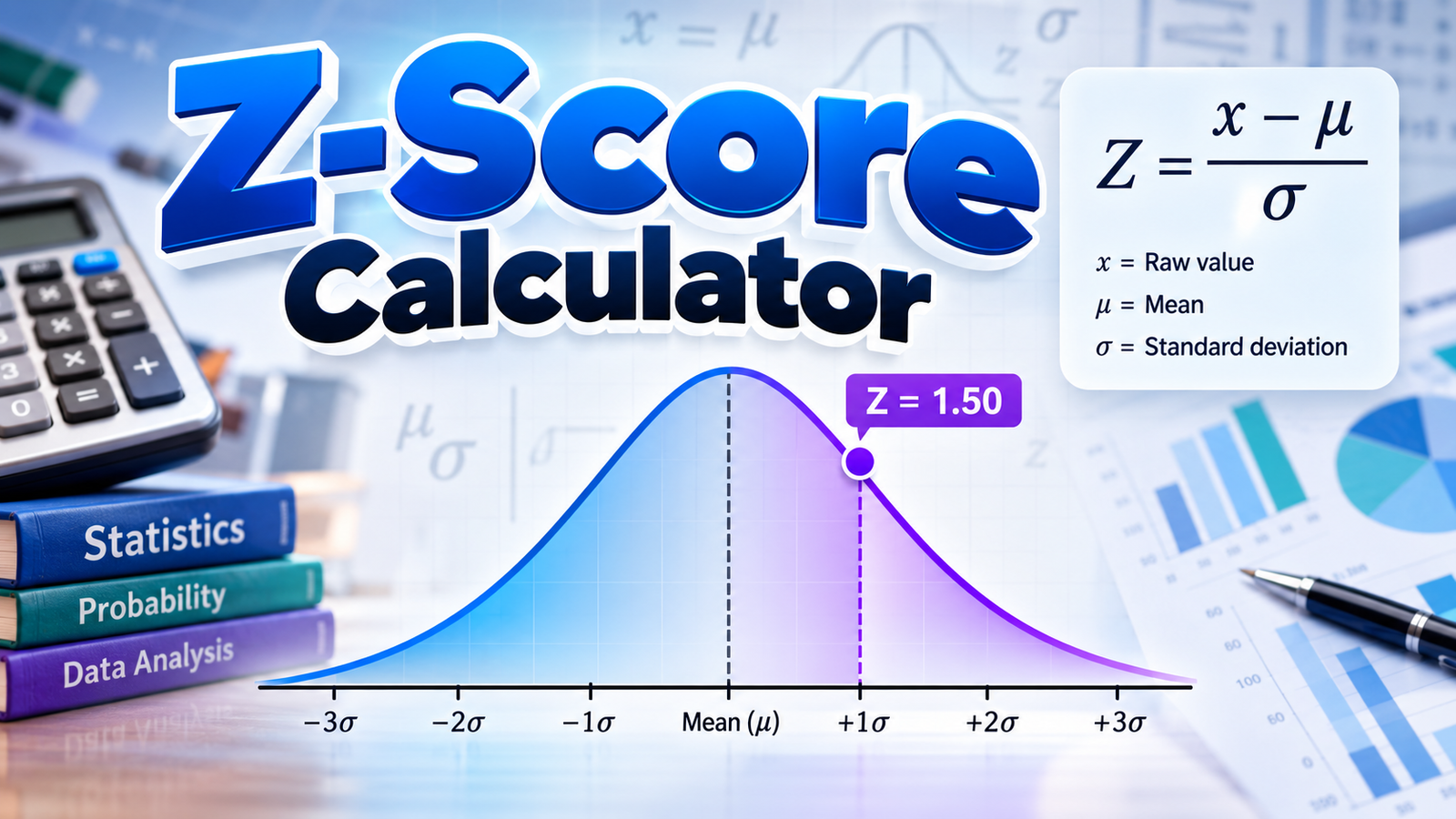
The calculator also provides a normal-distribution percentile, probability areas, calculation steps, and a visual bell curve. You can also reverse the calculation to find a raw score from a known Z-score.
What Is a Z-Score?
A Z-score, also called a standard score, tells you how far a value is from the mean in terms of standard deviations.
A Z-score can be:
- Positive: the value is above the mean.
- Negative: the value is below the mean.
- Zero: the value is equal to the mean.
For example, a Z-score of +1.50 means the value is 1.5 standard deviations above the mean.
How to Use the Z-Score Calculator
To calculate a Z-score:
- Enter the Raw Value (x).
- Enter the Mean (μ).
- Enter the Standard Deviation (σ).
- Click Calculate Z-Score.
- View the Z-score, interpretation, percentile, probability, and calculation breakdown.
For example:
Raw Value: 85Mean: 70Standard Deviation: 10
The result is:
Z = +1.500
This means 85 is 1.5 standard deviations above the mean.
Z-Score Formula
The standard Z-score formula is:
Z = (x − μ) ÷ σ
Where:
- Z = Z-score
- x = raw value
- μ = mean
- σ = standard deviation
Using the example above:
Z = (85 − 70) ÷ 10
First calculate the difference:
85 − 70 = 15
Then divide by the standard deviation:
15 ÷ 10 = 1.5
Therefore:
Z = 1.5
How to Interpret a Z-Score
A Z-score tells you the relative position of a value within a dataset.
| Z-Score | Meaning |
|---|---|
| Z = 0 | Exactly at the mean |
| Z > 0 | Above the mean |
| Z < 0 | Below the mean |
| Z = +1 | 1 standard deviation above the mean |
| Z = -1 | 1 standard deviation below the mean |
| Z = +2 | 2 standard deviations above the mean |
| Z = -2 | 2 standard deviations below the mean |
A Z-score does not tell you whether a result is inherently “good” or “bad.” It simply describes how far the value is from the mean.
Z-Score Percentile Calculator
This tool also estimates the percentile corresponding to a Z-score under a standard normal distribution.
For example:
Z = 1.50
corresponds to approximately:
93.32%
This means about 93.32% of the standard normal distribution lies below a Z-score of 1.50.
The calculator also shows:
- Probability below Z
- Probability above Z
- Probability between the mean and Z
These probability results assume a standard normal distribution.
Normal Distribution Visualization
The built-in bell curve helps you understand where your Z-score lies relative to the mean.
The chart displays:
- The mean at the center
- Standard-deviation positions
- Your current Z-score
- The area below the Z-score
A positive Z-score appears to the right of the mean, while a negative Z-score appears to the left.
Raw Score to Z-Score
The default mode converts a raw score into a Z-score.
Example:
Raw Score: 60Mean: 70Standard Deviation: 10
Calculation:
Z = (60 − 70) ÷ 10
Z = −1
So the raw value is 1 standard deviation below the mean.
Z-Score to Raw Score
You can also switch to Z-Score → Raw Score mode.
The reverse formula is:
x = μ + (Z × σ)
For example:
Z-Score: 1.5Mean: 70Standard Deviation: 10
Calculation:
x = 70 + (1.5 × 10)
x = 85
So a Z-score of 1.5 corresponds to a raw score of 85.
Why Are Z-Scores Useful?
Z-scores are commonly used in statistics because they put different values onto a standardized scale.
They can help with:
- Comparing test scores
- Analyzing research data
- Understanding distributions
- Finding relative position
- Identifying unusually high or low values
- Converting values to percentiles under a normal model
- Comparing observations measured on different scales
Example Z-Score Calculations
Example 1: Above the Mean
Raw value: 85Mean: 70Standard deviation: 10
Z = 1.50
The value is 1.5 standard deviations above the mean.
Example 2: Below the Mean
Raw value: 60Mean: 70Standard deviation: 10
Z = −1.00
The value is 1 standard deviation below the mean.
Example 3: Equal to the Mean
Raw value: 70Mean: 70Standard deviation: 10
Z = 0
The value is exactly at the mean.
Can a Z-Score Be Negative?
Yes.
A negative Z-score simply means the raw value is below the mean.
For example:
Z = −1.25
means the value is 1.25 standard deviations below the mean.
Can a Z-Score Be Greater Than 3?
Yes.
Z-scores are not limited to the range from −3 to +3.
For example, a Z-score of:
+3.5
means the value is 3.5 standard deviations above the mean.
Very large positive or negative Z-scores indicate values far from the mean.
Why Must Standard Deviation Be Greater Than Zero?
The Z-score formula divides by the standard deviation.
If:
σ = 0
the calculation would require division by zero, so a valid Z-score cannot be calculated using this formula.
That is why the calculator requires the standard deviation to be greater than zero.
Frequently Asked Questions
What does a Z-score of 0 mean?
A Z-score of 0 means the raw value is exactly equal to the mean.
What does a Z-score of 1 mean?
A Z-score of +1 means the value is one standard deviation above the mean.
What does a Z-score of -1 mean?
A Z-score of −1 means the value is one standard deviation below the mean.
Is Z-score the same as standard score?
Yes. A Z-score is commonly called a standard score.
Can I calculate a Z-score with decimal values?
Yes. The calculator accepts decimal raw values, means, and standard deviations.
Can the mean be negative?
Yes. The mean and raw value can both be negative.
Can standard deviation be negative?
No. Standard deviation must be greater than zero.
How do I find a raw score from a Z-score?
Use the Z-Score → Raw Score mode and enter the Z-score, mean, and standard deviation.
Does a Z-score require normally distributed data?
No. The basic Z-score calculation only standardizes a value relative to a mean and standard deviation. However, the percentile and probability results shown by this calculator assume a standard normal distribution.
What is the percentile for a Z-score of 1.5?
Under a standard normal distribution, a Z-score of 1.5 corresponds to approximately the 93.32nd percentile.
Calculate Your Z-Score Instantly
Use the Z-Score Calculator to quickly convert a raw score into a standard score and understand its position relative to the mean.
The tool provides:
Z-score calculation
Raw score conversion
Percentile estimate
Probability above and below Z
Normal-distribution visualization
Step-by-step calculation
Adjustable result precision
and a clear explanation of what your result means.