
100 Days Ago
Find out the exact date and time 100 days ago, live-updating — plus a general calculator for any number of minutes, hours, days, weeks, months, or years.
100 Days Ago
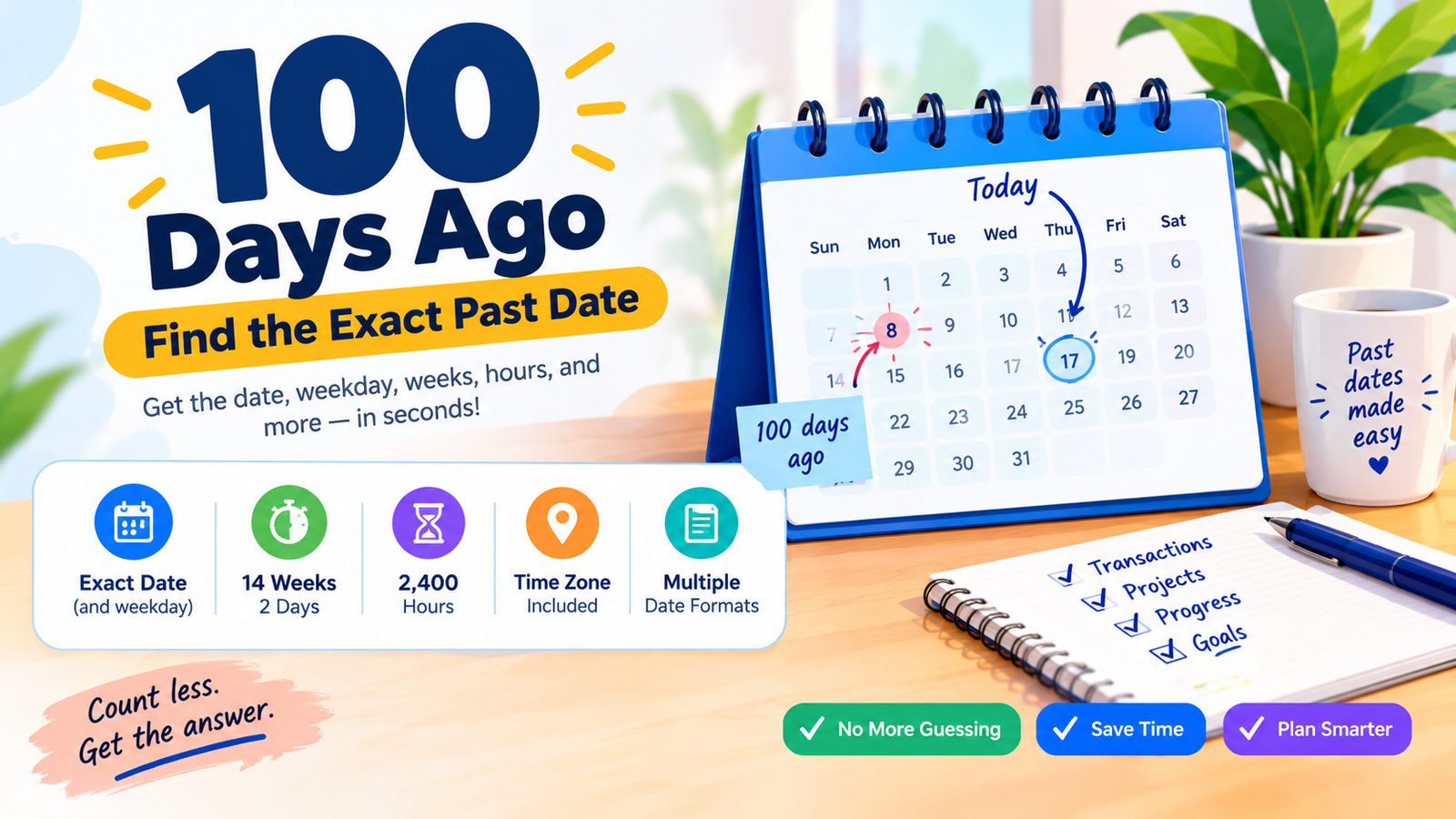
Trying to work out what date was 100 days ago? Instead of counting backward through several months, this calculator gives you the answer instantly.
It shows the exact date, weekday, equivalent weeks, hours, elapsed time, time zone, and multiple date formats.
A 100-day lookback is especially useful when checking old transactions, project milestones, fitness progress, account activity, subscription history, or any event that happened a few months ago.
What Does 100 Days Ago Mean?
It simply means moving back exactly 100 calendar days from today or from another date you choose.
The basic calculation is:
Reference Date − 100 Days = Date 100 Days Ago
Because the tool works with calendar days, it automatically moves through shorter and longer months and handles year changes for you.
100 Days Is Longer Than It Sounds
One hundred days is not just “about three months.”
It is actually:
14 weeks and 2 days
That is a useful mental shortcut because 14 full weeks account for 98 days, leaving two additional days.
So if you want a rough sense of how far back 100 days goes, think:
14 weeks back, then another 2 days
A Quick Weekday Trick
Since 98 days is exactly 14 weeks, it lands on the same weekday.
The remaining two days move the date two weekdays backward.
So if your reference day is Friday, 100 days earlier falls on Wednesday.
If the reference day is Monday, the result falls on Saturday.
This is a simple way to sanity-check the calculator result.
Why You Should Not Just Count Back Three Months
It is tempting to think:
100 days ago = roughly 3 months ago
But that can give you the wrong date.
Months are not equal in length. Some have 31 days, others have 30, and February has 28 or 29.
That means “three months ago” and “100 days ago” are two different calculations.
If a deadline, record, or report specifically says 100 days, always use the exact day count.
Real Example: Finding an Old Payment
Imagine you are looking through your payment history and remember that a transaction happened around 100 days ago.
Instead of scrolling through months of records, you can use the calculator to get the exact date first.
Then you know exactly where to look.
This can save time when checking:
bank transactions, online orders, client payments, invoices, refunds, or subscription charges.
Real Example: Comparing Progress
A 100-day lookback is also a strong progress checkpoint.
For example, you could compare where you are today with where you were 100 days earlier.
That works well for:
website traffic, SEO rankings, revenue, fitness progress, study results, savings, content output, or personal goals.
One hundred days is long enough for real changes to become visible.
Why 100 Days Is a Useful Milestone
A 100-day period feels meaningful because it is long enough to build momentum.
That is why people often use 100 days for:
habit challenges, learning goals, fitness routines, business reviews, productivity experiments, and personal projects.
Looking back 100 days can help answer a useful question:
What has actually changed since then?
Can 100 Days Ago Be in the Previous Year?
Yes.
If the reference date is early enough in the year, moving back 100 days can take you into the previous year.
For example, dates in January, February, or March can easily produce a result from the prior calendar year.
The calculator handles that rollover automatically.
How Much Time Is 100 Days?
Here is the same time period in different units:
100 days = 14 weeks and 2 days100 days = 2,400 hours100 days = 144,000 minutes100 days = 8,640,000 seconds
For most people, 14 weeks and 2 days is the easiest version to visualize.
100 Days Ago vs 90 Days Ago
These two date ranges are close, but not interchangeable.
90 days ago is 10 days more recent than 100 days ago.
That difference is large enough to move the date into another week or even another month.
If you are checking records or deadlines, those 10 days can matter.
100 Days Ago vs 14 Weeks Ago
Fourteen weeks equals:
14 × 7 = 98 days
So 100 days ago is two days earlier than 14 weeks ago.
That is another useful way to double-check the result.
Calendar Days or Business Days?
This calculator works with calendar days.
That means every day counts, including Saturdays, Sundays, and holidays.
If someone says “100 business days,” that is a completely different calculation because weekends are usually excluded.
A 100-business-day period can stretch much farther back than 100 calendar days.
When Is This Calculator Useful?
You might use the 100 Days Ago calculator when checking:
old payments, orders, emails, analytics, customer records, project milestones, subscriptions, fitness progress, application history, appointments, or personal challenges.
It is especially helpful when you remember the number of days but not the actual date.
How to Use the 100 Days Ago Calculator
The calculator uses today as the reference date by default.
It then subtracts exactly 100 calendar days and shows the result immediately.
If you want to calculate from another point in time, simply choose a different reference date.
The tool will update the past date, weekday, elapsed time, time zone, and date formats automatically.
Frequently Asked Questions
How far back is 100 days?
One hundred days is 14 weeks and 2 days.
Is 100 days roughly three months?
It is in that general range, but it is not the same as exactly three calendar months.
How many hours are in 100 days?
One hundred days contains 2,400 hours.
What weekday was 100 days ago?
It falls two weekdays earlier than the reference weekday.
Are weekends included?
Yes. This calculator counts calendar days, including weekends.
Can 100 days ago fall in a different year?
Yes. If the reference date is early enough in the year, the result can be in the previous year.
Can I calculate 100 days before a custom date?
Yes. Change the reference date and the result will update automatically.
Quick Takeaway
100 days ago means exactly 14 weeks and 2 days before your reference date.
It is a useful date range for checking old records, reviewing progress, finding transactions, comparing performance, or looking back at a meaningful 100-day milestone.