
21 Months From Today
Find out the exact date and time 21 months from today, live-updating — plus a general calculator for any number of minutes, hours, days, weeks, months, or years.
21 Months From Today Calculator
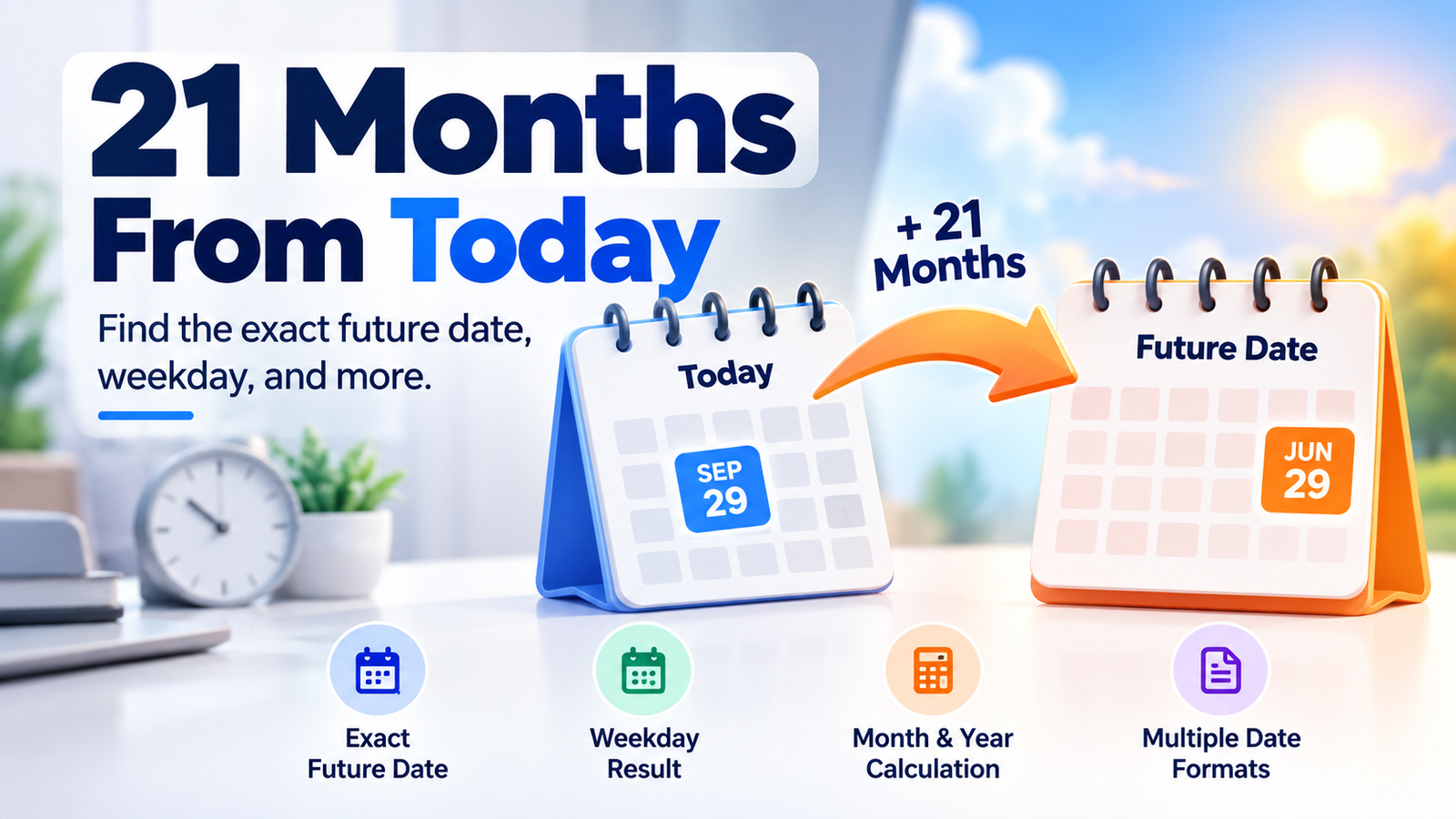
Want to know what date is 21 months from today? The calculator above automatically adds 21 calendar months to your current local date and shows the exact future date.
It also displays the weekday, exact number of days between the dates, destination calendar, countdown, year change, and useful date formats.
You do not need to manually count through months on a calendar.
What Date Is 21 Months From Today?
The exact result depends on today's date.
The calculator uses:
Today's Date + 21 Calendar Months = Future Date
Because:
21 months = 1 year and 9 months
the result is more than a year in the future.
The calculator uses real calendar months instead of assuming every month has the same number of days.
How Does the 21 Months From Today Calculator Work?
The tool starts with your selected date and adds exactly 21 calendar months.
For example, the calculation follows this idea:
Starting Month + 21 Months = Target Month
The day of the month is preserved whenever possible.
So if the starting date is the 15th of a month, the result will normally also fall on the 15th of the target month.
The calculator automatically handles changes in:
- Month length
- Year
- Leap years
- February
- End-of-month dates
Is 21 Months the Same as 630 Days?
No.
A common estimate is:
21 × 30 = 630 days
but calendar months do not all contain 30 days.
Months may contain:
28, 29, 30, or 31 days
Therefore, 21 months from today is not a fixed number of days.
The exact number of elapsed days depends on the starting date and the months crossed by the calculation.
That is why the tool calculates calendar months first and then shows the exact day difference separately.
How Long Is 21 Months?
Twenty-one calendar months equals:
1 year and 9 months
This conversion is exact in calendar-month terms.
However, the equivalent number of days varies because month lengths are different.
For date planning, using 1 year 9 months or 21 calendar months is more accurate than estimating with a fixed day total.
Why Calendar Months Matter
A month-based date calculation should follow the calendar.
For example, adding one month to January does not mean simply adding 30 days.
January contains 31 days, while February normally contains 28 days and sometimes 29.
The same issue appears across a 21-month period.
The calculator therefore moves through actual calendar months rather than using an approximate number of days.
What Happens With Dates Near the End of a Month?
Month-end dates need special handling.
Suppose a starting date falls on the:
29th, 30th, or 31st
but the destination month does not contain that day.
The calculator uses the last valid day of the target month.
For example, if a calculation would otherwise produce February 31, the date is adjusted to the final valid day of February.
This prevents invalid dates and keeps the result consistent with calendar arithmetic.
Does the Calculator Handle Leap Years?
Yes.
Leap years are handled automatically.
If the 21-month period includes February in a leap year, the calculator recognizes February 29 where appropriate.
If the selected day does not exist in the target month, the result is adjusted to the last valid date of that month.
You do not need to make any manual leap-year corrections.
Calculate 21 Months From Any Date
The calculator is not limited to today.
Choose any starting date to calculate exactly 21 months later.
This can be useful for:
- Project deadlines
- Contract renewals
- Subscription periods
- Warranty dates
- Academic schedules
- Travel planning
- Business timelines
- Event planning
- Personal milestones
- Long-term financial planning
The result updates automatically after you change the starting date.
Calculate Months Ago
You can also change the direction from From Today to Ago.
The calculation then becomes:
Starting Date − Number of Calendar Months = Past Date
For example:
21 Months Ago
uses the same calendar-month rules but works backward.
The result date, weekday, exact day difference, calendar, countdown, and details should all update automatically.
Exact Number of Days Between the Dates
Although 21 months is a fixed calendar interval, the exact number of days is not fixed.
The tool calculates the real day difference between:
Starting Date
and:
Result Date
This gives you a more useful answer when you need both:
21 calendar months
and:
the exact elapsed number of days
for planning or record keeping.
What Day of the Week Will It Be?
The tool displays the weekday of the calculated result.
Unlike whole-week calculations, adding 21 months does not guarantee the same weekday.
That is because calendar months contain different numbers of days.
The details section can therefore show:
Starting Weekday → Result Weekday
so you can verify the change easily.
Does 21 Months From Today Cross Into Another Year?
Yes.
Since 21 months equals 1 year and 9 months, the result will move into a later calendar year.
The tool shows the year relationship automatically, such as:
Starting Year → Result Year
This can be especially useful when planning contracts, long-term projects, renewals, or future milestones.
Live Countdown to the Result Date
The calculator can also show how much time remains until the future date.
A useful countdown can display:
Years | Months | Days | Hours | Minutes | Seconds
The calculated result date remains fixed while the countdown changes as time passes.
If you switch the direction and calculate a past date, the section can display:
Time Since Result Date
instead.
Result Calendar
The calendar view shows the month containing the calculated date.
The result date is highlighted so you can quickly see:
- The exact result day
- Its weekday
- Nearby dates
- Its position in the destination month
You can browse previous and next months without changing the main calculation.
Useful Date Formats
The result can be displayed in several common formats.
Long DateMonth D, YYYY
Day FirstD Month YYYY
NumericMM/DD/YYYY
ISOYYYY-MM-DD
The date-format examples are illustrative; the tool generates the actual date dynamically.
Each format can be copied directly.
When Is a 21 Months From Today Calculator Useful?
A 21-month date calculator is useful whenever a schedule is defined in months rather than a fixed number of days.
Common uses include contract periods, subscriptions, warranties, project planning, educational timelines, payment schedules, travel planning, business milestones, and personal events.
Using real calendar months helps avoid errors that can happen when you approximate the period as 630 days.
Related Month Calculators
You can also use these related SkillsElevate tools:
Frequently Asked Questions
What date is 21 months from today?
The exact date depends on today's local date. The calculator automatically adds 21 calendar months and displays the future result.
How long is 21 months?
21 months equals 1 year and 9 months.
Is 21 months exactly 630 days?
No. Calendar months contain different numbers of days, so the exact day total varies depending on the starting date.
Does the same day of the month stay the same?
Usually yes. The calculator preserves the same day whenever it exists in the target month.
What happens if the target month does not have the same day?
The calculator uses the last valid day of the target month. This commonly matters for dates near the 29th, 30th, or 31st.
Can I calculate 21 months from another date?
Yes. Select any starting date in the custom month calculator.
Can I calculate 21 months ago?
Yes. Change the direction to Ago and the calculator will subtract 21 calendar months.
Does the calculator handle leap years?
Yes. Leap years and February 29 are handled automatically.
Will the weekday be the same 21 months from today?
Not necessarily. Calendar months have varying lengths, so the weekday can change.
Can 21 months cross more than one calendar year?
Yes. Since 21 months equals 1 year and 9 months, the calculation extends beyond one full year.
Why shouldn't I just add 630 days?
Because 630 days assumes every month is 30 days long. A calendar-month calculation follows the actual lengths of the months involved.
Does the result calendar update when I choose another date?
Yes. The calendar should automatically move to the month containing the newly calculated result.