
Calculate Your Monthly Lease Payment and Total Cost
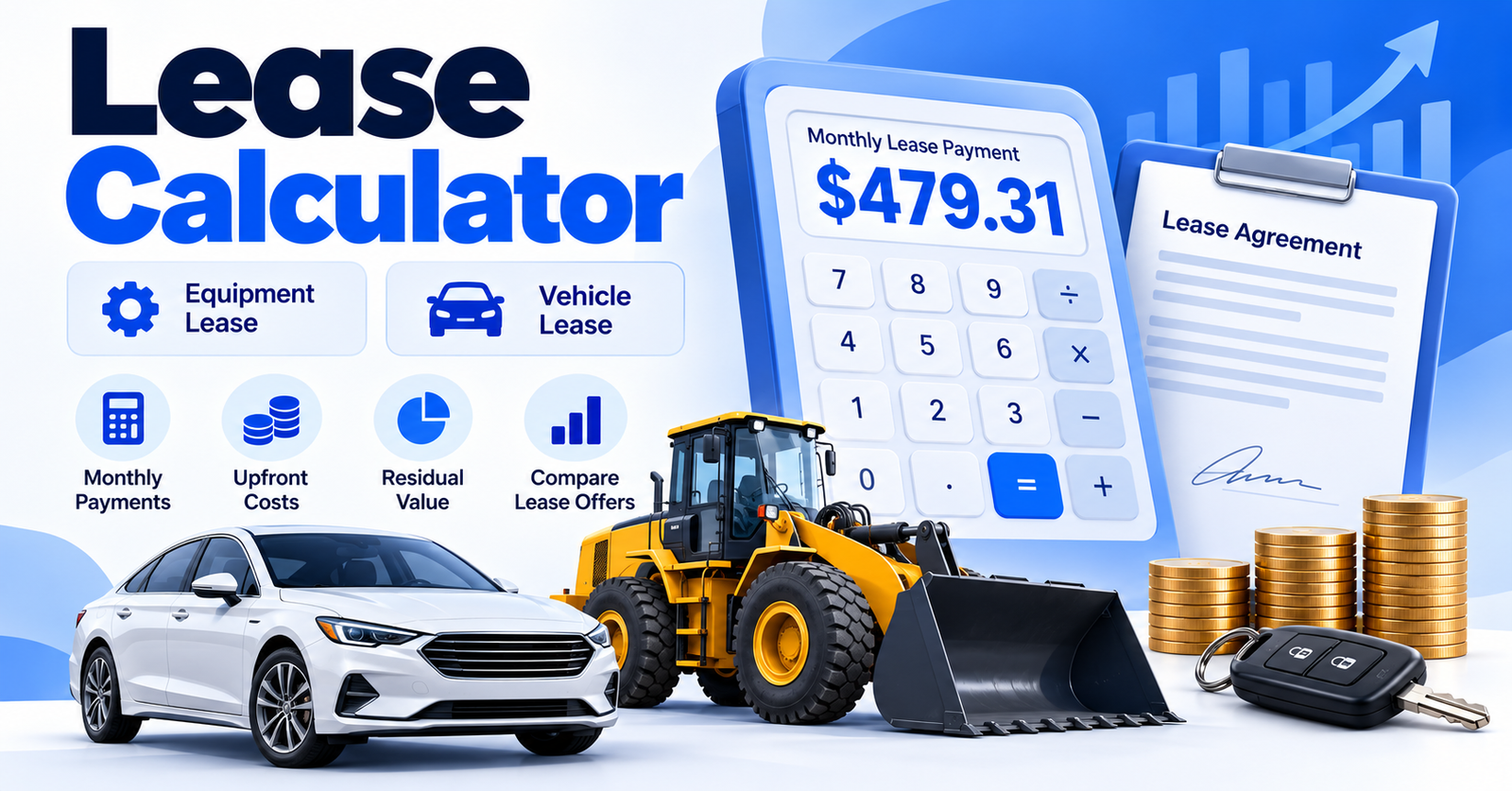
Use the Lease Calculator above to estimate your monthly payments, upfront costs, and total lease expenses for equipment or vehicle leasing.
How to Use the Lease Calculator
Our free Lease Calculator helps you estimate the cost of leasing equipment, machinery, vehicles, and other eligible assets. It calculates monthly payments, financing charges, residual values, and optional end-of-lease purchase costs.
The calculator includes two modes: Asset & Equipment Lease and Vehicle Lease.
Asset & Equipment Lease Calculator
Use this mode to estimate lease payments for equipment or other assets based on their value, residual amount, lease term, and financing rate.
Step 1: Enter the Asset Value
Enter the purchase or financed value of the equipment.
For example, enter $50,000 for a machine or piece of business equipment.
Step 2: Enter the Residual Value
Enter the estimated or contractual value remaining at the end of the lease.
For example, a $15,000 residual means that amount remains as the modeled end value.
Step 3: Choose the Lease Term
Enter the lease duration in months or years.
For example, choose 36 months for a three-year lease.
Step 4: Enter the Annual Financing Rate
Enter the nominal annual financing rate, such as 7%.
If you already have a monthly lease quote, choose Quoted Monthly Payment to estimate the implied financing rate instead.
Step 5: Calculate Your Lease
Click Calculate Lease to view the monthly payment, total installments, financing cost, amount due at signing, and optional buyout cost.
Vehicle Lease Calculator
Select Vehicle Lease to estimate the monthly payment for a car or another vehicle.
Enter the vehicle MSRP, negotiated selling price, residual value, lease term, money factor, cash down payment, and applicable monthly sales tax assumption.
The calculator then estimates the vehicle's monthly depreciation, rent charge, taxes, signing costs, and total lease expenses.
Advanced settings let you include trade-in equity, incentives, acquisition fees, other upfront charges, and a refundable security deposit.
What Is a Lease Calculator?
A Lease Calculator is a financial tool that estimates the payments and expenses associated with leasing an asset for a specified period.
Rather than paying the full purchase price upfront, a lessee generally makes scheduled payments for the right to use an asset under a lease agreement.
The amount paid depends on the lease structure and factors such as asset value, financing charges, residual value, lease duration, fees, and taxes.
Common uses include calculating payments for:
- Business equipment and machinery
- Commercial vehicles and company fleets
- Cars, SUVs, and trucks
- Office and technology equipment
- Other eligible depreciating assets
A lease calculator helps you understand the estimated financial commitment before accepting a leasing proposal.
Important: This tool calculates asset and vehicle lease payments. It is not designed for apartment rent, commercial real estate rent escalations, or ASC 842 lease-accounting measurements.
Understanding Your Lease Calculator Results
The calculator provides several results that explain the estimated cost of your selected lease.
| Result | What It Means |
|---|---|
| Monthly Lease Payment | Estimated amount due per scheduled monthly installment |
| Due at Signing | Cash required upfront under the selected assumptions |
| Total Scheduled Payments | Combined value of all regular lease installments |
| Net Lease Cash Outlay | Scheduled installments plus nonrefundable upfront cash charges |
| Financing / Rent Charges | Estimated cost attributed to financing or rent charges |
| Residual / Optional Buyout | Contractual or estimated lease-end value |
| Total With Optional Buyout | Lease cash outlay plus the assumed purchase price at lease-end |
| Lease Term | Number of scheduled lease payments |
Monthly Lease Payment
This is the primary result of the calculator.
For equipment leases, the payment is estimated using a discounted-residual financing formula.
For vehicle leases, the payment combines depreciation, a money-factor rent charge, and the selected monthly-payment tax assumption.
Due at Signing
This represents the initial cash required when the lease begins.
Depending on the selected lease mode, it may include a down payment, advance monthly installment, upfront fees, and refundable security deposit.
Total Scheduled Payments
This is the sum of all regular lease installments.
For example, a monthly payment of approximately $500 over 36 months produces approximately $18,000 in scheduled payments.
Net Lease Cash Outlay
The calculator adds scheduled lease installments and applicable nonrefundable upfront cash payments.
Refundable security deposits are excluded from net cost on the assumption that they will be returned in full.
Optional Buyout Cost
If the lease includes a purchase option, the calculator can estimate the additional cost of buying the asset at the end.
This amount is not automatically included in ordinary lease installments.
Equipment Lease Calculator Example
Suppose a small business wants to lease equipment worth $50,000.
The leasing terms are:
| Equipment Lease Detail | Value |
|---|---|
| Asset Value | $50,000 |
| Residual Value | $15,000 |
| Lease Term | 36 months |
| Nominal Annual Financing Rate | 7.00% |
| Upfront Capital Reduction | $0 |
| Additional Upfront Fees | $0 |
| Payment Timing | End of month |
Using the calculator's discounted-residual financing method:
| Calculation Result | Amount |
|---|---|
| Estimated Monthly Payment | $1,168.20 |
| Total Scheduled Payments | $42,055.14 |
| Amount Due at Signing | $0.00 |
| Optional Residual Buyout | $15,000.00 |
| Total Cost With Buyout | $57,055.14 |
| Financing Cost Including Buyout | $7,055.14 |
In this example, the business would make 36 monthly lease payments of approximately $1,168.20.
If the business exercised the assumed $15,000 purchase option at lease-end, the total modeled cost would be approximately $57,055.14.
The difference between that amount and the original $50,000 asset value represents approximately $7,055.14 in modeled financing cost.
These calculations exclude taxes, additional fees, and contract-specific charges.
How Is an Equipment Lease Payment Calculated?
The equipment lease mode uses a financing model in which regular payments recover part of the financed asset value while leaving a residual amount at the end of the lease.
For end-of-month installments, the payment formula is:
[M=\frac{P-\frac{R}{(1+r)^n}}{\frac{1-(1+r)^{-n}}{r}}]
Where:
| Symbol | Meaning |
|---|---|
| M | Monthly lease payment |
| P | Financed asset value |
| R | Residual value |
| r | Monthly financing rate |
| n | Total number of monthly payments |
The monthly financing rate is calculated as:
Monthly Rate = Nominal Annual Rate ÷ 12
For a 7% nominal annual rate:
7% ÷ 12 = approximately 0.5833% per month
The formula calculates a level monthly installment based on the financed amount, residual value, interest rate, and term.
What Happens at 0% Financing?
When the entered financing rate is 0%, the calculation becomes:
Monthly Payment = (Financed Asset Value − Residual Value) ÷ Lease Term
For example:
($50,000 − $15,000) ÷ 36 = $972.22 per month
This simplified calculation assumes no financing charge.
Beginning vs. End-of-Month Payments
The equipment calculator also supports two payment timings.
End of Month: Payments occur after each monthly financing period.
Beginning of Month: Payments are made at the start of each period, using an annuity-due calculation.
For otherwise identical terms, paying at the beginning of the month generally produces a lower calculated installment because payments occur earlier.
What Is Residual Value in a Lease?
Residual value is the estimated or contractual value of an asset at the end of its lease term.
It is an important factor in both equipment and vehicle lease calculations.
For example:
Original Asset Value: $50,000
Residual Value: $15,000
The modeled asset value recovered through depreciation or capital recovery over the lease term is based on the difference between these amounts, with financing charges added as applicable.
How Residual Value Affects Monthly Payments
A higher residual value generally reduces the portion of the asset value that must be recovered through scheduled payments.
However, a higher residual may also mean a larger purchase-option amount if you decide to buy the asset at lease-end.
A lower monthly payment is therefore not automatically the best overall deal.
Residual Value vs. Buyout Price
These amounts can be related but are not always identical.
Residual value is the lease-end amount used in the calculation.
The actual purchase-option price depends on the lease agreement and may include additional fees or taxes.
Our calculator uses the entered residual amount as the assumed optional buyout for estimation purposes.
Car Lease Calculator Example
Suppose you are considering leasing a vehicle with the following details:
| Vehicle Lease Detail | Value |
|---|---|
| Vehicle MSRP | $42,000 |
| Negotiated Selling Price | $39,000 |
| Lease Term | 36 months |
| Residual Value | 60% of MSRP |
| Money Factor | 0.00200 |
| Cash Down Payment | $2,000 |
| Monthly Payment Sales Tax | 6% |
| Additional Fees | $0 |
The residual value is:
$42,000 × 60% = $25,200
The adjusted capitalized cost is:
$39,000 − $2,000 = $37,000
Using these values, the calculator estimates:
| Result | Amount |
|---|---|
| Monthly Depreciation | $327.78 |
| Monthly Rent Charge | $124.40 |
| Monthly Tax | $27.13 |
| Monthly Lease Payment | $479.31 |
| Total Scheduled Payments | $17,255.10 |
| Due at Signing | $2,479.31 |
| Net Lease Cash Outlay | $19,255.10 |
| Optional Residual Buyout | $25,200.00 |
| Total With Optional Buyout | $44,455.10 |
The example assumes that 6% sales tax is charged on the monthly base payment.
The $2,479.31 due at signing includes the $2,000 down payment and the first monthly installment.
That first installment is already included in the 36 scheduled payments and is not counted twice.
How to Calculate a Car Lease Payment
Vehicle lease payments are commonly estimated using two main components: depreciation and a rent charge.
Our vehicle lease mode uses the following formulas.
Step 1: Calculate Adjusted Capitalized Cost
Adjusted capitalized cost is the amount used as the starting vehicle cost in the lease calculation.
Adjusted Cap Cost = Negotiated Price − Down Payment − Trade-In Equity − Incentives + Financed Acquisition Fee
For the example:
$39,000 − $2,000 = $37,000
Step 2: Calculate Monthly Depreciation
[\text{Monthly Depreciation}=\frac{C-R}{n}]
Where C is adjusted capitalized cost, R is residual value, and n is the number of months.
($37,000 − $25,200) ÷ 36 = $327.78
Step 3: Calculate Monthly Rent Charge
[\text{Rent Charge}=(C+R)\times MF]
Where MF is the money factor.
($37,000 + $25,200) × 0.00200 = $124.40
Step 4: Add Monthly Sales Tax
First calculate the base payment:
$327.78 + $124.40 = approximately $452.18
Then apply the example 6% monthly-payment tax:
$452.18 × 1.06 = approximately $479.31
The final estimated monthly vehicle lease payment is $479.31.
The calculator retains full precision internally and rounds the results for display.
What Is a Money Factor in a Car Lease?
The money factor is a number commonly used to calculate the financing or rent-charge component of a vehicle lease.
It is typically presented as a small decimal, such as:
0.00150 · 0.00200 · 0.00250
A higher money factor generally increases the rent-charge portion of the lease payment when other terms remain constant.
Money Factor to Approximate APR Equivalent
A commonly used leasing convention is:
Approximate APR-Equivalent (%) = Money Factor × 2,400
For example:
0.00200 × 2,400 = 4.80%
This is an approximate comparison convention.
It is not necessarily the vehicle lease's legally disclosed APR, effective annual interest rate, or complete financing cost.
Our calculator allows you to enter either a money factor or an approximate APR-equivalent percentage and automatically converts between them.
How Does a Down Payment Affect a Lease?
A cash down payment generally reduces the amount included in the vehicle's adjusted capitalized cost.
This can reduce the estimated monthly lease payment.
For example, suppose a vehicle has a negotiated selling price of $39,000.
| Cash Down Payment | Starting Adjusted Cost Before Other Credits |
|---|---|
| $0 | $39,000 |
| $1,000 | $38,000 |
| $2,000 | $37,000 |
| $3,000 | $36,000 |
Other inputs, such as residual value, money factor, incentives, and financed fees, also affect the final payment.
Is a Larger Down Payment Always Better?
Not necessarily.
A larger down payment may lower the monthly bill but increases the amount of cash committed upfront.
When comparing vehicle leases, review the total cost over the entire agreement rather than focusing on the monthly payment alone.
Also check what happens to any upfront capital reduction if the leased vehicle is totaled or stolen.
What Is Due at Signing on a Lease?
The amount due at signing is the cash required to begin the lease under the chosen terms.
Depending on the lease agreement, it may include:
- Down payment or capitalized cost reduction
- First monthly installment
- Acquisition fee
- Registration or administrative charges
- Applicable upfront taxes
- Refundable security deposit
For example, if a vehicle requires a $2,000 down payment and the first $479.31 installment at signing, the modeled amount due is:
$2,000 + $479.31 = $2,479.31
Additional taxes or fees can increase this figure.
The calculator distinguishes the upfront amount from the total lease cost, so the first payment is not double-counted.
Understanding Lease Acquisition Fees and Security Deposits
Acquisition Fee
An acquisition fee is a charge that may be assessed to initiate a vehicle lease.
The calculator offers two treatments:
Paid Upfront: The fee increases the amount due at signing.
Financed: The fee is added to the adjusted capitalized cost and affects scheduled payments.
The fee should not be counted both upfront and as a financed amount.
Refundable Security Deposit
A refundable deposit is money held under the lease's security terms.
The calculator includes the deposit in the cash due at signing but excludes it from the net lease cost under the assumption that the entire deposit will be returned.
Actual refunds can depend on contract terms and deductions.
Other Upfront Fees
Registration charges, administrative fees, and applicable upfront taxes can be entered under advanced settings.
The calculator does not automatically determine local or state-specific taxes.
How Lease Term Affects Monthly Payments
Lease duration can affect both monthly affordability and overall cost.
A longer term generally spreads the amount being recovered over more installments, although financing charges and actual contract terms also matter.
Consider the equipment example with a $50,000 asset, a $15,000 residual, and a 7% nominal annual financing rate.
| Lease Term | Monthly Payment | Total Scheduled Payments | Total With Buyout |
|---|---|---|---|
| 24 months | $1,654.54 | $39,708.97 | $54,708.97 |
| 36 months | $1,168.20 | $42,055.14 | $57,055.14 |
| 48 months | $925.62 | $44,429.69 | $59,429.69 |
| 60 months | $780.54 | $46,832.52 | $61,832.52 |
These examples hold the asset value, residual value, and financing rate constant.
In this scenario, extending the lease lowers the monthly installment but increases the total modeled financing cost.
The calculator's Compare Lease Terms section provides similar estimates for both equipment and vehicle modes.
Actual residual values and financing terms may change when a different lease duration is selected.
How to Compare Two Lease Offers
Our Compare Lease Offers feature helps you evaluate two leasing proposals without rebuilding the calculation.
Offer A uses the values from your main calculator.
Offer B allows you to enter an alternative set of lease terms.
Equipment Lease Offer Comparison Example
Suppose two providers offer financing for the same $50,000 equipment.
| Lease Detail | Offer A | Offer B |
|---|---|---|
| Asset Value | $50,000 | $50,000 |
| Annual Financing Rate | 7.00% | 6.25% |
| Residual Value | $15,000 | $12,000 |
| Lease Term | 36 months | 36 months |
| Monthly Payment | $1,168.20 | $1,222.84 |
| Total With Buyout | $57,055.14 | $56,022.35 |
Offer A offers a lower monthly payment.
However, Offer B has a lower modeled total cost if the asset is purchased at the end.
This illustrates why comparing only monthly installments can be misleading.
What Should You Compare?
Pay attention to the monthly payment, amount due at signing, total scheduled installments, residual value, optional buyout costs, and contract restrictions.
For vehicle leases, compare mileage limits and tax treatment as well.
Tip: Compare offers using similar assumptions wherever possible. A lease with a different term, residual, or included service package may not be directly comparable.
Can You Calculate the Interest Rate From a Lease Payment?
Yes, in Asset & Equipment Lease mode.
If you already have a monthly payment quote, the calculator can estimate the nominal annual financing rate implied by that quote.
For example:
| Detail | Value |
|---|---|
| Financed Asset Value | $50,000 |
| Residual Value | $15,000 |
| Lease Term | 36 months |
| Quoted Monthly Payment | $1,200 |
Under the end-of-month discounted-residual model, the implied nominal annual financing rate is approximately 8.11%.
This feature is useful for reviewing equipment lease quotes that provide a payment amount without clearly explaining the financing assumptions.
The implied rate is based on the entered values and the calculator's formula. It does not necessarily represent a lender's official APR or include undisclosed fees.
Lease vs. Buy: Which Option Costs Less?
Leasing and purchasing have different financial implications.
Leasing an Asset
Leasing may reduce the amount of cash required immediately and allow an individual or business to use an asset without purchasing it outright.
However, payments, financing charges, mileage restrictions, maintenance obligations, and end-of-term conditions can affect the overall cost.
Buying an Asset
Buying usually provides ownership, subject to any financing arrangement.
However, purchasing can require a larger upfront payment or loan commitment.
Ownership also means bearing the asset's depreciation and many related ownership expenses.
| Factor | Leasing | Buying |
|---|---|---|
| Ownership During Term | Usually remains with lessor | Buyer owns or finances asset |
| Upfront Cash | Depends on lease terms | Depends on cash purchase or financing |
| Monthly Payments | Lease-based payments | Loan payments if financed |
| End-of-Term Value | Residual or purchase option | Owned asset may retain resale value |
| Usage Restrictions | May apply | Generally fewer contractual usage limits |
| Total Cost | Depends on terms and fees | Depends on price, financing and ownership costs |
Our Lease Calculator estimates lease-related cash costs and an optional end-of-lease purchase scenario.
It does not provide a complete after-tax lease-versus-buy investment analysis.
What Happens at the End of a Lease?
The options available at lease-end depend on the specific contract.
Option 1: Return the Asset
You return the asset according to the lease agreement.
The calculator displays the estimated net cash outlay for the lease period, excluding assumed refundable deposits and unmodeled return charges.
Option 2: Purchase the Asset
Some leases provide an option to buy the asset at a specified price.
For example, in the equipment lease scenario:
Total Lease Cash Outlay: $42,055.14
Optional Buyout: $15,000
Total With Buyout: $57,055.14
The calculator assumes that the residual value is the optional purchase price.
Actual lease-end purchase charges and taxes may differ.
Option 3: Renew or Extend
Some providers may allow a lease extension or new agreement.
The calculator does not automatically model renegotiated lease terms or renewal charges.
Understanding the Lease Payment Schedule
The calculator includes a detailed monthly schedule to help you understand how scheduled installments are calculated.
Equipment Lease Schedule
The equipment schedule shows:
| Column | Description |
|---|---|
| Payment Number | Scheduled installment |
| Opening Balance | Modeled balance before the period |
| Interest | Monthly financing charge |
| Capital Recovery | Amount of installment allocated to balance recovery |
| Installment | Scheduled monthly payment |
| Remaining Balance | Modeled balance after payment |
Unlike a fully amortizing loan, the equipment lease can retain a residual amount at maturity.
Vehicle Lease Schedule
The vehicle schedule displays:
| Column | Description |
|---|---|
| Payment Number | Lease installment |
| Depreciation | Monthly vehicle depreciation component |
| Rent Charge | Money-factor charge |
| Monthly Tax | Selected payment tax |
| Installment | Estimated total payment |
| Cumulative Paid | Scheduled payments paid through that installment |
This vehicle schedule is a lease payment breakdown, not a conventional loan amortization schedule.
The first 12 payments appear initially. Select Show All Payments to view the full schedule.
How Annual Mileage Affects a Car Lease
Vehicle leases commonly include an annual mileage allowance.
For example, a lease might allow 12,000 miles per year.
Over a 36-month agreement, that represents 36,000 miles of contracted mileage.
Exceeding the allowance may result in additional charges, depending on the contract.
The calculator includes an annual mileage input for reference, but it does not automatically change the residual value or calculate excess-mileage charges.
For accurate comparisons, enter the actual residual and financing terms quoted for your selected mileage allowance.
Common Mistakes When Calculating Lease Payments
Comparing Only Monthly Payments
A lower monthly installment does not necessarily mean a lower total lease cost.
Always consider down payments, fees, residual values, and optional buyout costs.
Confusing Residual Value With Down Payment
Residual value represents the modeled asset value at lease-end, while a down payment reduces the initial capitalized or financed amount.
Using the Wrong Financing Formula
Equipment and vehicle leases can use different payment conventions.
Our calculator maintains separate formulas for each mode.
Forgetting the First Payment at Signing
Many vehicle lease agreements require the first installment upfront.
That payment should not be added twice to the total scheduled payments.
Ignoring Taxes and Additional Fees
Local tax treatment, registration, acquisition fees, and lease-end expenses may change the actual cost.
Assuming Security Deposits Are Permanent Expenses
Refundable deposits are different from nonrefundable fees.
The calculator assumes full refund when estimating net cost.
Assuming a Purchase Option Is Guaranteed
Not every lease includes a purchase option.
Review your contract before assuming that the asset can be purchased for its residual value.
Treating a Money Factor as an Ordinary APR
The money factor is a leasing calculation input, not necessarily a directly comparable loan APR.
How Accurate Is the Lease Calculator?
The calculator uses established mathematical models for equipment and vehicle lease payment estimates.
Equipment mode uses a discounted-residual financing model.
Vehicle mode uses depreciation and money-factor rent-charge calculations.
Results depend on the accuracy of your entered values and assumptions.
Actual lease quotes may differ because of:
- Lessor-specific financing formulas
- State and local tax treatment
- Acquisition and administrative fees
- Contractual residual values
- Manufacturer incentives
- Security deposit requirements
- Vehicle mileage allowances
- Early termination charges
- Lease-end disposition fees
- Purchase-option fees and taxes
- Insurance or service requirements
This calculator is intended for financial planning and comparing lease estimates. It does not replace the official leasing agreement or required disclosures.
Related Finance Calculators
These Skills Elevate tools can help you compare leasing expenses with borrowing and financing alternatives.
- Car Loan Calculator — estimate monthly payments and interest when financing a vehicle purchase instead of leasing.
- Loan Calculator — calculate regular payments and total borrowing costs when purchasing equipment with a loan.
- Interest Rate Calculator — estimate borrowing interest rates from loan payment information.
- Amortization Schedule Calculator — review principal, interest, and balances for conventional installment loans.
Frequently Asked Questions
What is a Lease Calculator?
A Lease Calculator estimates monthly lease payments, financing costs, upfront expenses, and total lease costs based on the selected asset or vehicle lease terms.
How do I calculate a monthly lease payment?
Enter the asset value or vehicle selling price, residual value, lease term, and applicable financing inputs. The calculator uses the relevant lease formula to estimate the monthly payment.
Can I use this calculator for a car lease?
Yes. Select Vehicle Lease and enter the vehicle MSRP, negotiated selling price, residual value, money factor, lease term, down payment, and applicable tax assumption.
Can I calculate equipment lease payments?
Yes. Select Asset & Equipment Lease and enter the asset value, residual value, lease duration, and nominal financing rate.
What is residual value in leasing?
Residual value is the estimated or contractual value of the asset at the end of the lease. It affects monthly payment calculations and may be used as an assumed buyout amount.
How does a higher residual value affect the lease payment?
A higher residual value generally reduces the portion of the asset value recovered during the lease, potentially lowering monthly payments. However, it may also increase the amount required to purchase the asset at lease-end.
What does money factor 0.00200 mean?
A money factor of 0.00200 is a financing input used in many vehicle lease payment calculations. Multiplying it by 2,400 produces an approximate APR-equivalent figure of 4.80%.
Can I convert a money factor into an interest rate?
You can calculate an approximate APR-equivalent percentage using the money-factor convention, but that result is not necessarily a legally disclosed loan APR or effective annual rate.
How much is due at signing on a lease?
The amount depends on the down payment, first installment, upfront fees, taxes, and refundable security deposit required by the agreement.
Does the first lease payment count toward the total?
Yes. If the first installment is paid at signing, it is still one of the scheduled lease payments and should only be counted once.
Can I lease a vehicle with no down payment?
The calculator supports entering $0 for the cash down payment. Actual zero-down availability depends on the leasing company and contract terms.
What is an acquisition fee?
An acquisition fee is a charge that may be assessed when initiating a lease. The calculator lets you treat it as either an upfront expense or an amount included in capitalized cost.
Does a lease include interest?
Lease payments often contain a financing or rent-charge component, although the calculation method and terminology differ from an ordinary installment loan.
Can I calculate an implied equipment lease interest rate?
Yes. In equipment mode, select Quoted Monthly Payment. Enter the payment and other lease details to estimate the nominal financing rate implied by the quote.
Is a 36-month lease better than a 48-month lease?
A shorter lease may involve larger monthly payments, while a longer lease may spread payments over more months. The better choice depends on the complete cost, residual value, financing terms, and your needs.
What happens when a car lease ends?
Depending on the agreement, you may return the vehicle, purchase it if an option exists, or arrange another lease. Mileage, wear, and disposition charges may apply.
Is a refundable deposit included in the total lease cost?
The calculator includes refundable security deposits in the upfront cash requirement but excludes them from net lease cost on the assumption that they are fully returned.
Does the calculator include sales tax?
Vehicle mode allows a percentage tax to be applied to each monthly base payment. Actual tax treatment varies by jurisdiction and may not match this method.
Equipment mode does not automatically add sales tax.
Does the calculator calculate mileage penalties?
No. Vehicle mode records an annual mileage allowance for reference but does not estimate excess-mileage charges.
Can I compare two lease offers?
Yes. The Compare Lease Offers section allows you to enter an alternative quote and compare monthly installments, signing costs, total lease expenses, and optional buyout costs.
Can I calculate the lease buyout cost?
Yes. The calculator uses the entered or calculated residual value as the assumed lease-end purchase price and adds it to the modeled lease cash outlay.
Actual buyout prices, taxes, and fees may differ.
Can I use this tool for apartment rent?
No. This calculator is designed for equipment, asset, and vehicle leasing, not residential rent increases or property leases.
Does the calculator support lease accounting under ASC 842?
No. It estimates lease payments and cash costs rather than generating formal accounting measurements, journal entries, or ASC 842 liability schedules.
Is the Lease Calculator free?
Yes. The Skills Elevate Lease Calculator is free to use for estimating monthly equipment and vehicle lease payments, financing costs, and lease comparisons.