
Calculate Your Loan Interest Rate
Enter your loan amount, monthly payment, and repayment term in the Interest Rate Calculator above to estimate your annual interest rate, total interest paid, and overall loan repayment cost.
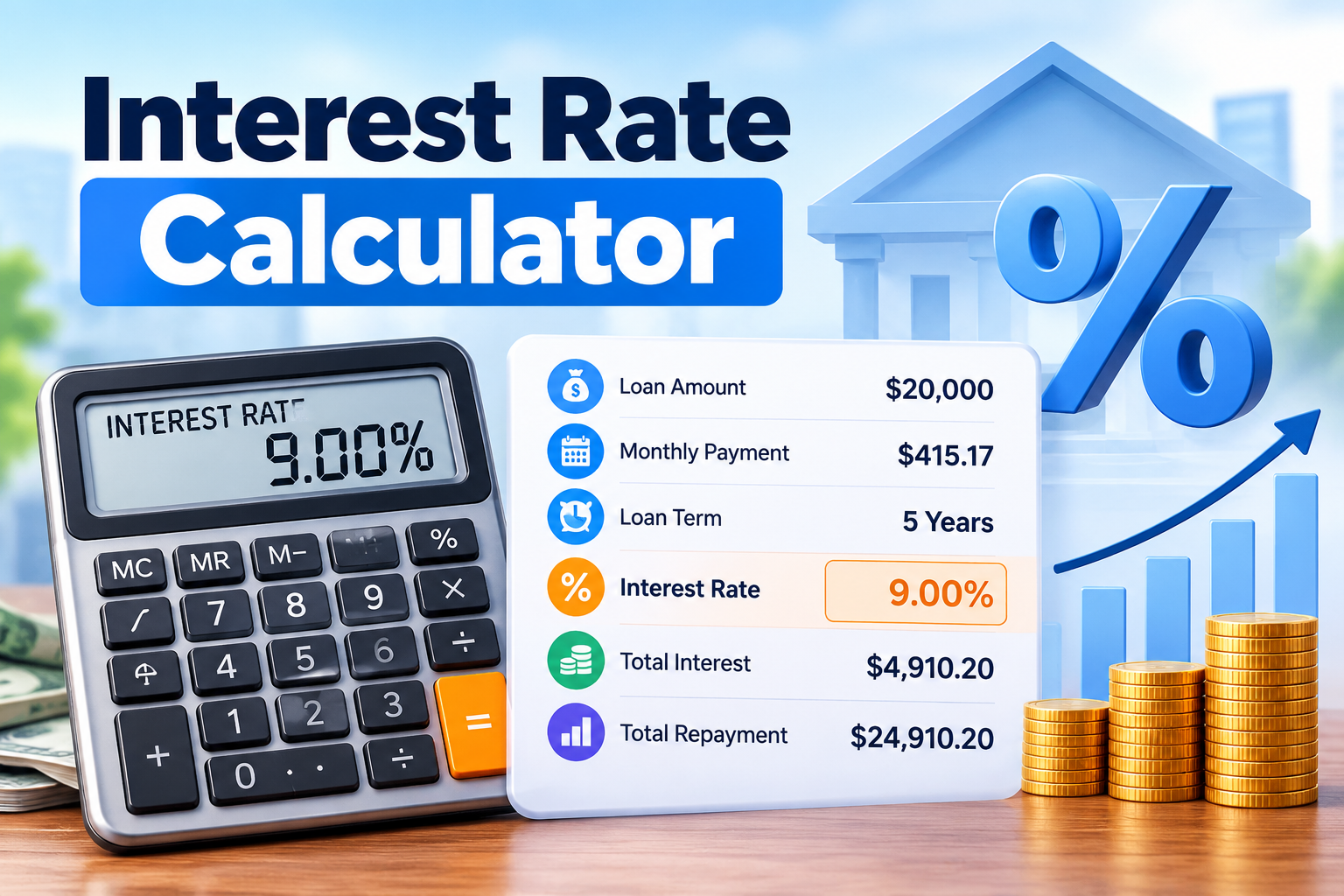
How to Use the Interest Rate Calculator
Finding an unknown loan interest rate is straightforward when you already know the amount borrowed, monthly payment, and repayment period.
Step 1: Enter the Loan Amount
Enter the total principal you borrowed or plan to finance. For example, if your loan principal is $20,000, enter 20000.
Use the actual financed amount rather than a product's full purchase price if you made a down payment.
Step 2: Enter Your Monthly Payment
Enter the fixed monthly amount that goes toward principal and interest. Do not include separately charged insurance, taxes, or other unrelated expenses.
Step 3: Choose the Loan Term
Enter the repayment period in years or months. For example, five years equals 60 monthly payments.
Step 4: Calculate Your Interest Rate
Click Calculate Interest Rate to see your estimated annual interest rate, monthly rate, effective annual rate, total interest, and repayment amount.
You can also explore the loan cost breakdown, compare nearby interest rates, and review the amortization schedule.
Understanding Your Interest Rate Calculator Results
The calculator provides more than an annual interest rate. It helps explain how much the loan costs and how repayment works.
| Result | What It Means |
|---|---|
| Annual Interest Rate | The estimated nominal yearly rate implied by your monthly payment |
| Monthly Interest Rate | The periodic interest rate applied each month |
| Effective Annual Rate | The yearly equivalent when monthly compounding is considered |
| Total Interest | Total scheduled payments minus the original loan principal |
| Total Repayment | The total amount paid over the scheduled loan term |
| Amortization Schedule | How each monthly payment is divided between principal and interest |
Annual Interest Rate
The annual interest rate is the calculator's primary result.
It estimates the yearly borrowing rate using your loan principal, scheduled monthly payment, and repayment term.
For example, a result of 9.00% represents an estimated nominal annual rate of 9% under the calculator's fixed-payment assumptions.
Monthly Interest Rate
The monthly periodic interest rate is calculated by dividing the nominal annual interest rate by 12.
For a 9% nominal annual rate:
9% ÷ 12 = 0.75% per month
This periodic rate is used to estimate the interest portion of each monthly loan payment.
Total Interest Paid
Total interest represents the amount paid above the original loan principal over the scheduled repayment period.
It can help you understand the long-term cost of borrowing rather than focusing only on the monthly installment.
Total Loan Repayment
Total repayment is the combined amount of principal and interest paid during the entire loan term.
For a standard fixed-payment loan:
Total Repayment = Monthly Payment × Number of Payments
This calculation does not include costs paid separately from the scheduled loan payments.
Interest Rate Calculator Example
Suppose you receive a loan offer with the following terms:
| Loan Detail | Example |
|---|---|
| Loan Amount | $20,000 |
| Monthly Payment | $415.17 |
| Loan Term | 5 years |
| Number of Payments | 60 |
| Estimated Annual Interest Rate | 9.00% |
| Monthly Interest Rate | Approximately 0.75% |
| Total Interest | $4,910.20 |
| Total Repayment | $24,910.20 |
The calculator estimates an annual interest rate of approximately 9.00%.
To calculate total repayment:
$415.17 × 60 = $24,910.20
Then subtract the original principal:
$24,910.20 − $20,000 = $4,910.20
This means the scheduled loan payments include approximately $4,910.20 in interest over five years.
The annual interest rate is estimated by solving the loan-payment equation rather than simply dividing total interest by the original loan amount.
How to Calculate Interest Rate From Monthly Payment
When the loan amount, payment, and repayment term are known, the unknown interest rate can be calculated using the standard amortizing-loan payment formula.
[M=P\times\frac{r}{1-(1+r)^{-n}}]
Where:
| Symbol | Meaning |
|---|---|
| M | Monthly principal-and-interest payment |
| P | Original loan principal |
| r | Monthly periodic interest rate |
| n | Total number of monthly payments |
When calculating a monthly loan payment, the interest rate is normally a known input.
However, this Interest Rate Calculator works in reverse.
It takes the known payment amount and mathematically solves for the unknown monthly interest rate.
Because the rate appears in multiple parts of the equation, the calculator uses a numerical solving method rather than a simple percentage formula.
Once the monthly rate is found:
Nominal Annual Interest Rate = Monthly Interest Rate × 12
This method is suitable for conventional fixed-rate, fully amortizing loans with equal monthly payments.
Interest Rate vs. APR vs. Effective Annual Rate
These three financial terms are related, but they do not always represent the same thing.
| Term | Meaning |
|---|---|
| Interest Rate | The borrowing rate charged on the outstanding loan balance |
| APR | A broader annualized measure that may include certain loan fees and finance charges |
| Effective Annual Rate | The annual equivalent of a periodic interest rate after accounting for compounding |
Interest Rate
The nominal interest rate describes the rate used to calculate interest on the loan balance.
The result displayed by this calculator is an estimated nominal annual interest rate.
Annual Percentage Rate (APR)
APR generally includes the borrowing interest rate plus applicable finance charges, such as certain origination fees.
For this reason, the APR disclosed by a lender may be higher than the loan's stated interest rate.
This calculator estimates the underlying loan interest rate, not the lender's official APR.
Effective Annual Rate
The effective annual rate accounts for the effect of compounding a periodic interest rate over a full year.
For a monthly periodic rate, the calculation is:
[EAR=(1+r)^{12}-1]
Here, r is the monthly rate expressed as a decimal.
For a nominal annual interest rate of 9%, the effective annual rate under monthly compounding is approximately 9.38%.
An effective annual rate is not automatically the same as a loan's disclosed APR.
How Monthly Payments Affect the Interest Rate
A loan's monthly payment depends on the principal, interest rate, and repayment term.
When the principal and term remain unchanged, a higher interest rate generally produces a higher required monthly payment.
For example, consider a $20,000 loan repaid over five years.
A loan with an 8% annual rate would generally require a lower monthly principal-and-interest payment than the same loan at 10%.
That is why the calculator includes a What If the Interest Rate Changes? section.
It compares estimated monthly payments at the calculated interest rate and at rates one percentage point lower or higher, without changing the original loan amount or repayment duration.
These comparisons are illustrations, not actual lender offers.
Important: If you voluntarily make extra payments on an existing loan, do not enter that higher amount as though it were the original required installment. Extra payments change your repayment plan, not the contractual interest rate.
How the Loan Term Affects Interest Costs
The repayment period has a major effect on monthly affordability and total interest.
A longer loan term commonly reduces the monthly payment when the principal and annual rate remain the same.
However, spreading repayment over additional months can increase the total interest paid.
A shorter loan term generally requires a larger monthly payment but may reduce the overall interest cost.
For example, financing the same amount at the same annual interest rate for three years rather than five years typically means higher monthly payments but less total interest.
The calculator allows you to enter the repayment term in either years or months, helping you work with whichever format appears on your loan offer.
Understanding the Loan Cost Breakdown
The Loan Cost Breakdown section helps you understand where your repayment money goes.
It separates your total scheduled repayment into two components.
Principal is the original amount borrowed.
Interest is the additional amount paid for borrowing that money.
The calculator also displays a horizontal visual breakdown showing the relative proportion of principal and interest.
For the earlier example of a $20,000 loan with $24,910.20 in total scheduled payments, principal represents approximately 80.3% of repayment, while interest represents approximately 19.7%.
This can make the loan's overall borrowing cost easier to understand.
What Is an Amortization Schedule?
An amortization schedule is a month-by-month breakdown of a loan's scheduled repayments.
It shows how each payment is divided between interest and principal, together with the remaining balance.
For a conventional fixed-rate amortizing loan, more interest is generally paid during the earlier months because the outstanding principal balance is larger.
As the loan balance decreases, less interest accrues and more of each payment goes toward reducing principal.
What Does the Schedule Show?
The calculator's amortization schedule displays the payment number, monthly payment, principal portion, interest portion, and remaining loan balance.
By default, you can view the first 12 payments.
Select Show All Payments to display the complete schedule for the entered repayment term.
Minor differences from a lender's actual schedule may arise from payment rounding, interest-accrual conventions, or other contractual details.
Can You Use This Calculator for a Car Loan?
Yes. The calculator can estimate the interest rate implied by a fixed-rate auto loan with equal monthly principal-and-interest payments.
For example, suppose a dealership offers financing and gives you the amount financed, monthly installment, and loan term.
You can enter those values to estimate the underlying annual interest rate.
However, be careful when entering the monthly payment. It should represent the actual principal-and-interest installment, not a combined payment that includes separately billed insurance or other expenses.
Some auto loans also calculate interest using daily balances or other conventions, so the calculator's estimate may differ slightly from the lender's contractual rate.
Can You Use This Calculator for a Personal Loan?
Yes. This tool is also suitable for estimating the interest rate on a standard fixed-payment personal loan.
It may help when a lender provides a repayment amount but you want to understand the annual rate behind it.
Before comparing personal loan offers, also review origination fees, required charges, and the disclosed APR.
Two loans can have similar stated interest rates while having different total borrowing costs.
What Happens if the Loan Has 0% Interest?
A zero-interest loan is a special case where no interest is charged on the outstanding principal.
For example:
| Loan Detail | Value |
|---|---|
| Loan Amount | $12,000 |
| Repayment Term | 12 months |
| Monthly Payment | $1,000 |
| Interest Rate | 0% |
| Total Interest | $0 |
The total amount repaid is exactly equal to the original principal.
For this type of loan, the calculator recognizes that the payment is consistent with a 0% annual interest rate.
What if the Monthly Payment Is Too Low?
For a fully amortizing loan with a nonnegative interest rate, the monthly payment must be sufficient to repay the principal within the selected term.
For example, a $12,000 loan repaid over 12 months requires at least $1,000 per month even at 0% interest.
If the entered payment is lower than the principal divided by the number of payments, the calculator displays an error rather than inventing an interest rate.
A payment below that amount could indicate an incorrect input or a different loan structure, such as one involving a balloon payment.
How Accurate Is the Interest Rate Calculator?
The Interest Rate Calculator uses the standard mathematical relationship for a fixed-rate loan with equal monthly repayments.
Within those assumptions, it can calculate the implied interest rate with high numerical precision.
However, your actual loan may include features the calculator does not model, including payment fees, irregular repayments, daily interest accrual, changing interest rates, promotional periods, or balloon payments.
The calculator also assumes payments are made on schedule.
For these reasons, its results should be treated as estimates and checked against the lender's official loan agreement and disclosures.
Related Loan Calculators
Explore these related Skills Elevate tools when you want to calculate other aspects of borrowing and loan repayment.
- Loan Calculator — estimate monthly payments and loan costs when the interest rate is already known.
- APR Calculator — estimate borrowing costs while accounting for applicable loan fees.
- Car Loan Calculator — explore financing estimates for vehicle purchases.
- Amortization Schedule Calculator — generate a detailed month-by-month loan repayment schedule.
- Loan Payoff Calculator — explore how additional payments may affect repayment time and interest costs.
Frequently Asked Questions
How do I calculate an interest rate from a monthly payment?
Enter the original loan principal, monthly principal-and-interest payment, and repayment term. The calculator solves the amortizing-loan equation to estimate the monthly periodic rate and converts it into a nominal annual interest rate.
Can I find my loan interest rate without knowing the APR?
Yes. If you know the amount borrowed, fixed monthly installment, and number of payments, you can estimate the underlying interest rate without entering an APR.
The result does not necessarily equal the lender's disclosed APR, which may reflect additional fees.
What is the difference between annual and monthly interest rates?
The nominal annual rate represents the stated yearly interest rate, while the monthly periodic rate is used to calculate interest during each month.
For an annual nominal rate of 12%, the corresponding monthly periodic rate is 1% when the annual rate is divided into 12 monthly periods.
Is interest rate the same as APR?
No. The interest rate generally represents the borrowing rate applied to the principal, while APR can include certain additional loan fees and charges.
A loan's disclosed APR may therefore be different from its stated interest rate.
Can this calculator find the interest rate on an auto loan?
Yes, provided the auto loan has a fixed rate, equal monthly principal-and-interest payments, and no unusual repayment structure that changes the standard calculation.
Why does my calculated rate differ from my loan statement?
Differences can result from rounding, fees included in the payment, daily interest calculations, payment timing, or other lender-specific loan terms.
Make sure you entered the principal-and-interest payment rather than a payment containing unrelated charges.
Does a longer loan term mean a higher interest rate?
Not necessarily. The interest rate and loan term are separate terms.
A lender may offer different rates for different durations, but a longer term does not automatically create a higher annual rate.
At the same annual interest rate, a longer repayment term generally reduces the monthly payment while increasing the total interest paid.
Can the calculator estimate a 0% interest loan?
Yes. When the scheduled monthly payments add up to the original loan principal, the calculator can identify an implied 0% interest rate under its assumptions.
Can I calculate interest rates using months instead of years?
Yes. Use the term-unit switch beside the Loan Term field to change between months and years.
The calculator adjusts the duration without requiring you to manually convert the term.
Does this calculator include loan origination fees?
No. The Interest Rate Calculator estimates the rate implied by the principal-and-interest payments.
Origination fees and other finance charges can affect the actual borrowing cost and disclosed APR.
What is the difference between total interest and total repayment?
Total interest is the amount paid above the original loan principal.
Total repayment includes both the principal and the interest paid over the scheduled loan term.
For example, if you borrow $20,000 and repay $24,910.20, the total scheduled interest is $4,910.20.
Can I use this calculator for an adjustable-rate loan?
The calculator is intended for fixed-rate loans with equal monthly payments.
An adjustable-rate loan can have changing interest rates and repayment amounts, so a single fixed-rate calculation may not accurately represent the full loan.
Why does the calculator show an effective annual rate?
The effective annual rate helps explain how monthly compounding changes the annualized rate.
It is useful as an additional financial measure but should not be confused with a lender's disclosed APR.
Can this calculator show how much interest I pay each month?
Yes. Open the Amortization Schedule section to review each scheduled payment's principal and interest portions.
You can view the first 12 months or expand the schedule to show the entire repayment period.