
Calculate Your Daily Macros
Use the Macro Calculator above to estimate your daily calories, protein, carbohydrates, and fat based on your age, height, weight, activity level, and nutrition goal.
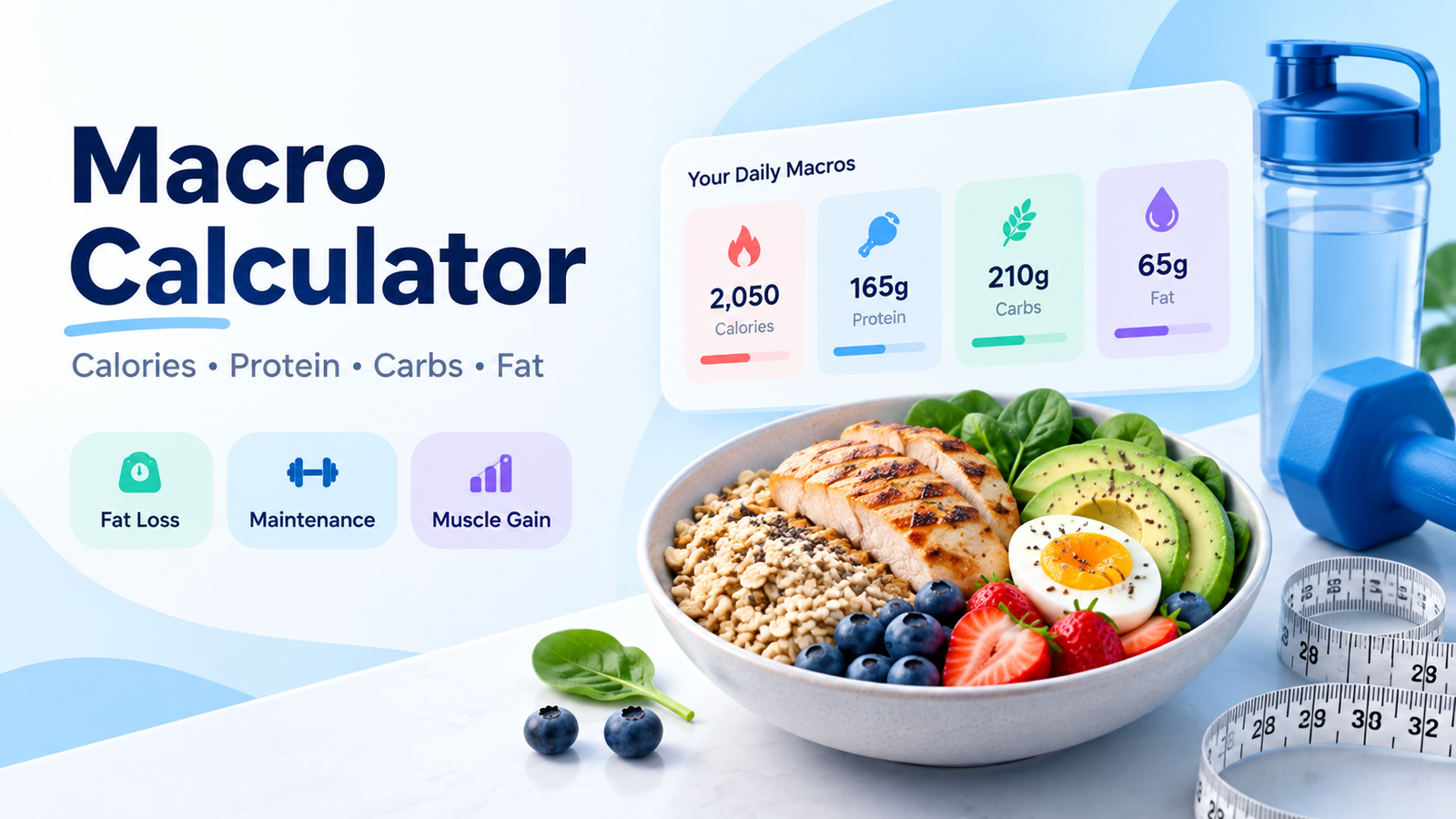
How to Use the Macro Calculator
Enter your basic details, choose your activity level, and select whether your goal is fat loss, weight maintenance, or muscle gain. The calculator estimates your daily calorie needs and converts those calories into practical protein, carbohydrate, and fat targets.
You can use either US or metric units and adjust the macro distribution if the default balance does not match your preferences.
For more control, open the advanced options to choose a different calorie formula or enter a daily calorie target you already follow.
What Your Macro Calculator Results Mean
Your results include a daily calorie target together with estimated grams of protein, carbohydrates, and fat.
Daily Calories
Your daily calorie target represents an estimated amount of energy to consume based on your body measurements, activity level, and selected goal.
Choosing Fat loss reduces calories below estimated maintenance, while Build muscle increases them. Selecting Maintain keeps the result close to estimated daily energy expenditure.
The number should be treated as a practical starting point rather than an exact requirement.
Protein
Protein is displayed in grams per day and as a percentage of your total calories.
Protein supports many normal body functions and is especially relevant for people who exercise or want to manage body composition.
The calculator lets you estimate protein using either a percentage-based macro split or the Protein by Weight option.
Carbohydrates
Carbohydrates are shown in grams per day and provide part of your daily calorie intake.
Your carb target changes depending on the macro preset you choose. A higher-carb setting increases the proportion of calories from carbohydrates, while a lower-carb setting reduces it.
Fat
Fat is also shown in grams per day and as a percentage of calories.
Because fat contains more calories per gram than protein or carbohydrates, a smaller number of fat grams can still represent a meaningful percentage of your total calorie intake.
How Does the Macro Calculator Work?
The calculator first estimates your resting calorie needs and then adjusts that estimate based on your activity level.
The basic process is:
Resting calorie estimate → Activity adjustment → Goal adjustment → Macro distribution
Once your daily calorie target is calculated, those calories are divided between protein, carbohydrates, and fat.
Protein and carbohydrates provide approximately 4 calories per gram, while fat provides approximately 9 calories per gram.
This allows the calculator to convert percentages into useful daily gram targets.
How Are Daily Calories Estimated?
The default calculation uses the Mifflin–St Jeor equation.
The formula uses:
- Age
- Weight
- Height
- Sex-based coefficient
The equations are:
Male coefficient
BMR = (10 × weight in kg) + (6.25 × height in cm) − (5 × age) + 5
Female coefficient
BMR = (10 × weight in kg) + (6.25 × height in cm) − (5 × age) − 161
The result estimates your Basal Metabolic Rate (BMR), or approximately how much energy your body uses at rest.
The calculator then applies your selected activity level:
Estimated Maintenance Calories = BMR × Activity Factor
Your fat-loss, maintenance, or muscle-gain adjustment is applied after that.
Mifflin–St Jeor vs. Katch–McArdle
The advanced settings include two BMR calculation methods.
Mifflin–St Jeor
This is the default option and does not require a body-fat percentage.
It uses age, height, weight, and a sex-based coefficient to estimate resting calorie needs.
For most visitors, this is the simplest starting point.
Katch–McArdle
Katch–McArdle estimates resting calorie needs using lean body mass.
Because lean body mass depends on body composition, you need to enter an estimated body-fat percentage when using this option.
This method may be useful if you already have a reasonable body-fat estimate.
What Is a Good Macro Split?
There is no single protein, carbohydrate, and fat ratio that works perfectly for everyone.
Macro needs and preferences can vary according to:
- Fitness goal
- Training style
- Calorie intake
- Body size
- Appetite
- Food preferences
- Daily activity
General adult reference ranges are commonly around:
| Macronutrient | General Range |
|---|---|
| Protein | 10–35% of calories |
| Carbohydrates | 45–65% of calories |
| Fat | 20–35% of calories |
These are broad reference ranges, not fixed targets for every person.
That is why the calculator provides multiple macro options instead of forcing everyone to use the same ratio.
Macro Split Options
Balanced
The Balanced preset provides a practical combination of protein, carbohydrates, and fat.
It is a useful starting point if you do not already follow a specific macro strategy.
Higher Protein
The Higher Protein option increases the share of calories assigned to protein.
It can be useful for people who want protein to play a larger role in their daily nutrition plan.
Lower Carb
The Lower Carb preset reduces the percentage of calories from carbohydrates and distributes more calories toward protein and fat.
It offers an alternative eating pattern rather than automatically being better for every goal.
Higher Carb
The Higher Carb option assigns a larger percentage of your calories to carbohydrates.
Some active people may prefer this distribution when carbohydrates form a larger part of their regular meals or training routine.
Custom Macro Percentage
Choose Custom % if you already know the macro ratio you want to follow.
Enter percentages for:
- Protein
- Carbohydrates
- Fat
The three values must equal 100%.
Protein by Weight
This option calculates protein using grams per kilogram of body weight rather than assigning protein a fixed percentage of calories.
The calculator then assigns your selected percentage to fat and uses the remaining calories for carbohydrates.
Macro Calculator Example
Imagine your daily calorie target is 2,200 calories, with a macro split of:
- Protein: 30%
- Carbohydrates: 40%
- Fat: 30%
Your approximate daily targets would be:
| Macro | Calories | Approx. Grams |
|---|---|---|
| Protein | 660 kcal | 165 g |
| Carbohydrates | 880 kcal | 220 g |
| Fat | 660 kcal | 73 g |
| Total | 2,200 kcal | — |
The protein calculation is:
660 ÷ 4 = 165 grams
The carbohydrate calculation is:
880 ÷ 4 = 220 grams
The fat calculation is:
660 ÷ 9 ≈ 73 grams
Small differences may occur because displayed values are rounded.
Macros for Fat Loss
Selecting Fat loss starts with a moderate reduction from estimated maintenance calories.
The calculator then divides the reduced calorie target between protein, carbohydrates, and fat according to your chosen macro split.
You can still customize your macros using:
- Balanced
- Higher protein
- Lower carb
- Higher carb
- Custom percentage
- Protein by weight
A larger calorie reduction is not automatically better. Your target should remain practical enough to support everyday activity and consistency.
As your body weight or activity level changes, your estimated calorie needs may also change.
Macros for Maintaining Weight
Select Maintain when your goal is to stay near your estimated current energy requirements.
This option can be helpful when you want to establish a baseline before making changes to your diet.
Maintenance macros can also help you compare different protein, carb, and fat combinations without changing your overall calorie target.
Remember that actual maintenance calories may fluctuate depending on daily activity and other individual factors.
Macros for Building Muscle
The Build muscle option begins with a modest calorie increase above estimated maintenance.
You can then choose a macro distribution that suits your preferences and training routine.
For example, you may prefer:
Higher Protein if protein intake is a priority.
Higher Carb if you prefer more carbohydrates in your daily diet.
Protein by Weight if you already have a specific protein target in mind.
Nutrition is only one part of muscle development. Training, recovery, sleep, and consistency also influence progress.
How to Calculate Macros Per Meal
The calculator can divide your daily targets across 3, 4, or 5 meals.
For example, if your daily protein goal is:
160 grams
and you choose four meals:
160 ÷ 4 = 40 grams of protein per meal
The same method is used for calories, carbs, and fat.
You do not need to consume exactly the same macros at every meal. The per-meal calculation is simply a convenient planning guide.
Calories vs. Macros: What Is the Difference?
Calories measure the total amount of energy in your food.
Macros explain where much of that energy comes from.
For example, two diets can contain the same number of calories but have very different amounts of protein, carbohydrates, and fat.
Tracking only calories may be enough for someone who wants a simple energy target.
Tracking macros provides additional detail for people who want more control over how their daily calories are distributed.
How Accurate Is a Macro Calculator?
A macro calculator provides an estimate, not an exact measurement of your metabolism or food requirements.
Results may differ from your actual needs because of factors such as:
- Daily movement
- Exercise intensity
- Training frequency
- Body composition
- Changes in body weight
- Individual metabolism
- Food tracking accuracy
- Lifestyle changes
Activity level can also be difficult to estimate precisely.
For example, two people who exercise four days per week may still have very different energy needs if one sits most of the day while the other has a physically active job.
Use your result as a starting point and adjust based on real-world progress.
Related Nutrition Calculators
You can use these related Skills Elevate calculators when you want to explore a specific part of your nutrition or body-composition plan:
- TDEE Calculator — estimate total daily energy expenditure.
- Protein Calculator — calculate a more focused daily protein target.
- BMR Calculator — estimate resting daily calorie expenditure.
- Calorie Calculator — estimate calorie needs for different goals.
- Body Fat Calculator — estimate body-fat percentage for body-composition planning.
Important Limitations
This calculator is intended to provide general estimates for adults aged 18 and older.
It should not be treated as an individualized nutrition prescription.
People who are pregnant, breastfeeding, recovering from an eating disorder, or managing a medical condition that affects nutrition may need personalized guidance from an appropriate healthcare professional.
Frequently Asked Questions
What is a macro calculator?
A macro calculator estimates your daily calorie target and divides those calories into recommended amounts of protein, carbohydrates, and fat.
How do I calculate my macros?
Estimate your daily calorie requirement first, then divide those calories between protein, carbohydrates, and fat. Protein and carbs provide about 4 calories per gram, while fat provides about 9 calories per gram.
What macros should I eat for weight loss?
There is no single macro ratio that works for everyone. Your overall calorie intake, activity, food preferences, and protein needs should all be considered. Use the Fat Loss goal as a starting point and adjust the macro split if needed.
What is the best macro split for muscle gain?
There is no universal perfect ratio. Many people prioritize adequate protein while adjusting carbohydrates and fats according to calorie needs, training demands, and food preferences.
Can I calculate protein based on my body weight?
Yes. Select Protein by Weight and enter the number of grams of protein per kilogram of body weight you want to use. The calculator assigns fat according to your chosen percentage and uses the remaining calories for carbohydrates.
Can I use my own calorie target?
Yes. Open Advanced calorie and formula options and select I already know my daily calorie target. Enter your preferred calories, and the calculator will use them when calculating your macros.
Why are my macros different from another calculator?
Different tools may use different BMR equations, activity factors, calorie adjustments, macro ratios, protein methods, and rounding rules. Macro calculations are estimates, so small differences are normal.
Do my macros need to be exact every day?
Not necessarily. Your calculated numbers are useful daily targets, but you do not need to hit every gram perfectly. A consistent approach over time is usually more practical than trying to make every day mathematically exact.
How often should I recalculate my macros?
Recalculate when your weight, activity level, training routine, or nutrition goal changes significantly. You can also review your targets if your actual progress differs noticeably from the estimate.