
How Many Cubic Feet Are in a Yard? Cubic Yard Conversion Guide
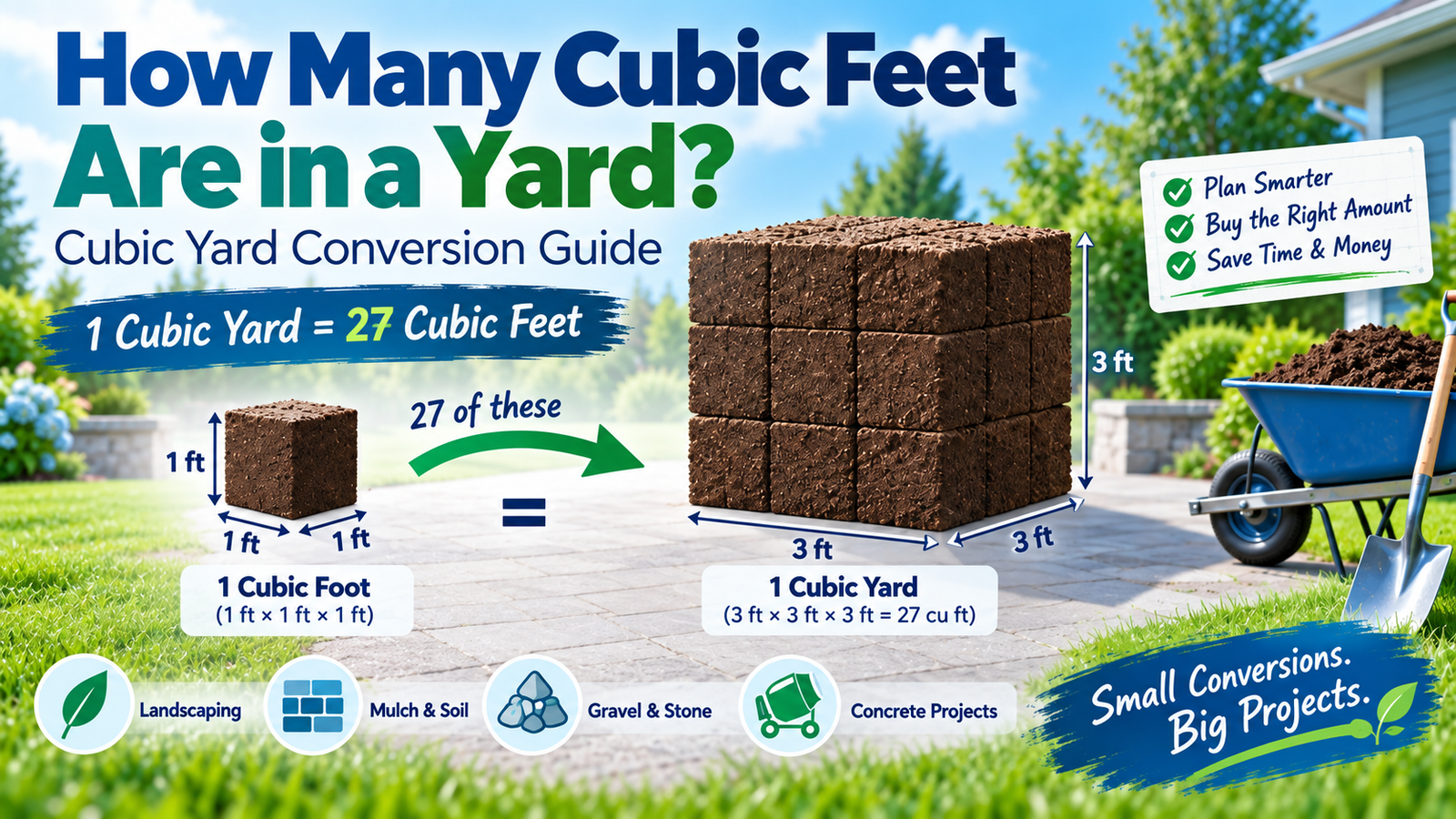
There are 27 cubic feet in one cubic yard. If you're buying mulch, topsoil, gravel, compost, concrete, or another bulk material, this is the conversion you'll use to move between cubic feet and cubic yards.
Quick answer
1 cubic yard = 27 cubic feet
A cubic yard measures 3 feet long × 3 feet wide × 3 feet high. Multiply those dimensions together and you get 3 × 3 × 3 = 27 cubic feet.
Cubic Yard & Cubic Feet Calculator
Convert cubic feet and cubic yards, or estimate how much mulch, soil, gravel, compost, or other material your project needs.
Quick Volume Converter
Project Material Calculator
Enter the size of your project area to estimate cubic feet, cubic yards, and bag quantities.
Formula: Length × width × depth = cubic feet. Divide cubic feet by 27 to get cubic yards. For real projects, you may want to order a little extra for settling, uneven surfaces, or waste.
That sounds simple—and it is. The confusing part usually comes when a project is measured in square feet, the depth is given in inches, bags are labeled in cubic feet, and the landscape supplier sells the same material by the cubic yard.
This guide shows you how the conversion works and, more importantly, how to use it when buying material for an actual project.
Why Are There 27 Cubic Feet in a Cubic Yard?
One yard is 3 feet long. But a cubic yard measures volume, so you have to account for three dimensions: length, width, and height.
3 feet × 3 feet × 3 feet
= 27 cubic feet
Imagine a box that is 3 feet wide, 3 feet long, and 3 feet tall. That box occupies exactly one cubic yard of space. Inside it are 27 individual one-foot-by-one-foot-by-one-foot cubes.
The conversion is based on volume, so it does not change depending on what fills the space. One cubic yard of mulch, soil, gravel, concrete, or air is still 27 cubic feet of volume.
A Yard, Square Yard, and Cubic Yard Are Not the Same
One of the most common mistakes is treating the word yard as if it always describes the same measurement.
| Measurement | Measures | Equivalent |
|---|---|---|
| 1 yard | Length | 3 feet |
| 1 square yard | Area | 9 square feet |
| 1 cubic yard | Volume | 27 cubic feet |
When a landscape supplier says mulch or soil costs a certain amount “per yard,” they generally mean per cubic yard, because these materials are sold by volume.
Cubic Yards to Cubic Feet Conversion Formula
To convert cubic yards to cubic feet, simply multiply the number of cubic yards by 27.
Cubic feet = cubic yards × 27
Example: Convert 4 cubic yards to cubic feet
Multiply 4 by 27:
4 × 27 = 108 cubic feet
So 4 cubic yards = 108 cubic feet.
Cubic Feet to Cubic Yards Conversion Formula
To go in the opposite direction, divide the number of cubic feet by 27.
Cubic yards = cubic feet ÷ 27
Example: Convert 81 cubic feet to cubic yards
Divide 81 by 27:
81 ÷ 27 = 3 cubic yards
So 81 cubic feet = 3 cubic yards.
Cubic Yard to Cubic Feet Conversion Chart
Use this quick-reference table when estimating material:
| Cubic yards | Cubic feet |
|---|---|
| 0.25 yd³ | 6.75 ft³ |
| 0.5 yd³ | 13.5 ft³ |
| 1 yd³ | 27 ft³ |
| 1.5 yd³ | 40.5 ft³ |
| 2 yd³ | 54 ft³ |
| 3 yd³ | 81 ft³ |
| 4 yd³ | 108 ft³ |
| 5 yd³ | 135 ft³ |
| 10 yd³ | 270 ft³ |
How Many Bags Make One Cubic Yard?
This is where knowing that a cubic yard contains 27 cubic feet becomes especially useful.
Bulk landscape materials are often sold by the cubic yard, while bagged mulch, soil, compost, and similar products are labeled in cubic feet. Divide 27 by the volume of one bag to find how many bags equal a cubic yard.
| Bag size | Equivalent to 1 cubic yard |
|---|---|
| 0.75 cu ft | 36 bags |
| 1 cu ft | 27 bags |
| 1.5 cu ft | 18 bags |
| 2 cu ft | 13.5 bags |
| 3 cu ft | 9 bags |
When buying whole bags, round fractional bag counts up. For example, you would need 14 two-cubic-foot bags to buy at least one cubic yard of material.
How many 2 cubic foot bags are in a yard?
Mathematically, 13.5 two-cubic-foot bags equal one cubic yard:
27 ÷ 2 = 13.5
Because stores sell complete bags, you would normally purchase 14 bags if you need at least a full cubic yard.
How Much Area Does One Cubic Yard Cover?
A cubic yard tells you the amount of material you have. The square footage it covers depends on how deeply you spread that material.
| Depth | Approx. coverage from 1 cubic yard |
|---|---|
| 1 inch | 324 sq ft |
| 2 inches | 162 sq ft |
| 3 inches | 108 sq ft |
| 4 inches | 81 sq ft |
| 6 inches | 54 sq ft |
| 12 inches | 27 sq ft |
For example, one cubic yard spread 3 inches deep covers about 108 square feet. Spread that same material only 1 inch deep and it covers about 324 square feet.
How to Calculate Cubic Yards for Your Project
If you know the length, width, and desired depth of an area, you can calculate the cubic yards required yourself.
First make sure every measurement is in feet.
Length × Width × Depth ÷ 27 = Cubic Yards
Example: 10 × 20 foot garden bed at 3 inches deep
The depth is given in inches, so convert 3 inches to feet first:
3 ÷ 12 = 0.25 feet
Now calculate the volume in cubic feet:
10 × 20 × 0.25 = 50 cubic feet
Finally, divide by 27:
50 ÷ 27 = about 1.85 cubic yards
So the project requires approximately 1.85 cubic yards before accounting for any extra material you choose to order.
Using Cubic Yards for Mulch
Mulch is one of the most common reasons homeowners need this conversion. Bagged mulch is frequently labeled in cubic feet, while landscape suppliers often sell bulk mulch by the cubic yard.
If your garden requires 54 cubic feet of mulch:
54 ÷ 27 = 2 cubic yards
If you were instead buying 2-cubic-foot bags, the same 54 cubic feet would equal:
54 ÷ 2 = 27 bags
That makes it easier to compare bagged and bulk options without comparing two different units.
Using Cubic Yards for Topsoil and Compost
Topsoil and compost are also commonly sold in bulk by the cubic yard. Measure the area you want to fill and determine the intended depth before ordering.
For example, adding 3 inches of material to a 200-square-foot bed requires:
200 × 0.25 = 50 cubic feet
50 ÷ 27 ≈ 1.85 cubic yards
Real soil and compost may settle after placement, so project planning can involve considerations beyond the basic volume conversion.
Using Cubic Yards for Gravel
Gravel suppliers may quote material by cubic yard, by weight, or both. The volume calculation itself still follows the same formula:
Cubic feet ÷ 27 = cubic yards
But don't assume one cubic yard has one fixed weight. Different types and sizes of rock have different densities, and moisture can also affect weight. Use the supplier's material-specific weight information when converting between cubic yards and tons.
Using Cubic Yards for Concrete
Ready-mix concrete is commonly ordered by the cubic yard, so accurately measuring slab dimensions matters.
Suppose a slab is 12 feet long, 12 feet wide, and 4 inches thick.
Convert 4 inches to feet:
4 ÷ 12 ≈ 0.333 feet
Calculate the cubic feet:
12 × 12 × 0.333 ≈ 48 cubic feet
Then convert to cubic yards:
48 ÷ 27 ≈ 1.78 cubic yards
For actual concrete ordering, contractors typically account for waste, uneven subgrade, spillage, and supplier minimums rather than ordering exactly the theoretical volume.
Common Cubic Yard Conversion Mistakes
Quick Conversion Cheat Sheet
1 yard = 3 feet
1 square yard = 9 square feet
1 cubic yard = 27 cubic feet
Cubic yards → cubic feet: multiply by 27
Cubic feet → cubic yards: divide by 27
Frequently Asked Questions
How many cubic feet are in a yard?
There are exactly 27 cubic feet in one cubic yard. A cubic yard measures 3 feet × 3 feet × 3 feet.
How many cu ft are in a yard?
One cubic yard contains 27 cu ft. “Cu ft” is simply an abbreviation for cubic feet.
Is a yard the same as a cubic yard?
Not technically. A yard measures length and equals 3 feet. A cubic yard measures volume and equals 27 cubic feet. When bulk landscape suppliers say a “yard” of material, they usually mean a cubic yard.
How many cubic feet are in half a yard?
Half a cubic yard contains 13.5 cubic feet. Multiply 0.5 by 27.
How many cubic feet are in 2 yards?
Two cubic yards equal 54 cubic feet: 2 × 27 = 54.
How many cubic feet are in 3 yards?
Three cubic yards equal 81 cubic feet: 3 × 27 = 81.
How many 2 cubic foot bags make a yard?
One cubic yard equals 13.5 two-cubic-foot bags by volume. If buying complete bags, purchase 14 bags to have at least one cubic yard.
How many 1.5 cubic foot bags are in a yard?
There are 18 bags of 1.5 cubic feet each in one cubic yard because 27 ÷ 1.5 = 18.
How many 3 cubic foot bags make a yard?
Nine 3-cubic-foot bags equal exactly one cubic yard because 27 ÷ 3 = 9.
How do I convert cubic feet to yards?
Divide the number of cubic feet by 27. For example, 135 cubic feet ÷ 27 = 5 cubic yards.
Can I convert square feet directly to cubic yards?
No. Square feet measure area, while cubic yards measure volume. You need to know the material depth first. Multiply the square footage by the depth in feet to get cubic feet, then divide by 27.
Does a cubic yard always equal 27 cubic feet?
Yes. The conversion is exact. The type of material changes its weight, but it does not change the volume represented by one cubic yard.
The Bottom Line
If you only remember one number, remember 27: there are 27 cubic feet in a cubic yard.
Multiply cubic yards by 27 to get cubic feet. Divide cubic feet by 27 to get cubic yards. When you're estimating mulch, soil, gravel, compost, or concrete, make sure your depth is converted to feet before calculating the volume.
The conversion in one line
1 cubic yard = 27 cubic feet — because 3 ft × 3 ft × 3 ft = 27 ft³.
Measurement note: This guide deals with volume. Material weight can vary substantially based on density, particle size, compaction, and moisture, so use supplier-specific information when converting cubic yards to pounds or tons.