
20 Hours From Now
Find out the exact date and time 20 hours from now, live-updating — plus a general calculator for any number of minutes, hours, days, weeks, months, or years.
What Time Is 20 Hours From Now?
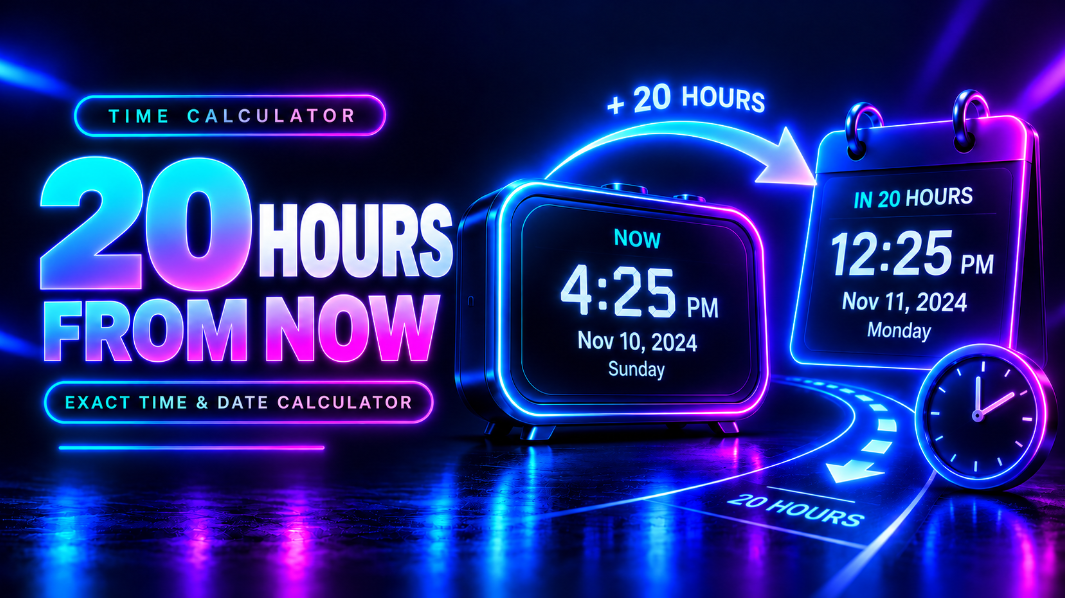
The 20 Hours From Now Calculator instantly shows the exact local time and date that will occur twenty hours after the current moment.
The result above includes the future time, full calendar date, day of the week, and whether the result falls on the same day or the next calendar day.
By default, the calculator uses your current local time automatically. You can also choose another starting date and time and calculate any number of hours forward or backward.
This tool helps answer questions such as:
- What time is 20 hours from now?
- What time will it be in 20 hours?
- What date and time is 20 hours from now?
- What is twenty hours from now?
- What time is 20 hours after another time?
How to Calculate 20 Hours From Now
The basic calculation is:
Current Time + 20 Hours = Time 20 Hours From Now
Twenty hours is an exact elapsed-time interval equal to:
20 hours = 1,200 minutes = 72,000 seconds
The calculator adds that elapsed duration to the starting moment and automatically determines the correct time, date, weekday, and calendar-day relationship.
How Many Minutes Is 20 Hours?
There are 1,200 minutes in 20 hours.
The calculation is:
20 × 60 = 1,200 minutes
So 1,200 minutes from now represents the same elapsed duration as twenty hours from now.
How Many Seconds Is 20 Hours?
There are 72,000 seconds in 20 hours.
The calculation is:
20 × 60 × 60 = 72,000 seconds
Therefore:
20 hours = 1,200 minutes = 72,000 seconds
Will 20 Hours From Now Be Today or Tomorrow?
In many cases, 20 hours from now will be on the next calendar day, but the exact answer depends on the current time.
Because twenty hours is only four hours short of a full day, a result will stay on the same date only when the starting time is early enough.
For example, if you begin at 2:00 AM, twenty hours later is 10:00 PM on the same day. If you begin at 8:00 AM, twenty hours later is 4:00 AM the following day.
The calculator shows the correct date automatically.
Why the Date Matters When Adding 20 Hours
A twenty-hour calculation frequently crosses midnight, so looking only at the clock time can be misleading.
This calculator also shows:
- Exact future time
- Full calendar date
- Day of the week
- Same-day or next-day relationship
- Starting time
- Local time zone
This is especially useful for travel, overnight work, appointments, deadlines, and events scheduled across calendar days.
What Happens When 20 Hours Crosses Midnight?
If adding twenty hours passes midnight, the result automatically moves to the next date.
For example, a late-morning starting time will usually produce a result the following morning.
The tool handles this date rollover automatically and labels the result as the Next Calendar Day when appropriate.
12-Hour vs 24-Hour Time
The calculator supports both 12-hour and 24-hour formats.
12-Hour Format
The 12-hour clock uses AM and PM.
Examples:
- 7:30 AM
- 2:45 PM
- 11:10 PM
24-Hour Format
The 24-hour clock runs from 00:00 to 23:59.
Examples:
- 07:30
- 14:45
- 23:10
You can switch between both formats without changing the calculated moment.
Calculate 20 Hours From Another Time
You can calculate twenty hours from any custom starting date and time.
Enter:
- 20 in the Number of Hours field.
- Choose From Now.
- Select a starting date.
- Enter a starting time.
- Click Calculate Time.
The tool will display the exact result time, date, weekday, and calendar-day relationship.
You can also choose Ago to calculate twenty hours before a selected time.
Does the Calculator Use My Local Time Zone?
Yes. The calculator uses the local time zone reported by your browser or device.
The Time & Date Details section also shows the detected time-zone name and UTC offset.
This is important because the same instant can display as a different local clock time in another part of the world.
Can Daylight Saving Time Affect 20 Hours From Now?
Yes, if the twenty-hour interval crosses a daylight-saving time transition.
The calculator adds 20 actual elapsed hours. If your location changes UTC offset during that interval, the displayed local clock time may not look like a simple twenty-hour shift on the wall clock.
For example, a daylight-saving change can make the local clock appear one hour ahead or behind what you might expect from manual clock arithmetic.
The elapsed duration is still twenty hours.
Is 20 Hours the Same as One Day?
No.
A full day is:
24 hours
Twenty hours is:
4 hours less than one full day
That is why twenty hours from now may land on the next calendar day without being exactly the same time tomorrow.
Common Uses for a 20 Hours From Now Calculator
Work and Shift Planning
Use it for:
- Shift start or end times
- Work deadlines
- Client follow-ups
- Overnight processes
- Server monitoring
- Team schedules
Travel and Transportation
It can help calculate:
- Flight arrival times
- Long-distance journeys
- Train or bus arrivals
- Airport pickups
- Travel connections
- Road-trip timing
Appointments and Scheduling
You may use it for:
- Medical appointments
- Business meetings
- Interviews
- Classes
- Service bookings
- Scheduled calls
Sleep and Daily Planning
Common uses include:
- Wake-up times
- Sleep schedules
- Study periods
- Meal timing
- Exercise
- Personal routines
Online Events and Digital Activity
It can also help with:
- Livestreams
- Gaming events
- Product launches
- Auctions
- Online meetings
- Limited-time offers
Why Use a 20 Hours From Now Calculator?
Adding twenty hours manually can be easy to get wrong because the calculation often crosses midnight.
Common mistakes include:
- Mixing up AM and PM
- Forgetting the date change
- Choosing the wrong weekday
- Incorrectly converting to 24-hour time
- Miscalculating from a custom starting time
- Overlooking time-zone or daylight-saving changes
The calculator handles these details automatically and provides the answer immediately.
Related Time Calculations
You may also want to calculate:
- 18 hours from now
- 19 hours from now
- 21 hours from now
- 22 hours from now
- 24 hours from now
- 36 hours from now
- 20 hours ago
- 1,200 minutes from now
Frequently Asked Questions
What time is 20 hours from now?
The exact result depends on the current time. The calculator above automatically adds twenty elapsed hours to your device's current local time.
How many minutes is 20 hours?
20 hours equals 1,200 minutes.
How many seconds is 20 hours?
20 hours equals 72,000 seconds.
Will 20 hours from now be tomorrow?
Often, yes. Whether it falls today or tomorrow depends on the starting time.
Is 20 hours the same as one day?
No. One full day is 24 hours, so 20 hours is four hours shorter than a day.
Can I calculate 20 hours from another time?
Yes. Choose any custom starting date and time and enter 20 hours.
Can I calculate 20 hours ago?
Yes. Change the Direction setting from From Now to Ago.
Does the calculator support 24-hour time?
Yes. You can switch between 12-hour AM/PM and 24-hour formats.
Does the calculator use my local time zone?
Yes. It uses the local time zone detected from your browser or device.
Can daylight saving time affect the displayed result?
Yes. If a daylight-saving transition occurs during the twenty-hour interval, the local clock reading may reflect the UTC-offset change.