
90 Days From a Selected Date
90 Days From a Selected Date
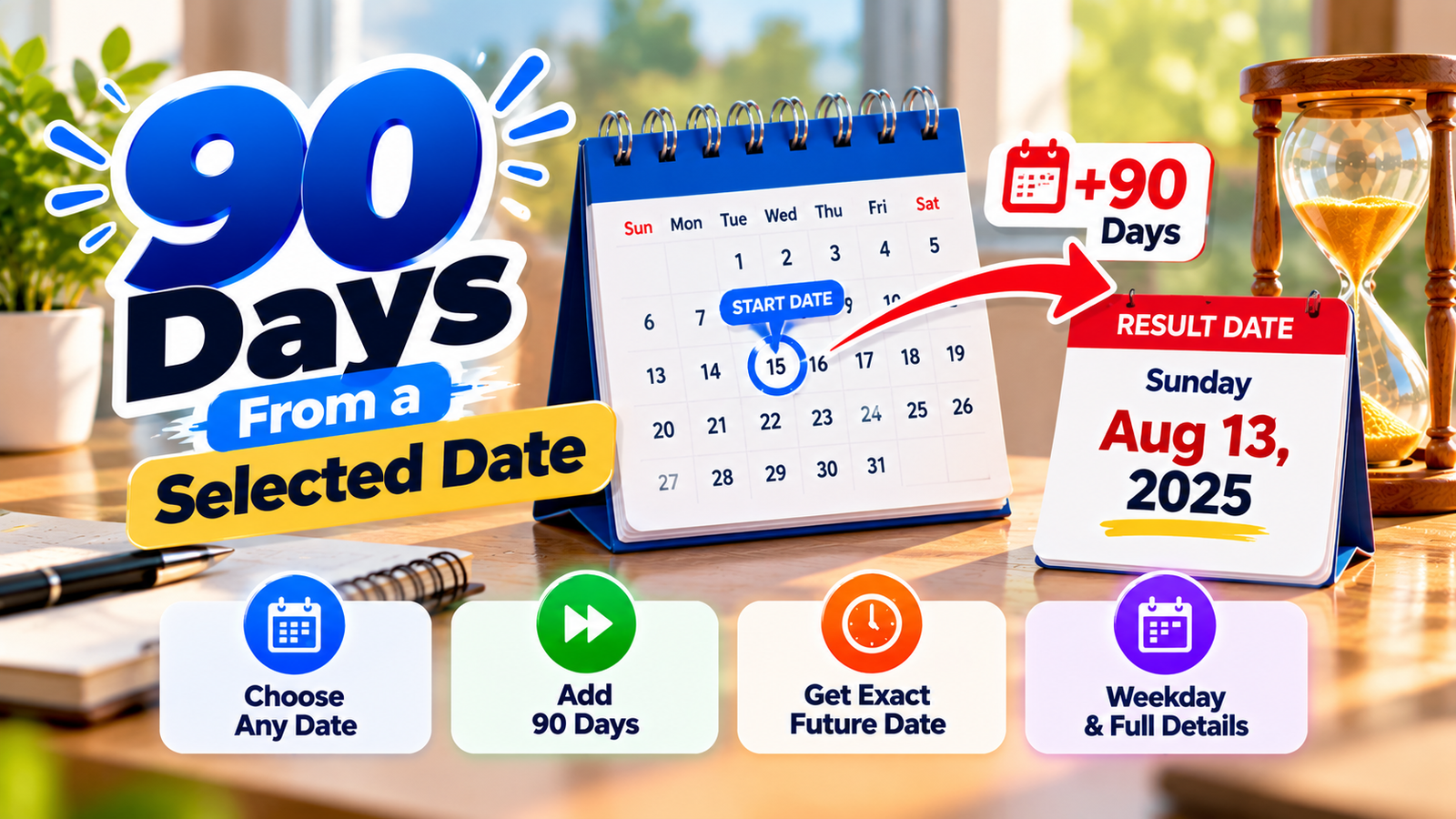
Need to know what date is 90 days from a selected date? This calculator lets you choose any starting date and instantly adds 90 calendar days to it.
It is especially useful when a deadline does not begin today. You may be working from a contract date, invoice date, employment start date, appointment date, purchase date, application date, or project kickoff.
The quick conversion is:
90 days = 12 weeks and 6 days
It also equals 2,160 hours, 129,600 minutes, and 7,776,000 seconds.
Why Use a Selected Date Instead of Today?
A standard “90 days from today” calculator always starts with the current date.
But many real-world deadlines begin from a specific date.
For example, you may need to calculate:
- 90 days after an invoice was issued
- 90 days after a contract started
- 90 days after an employee’s first day
- 90 days after an appointment
- 90 days after a project kickoff
- 90 days after a purchase or application
In these situations, the selected starting date is more important than today’s date.
How the 90-Day Calculator Works
The calculation is simple.
Choose the date you want to use as the starting point.
The calculator then adds exactly 90 calendar days and shows the resulting future date.
It also provides the weekday, equivalent weeks, equivalent hours, time zone, date formats, and a live countdown when the result is still in the future.
90 Days in Weeks
There are 7 days in one week.
So:
90 ÷ 7 = 12 weeks with 6 days remaining
That means:
90 days = 12 weeks and 6 days
It is also only one day short of 13 full weeks.
What Weekday Is 90 Days Later?
There is an easy shortcut for checking the weekday.
Twelve full weeks equal:
12 × 7 = 84 days
That leaves:
90 − 84 = 6 days
So the result falls six weekdays after the selected starting weekday.
Another way to think about it is that the result is one weekday before the starting weekday.
For example, if the selected date is Monday, 90 days later will be Sunday.
Is 90 Days the Same as 3 Months?
Not always.
This is one of the most important distinctions when calculating 90 days from a selected date.
Months do not all contain the same number of days.
Some have 31 days, some have 30, and February has 28 or 29.
So:
90 days means adding exactly 90 calendar days.
3 months means moving forward three calendar months.
Those two calculations can produce different dates.
If a document, agreement, or instruction specifically says 90 days, use the 90-day calculation rather than assuming it means three months.
A Simple 90-Day Timeline
It can help to visualize the period in three stages.
Starting Date → 30 Days → 60 Days → 90 Days
This creates three useful checkpoints.
At 30 days, you are about one-third of the way through.
At 60 days, you are about two-thirds through.
At 90 days, you reach the final calculated date.
This structure is useful for projects, study plans, onboarding, fitness programs, and financial goals.
Example: 90 Days From a Contract Date
Imagine a contract becomes effective on a specific date and requires a review 90 days later.
Estimating “about three months” could lead to the wrong deadline.
Instead, select the exact effective date and add 90 calendar days.
The resulting date gives you a more precise planning reference.
For legal or contractual deadlines, always confirm whether the document uses calendar days, business days, or another counting method.
Example: 90 Days From an Invoice Date
Some payment terms or business processes use a 90-day period.
If an invoice has a specific issue date, you can select that date and calculate the date 90 days later.
This can help with:
- payment tracking
- accounting reminders
- follow-up dates
- internal planning
- cash-flow forecasting
The calculator provides the date, but the exact payment terms in the agreement should determine how the deadline is interpreted.
Example: 90 Days From an Employment Start Date
A 90-day milestone is common in onboarding and performance planning.
An employee or manager may want to know the exact date 90 days after the employee's first day.
This date can be useful for:
- probation reviews
- onboarding check-ins
- training milestones
- performance discussions
- goal reviews
Using the actual start date makes the calculation more accurate than using an approximate three-month period.
Example: Building a 90-Day Project Plan
Ninety days is a practical period for project planning.
You can divide it into three 30-day phases.
Days 1–30: Research, setup, and planning.
Days 31–60: Main execution and progress tracking.
Days 61–90: Review, refinement, and completion.
This structure gives a longer project clear checkpoints without making the timeline feel overwhelming.
90 Days vs 12 Weeks
Twelve weeks equals:
84 days
So 90 days is:
6 days longer than 12 weeks
That means 90 days and 12 weeks will not normally end on the same weekday.
90 Days vs 13 Weeks
Thirteen weeks equals:
91 days
So:
90 days is exactly one day shorter than 13 weeks
This is a useful shortcut when estimating the length of the period.
90 Days vs 60 Days
Sixty days equals:
8 weeks and 4 days
Ninety days equals:
12 weeks and 6 days
The difference is exactly:
30 days
So a 90-day timeline gives you a full additional 30-day planning period compared with 60 days.
Do Weekends Count in 90 Days?
Yes.
This calculator uses calendar days.
That means Saturdays and Sundays are included in the 90-day count.
If you need 90 business days, that is a different calculation because weekends are normally excluded and holidays may also need to be considered.
Does the Starting Date Count as Day One?
For this calculator, the selected date is treated as the reference point.
The tool then adds 90 full calendar days after it.
This helps avoid a common off-by-one mistake.
Some contracts, government rules, or policies may define counting differently, so formal deadlines should always be checked against the original wording.
Can 90 Days Cross Into Another Year?
Yes.
If the selected starting date is late enough in the year, adding 90 days may place the result in the next calendar year.
The calculator automatically handles month lengths, leap years, and year changes.
Can I Select Any Starting Date?
Yes.
That is the main purpose of this tool.
You can choose a past, present, or future starting date and calculate the date 90 days later.
You can also change the number of days if you want to calculate a different period from the same selected date.
Understanding the Date Formats
The result can be shown in several common formats.
Full Date: weekday, month, day, and year
US Format: MM/DD/YYYY
Day-First Format: DD/MM/YYYY
ISO Format: YYYY-MM-DD
This is helpful when you need to copy the calculated date into documents, spreadsheets, forms, or international systems.
Common Mistakes When Adding 90 Days
One of the most common mistakes is treating 90 days as exactly three months.
Another is counting only weekdays even though the requirement refers to calendar days.
It is also easy to make an off-by-one error by counting the starting date incorrectly.
A date calculator removes most of these manual counting problems.
How to Use the 90 Days From a Selected Date Calculator
Choose your starting date first.
The calculator automatically uses 90 days as the default period.
Select Calculate Date to see the exact future date.
You will also see:
- the resulting weekday
- starting date
- number of days added
- equivalent weeks
- equivalent hours
- time zone
- multiple date formats
- live countdown
If you want to start from today, use the Use Today button.
Frequently Asked Questions
What date is 90 days from a selected date?
Choose your starting date in the calculator and it will add exactly 90 calendar days to show the result.
How many weeks are in 90 days?
90 days equals 12 weeks and 6 days.
How many hours are in 90 days?
There are 2,160 hours in 90 conventional 24-hour days.
How many minutes are in 90 days?
There are 129,600 minutes.
Is 90 days the same as 3 months?
No. The results can differ because calendar months have different lengths.
Are weekends included?
Yes. The calculator counts calendar days.
What weekday is 90 days after a selected date?
It falls six weekdays after the starting weekday, which is equivalent to one weekday before it.
Can I use a past date as the starting date?
Yes. You can choose any valid date.
Can I calculate more or fewer than 90 days?
Yes. Change the number in the Days to Add field.
Quick Takeaway
90 days = 12 weeks and 6 days = 2,160 hours.
The main advantage of this calculator is that you can start from any selected date, rather than being limited to today.
That makes it useful for contracts, invoices, employment milestones, appointments, projects, applications, purchases, and other situations where a 90-day period begins from a specific date.