
How Long Is 100 Days?
How Long Is 100 Days?
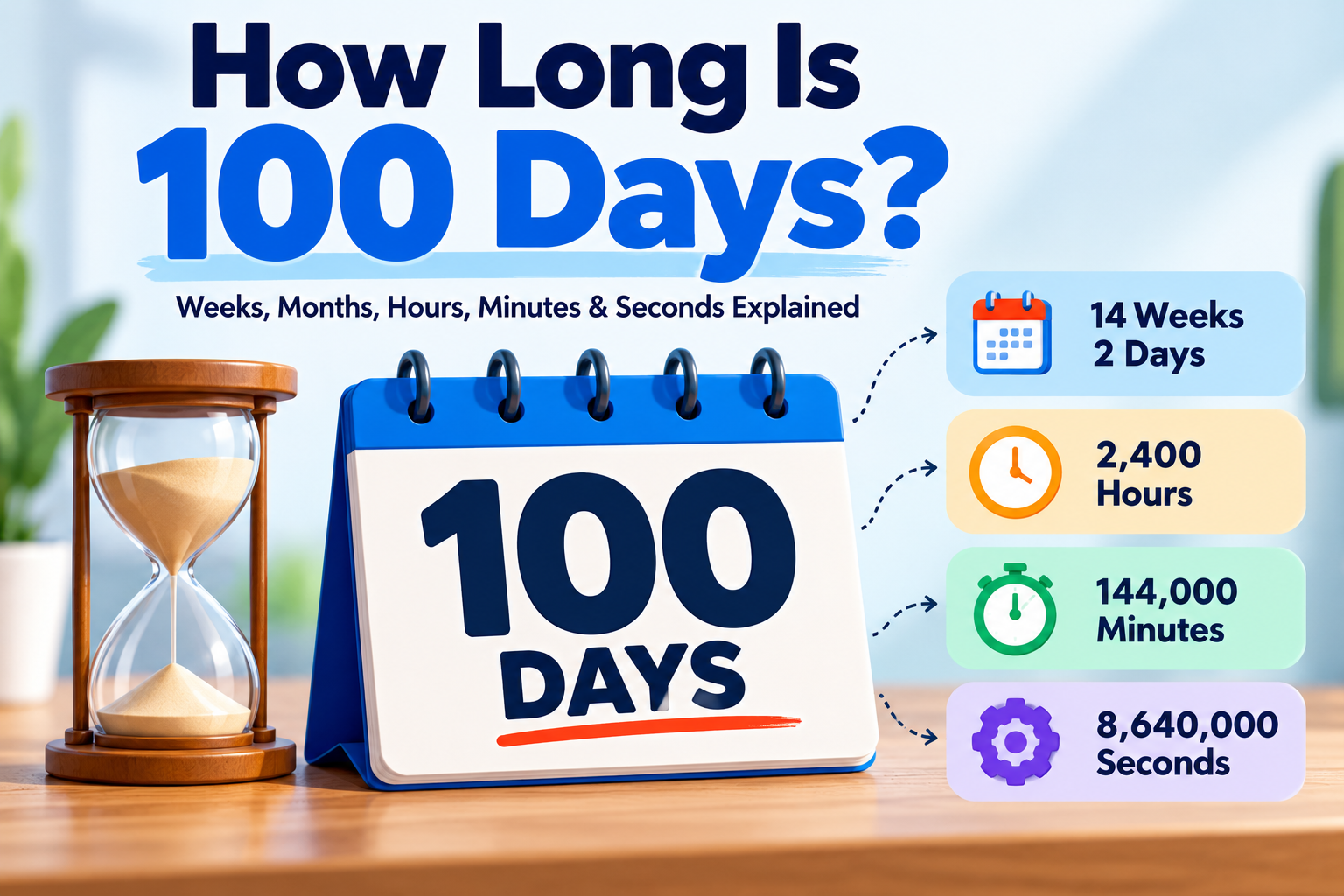
If you are wondering how long 100 days is, the easiest way to understand it is to break the duration into weeks, hours, minutes, and a rough month estimate.
The exact conversion is:
100 days = 14 weeks and 2 days
It also equals:
2,400 hours144,000 minutes8,640,000 seconds
In calendar terms, 100 days is a little more than 14 weeks and roughly 3.3 months.
100 Days in Weeks
There are 7 days in one week.
So:
100 ÷ 7 = 14 weeks with 2 days left over
That means:
100 days = 14 weeks and 2 days
If you prefer decimal form:
100 days ≈ 14.29 weeks
This is useful for project planning, study schedules, fitness programs, savings goals, and other medium-term timelines.
100 Days in Months
This part is less exact because calendar months have different lengths.
Some months have:
- 31 days
- 30 days
- 28 days
- 29 days in a leap year
So 100 days is not a fixed number of calendar months.
Using the average Gregorian month length, 100 days is approximately:
3.29 months
For practical planning, many people think of 100 days as a little over three months.
Is 100 Days the Same as 3 Months?
Not exactly.
Three calendar months can represent different numbers of days depending on which months are involved.
For example, three months might total around 89, 90, 91, or 92 days in many common date ranges.
Since 100 days is longer, it usually extends beyond three full calendar months.
If precision matters, count 100 calendar days rather than converting it to three months.
What Does 100 Days Feel Like?
One hundred days is long enough to make meaningful progress but short enough to feel manageable.
It can be useful for:
- completing a focused project
- preparing for an exam
- building a new habit
- following a fitness plan
- saving toward a goal
- launching a content strategy
- improving a professional skill
- tracking a business target
Instead of thinking of 100 days as one large block, it can help to divide it into smaller phases.
A Simple 100-Day Planning Framework
One practical way to organize 100 days is into four 25-day stages.
Days 1–25: Setup and preparation
Use this period to define the goal, gather resources, and establish the routine.
Days 26–50: Build momentum
Focus on consistent execution and correcting early problems.
Days 51–75: Improve and refine
Review progress, strengthen weak areas, and make adjustments.
Days 76–100: Finish and evaluate
Complete the main objective and review the results.
This approach makes a 100-day goal easier to manage.
Example: A 100-Day Study Plan
Suppose you have 100 days to prepare for an important exam.
You could divide the period like this:
First 25 days: Learn the foundationsNext 25 days: Cover the main syllabusNext 25 days: Practice and reviewFinal 25 days: Mock tests and revision
Because 100 days equals more than 14 weeks, there is enough time to build a consistent routine without trying to do everything at once.
Example: A 100-Day Fitness Goal
A 100-day fitness program is also long enough to track meaningful progress.
A simple structure could be:
Weeks 1–4: Establish the routineWeeks 5–8: Increase consistencyWeeks 9–12: Build performanceFinal 16 days: Review and finish
The exact approach depends on your goal, but the 100-day period gives you a clear start and finish.
100 Days vs 90 Days
Ninety days equals:
12 weeks and 6 days
One hundred days equals:
14 weeks and 2 days
So 100 days is exactly:
10 days longer than 90 days
That extra time equals 1 week and 3 days.
100 Days vs 14 Weeks
Fourteen weeks equals:
98 days
So:
100 days = 14 weeks + 2 days
This makes 14 weeks a very close mental shortcut when estimating 100 days.
100 Days vs 15 Weeks
Fifteen weeks equals:
105 days
That means 100 days is:
5 days shorter than 15 weeks
So 100 days falls neatly between 14 and 15 weeks.
How Many Weekends Are in 100 Days?
There are 14 complete weeks inside 100 days.
That guarantees:
14 Saturdays14 Sundays
So a 100-day period contains at least 28 weekend days.
The remaining two days may add another Saturday or Sunday depending on the weekday on which the period begins.
How Many Working Days Are in 100 Days?
There is no single exact answer without knowing the starting weekday and which holidays apply.
A 100-calendar-day period includes weekends automatically.
If you need a business-day calculation, weekends and possibly public holidays must be removed separately.
So:
100 calendar days ≠ 100 business days
How Many Hours Are in 100 Days?
Using conventional 24-hour days:
100 × 24 = 2,400 hours
So:
100 days = 2,400 hours
How Many Minutes Are in 100 Days?
Each hour contains 60 minutes.
So:
2,400 × 60 = 144,000 minutes
Therefore:
100 days = 144,000 minutes
How Many Seconds Are in 100 Days?
Each minute contains 60 seconds.
So:
144,000 × 60 = 8,640,000 seconds
Therefore:
100 days = 8,640,000 seconds
Why 100 Days Is a Useful Goal Period
A 100-day period has a useful balance.
It is longer than a typical 30-, 60-, or 90-day challenge, but it is still much shorter than a full year.
That makes it useful for goals where you want enough time to see genuine progress without committing to a very long timeline.
It also gives you natural checkpoints at:
25 days50 days75 days100 days
These checkpoints make progress easier to measure.
How to Use the How Long Is 100 Days Calculator
The calculator starts with 100 days by default.
It shows the duration in:
- weeks and days
- decimal weeks
- hours
- minutes
- seconds
- approximate months
You can also change the number of days if you want to compare another duration.
Use the conversion view to focus on the unit that matters most to you.
Frequently Asked Questions
How many weeks are in 100 days?
100 days equals 14 weeks and 2 days.
Is 100 days about 3 months?
Yes, approximately. It is around 3.29 average months, but calendar months vary in length.
How many hours are in 100 days?
There are 2,400 hours.
How many minutes are in 100 days?
There are 144,000 minutes.
How many seconds are in 100 days?
There are 8,640,000 seconds.
Is 100 days longer than 14 weeks?
Yes. Fourteen weeks equals 98 days, so 100 days is 2 days longer.
Is 100 days the same as 15 weeks?
No. Fifteen weeks equals 105 days, so 100 days is 5 days shorter.
Are weekends included in 100 days?
Yes, when you are counting calendar days.
Is 100 days a good goal period?
It can be. One hundred days is long enough for measurable progress while still being short enough to plan in clear stages.
Quick Takeaway
The simplest way to remember it is:
100 days = 14 weeks and 2 days
It also equals:
2,400 hours = 144,000 minutes = 8,640,000 seconds
And in rough calendar terms, 100 days is a little over three months.