
Long Division Calculator
Divide two numbers and see the quotient and remainder step by step.
Long Division Calculator With Steps & Remainder
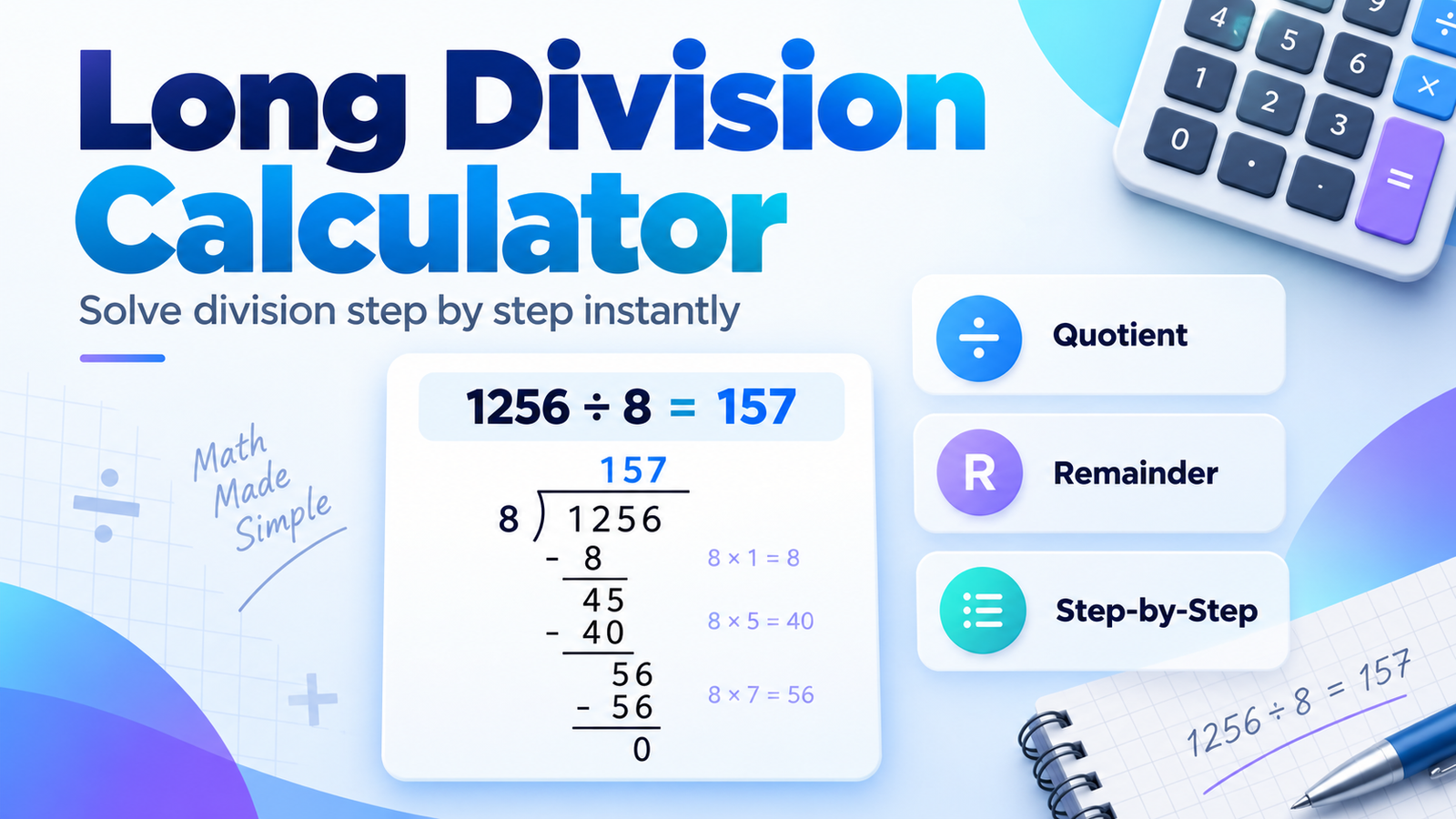
Use the Long Division Calculator to divide whole numbers and see the complete calculation step by step. Enter a dividend and divisor to find the quotient, remainder, decimal result, traditional long division work, and a verification equation.
The calculator is useful for students learning division, parents checking homework, teachers preparing examples, tutors explaining arithmetic, and anyone who wants to verify a division problem without doing every step manually.
What Is a Long Division Calculator?
A long division calculator solves division problems while showing how the answer is obtained.
Instead of displaying only the final result, this tool can show:
- Dividend
- Divisor
- Quotient
- Remainder
- Decimal result
- Traditional long division layout
- Divide, multiply, subtract, and bring-down steps
- Final division check
For example:
1256 ÷ 8
gives:
Quotient = 157
Remainder = 0
Decimal result = 157
Because the calculator shows the working, it can be used both as a quick division solver and as a learning tool.
How to Use the Long Division Calculator
Using the calculator requires only two main numbers.
1. Enter the Dividend
The dividend is the number being divided.
For example, in:
1256 ÷ 8
the dividend is:
1256
2. Enter the Divisor
The divisor is the number you divide by.
In:
1256 ÷ 8
the divisor is:
8
The divisor cannot be zero because division by zero is undefined.
3. Choose Decimal Digits
If the division does not produce an exact whole number, you can control how many decimal digits are displayed.
For example:
10 ÷ 3
may be shown as:
3.333333…
depending on the selected precision.
4. Calculate the Division
Select Calculate Division.
The calculator displays the quotient first, followed by the remainder, decimal result, traditional long division work, individual calculation steps, and a division check.
What Are the Dividend, Divisor, Quotient, and Remainder?
Understanding these four terms makes long division much easier.
Consider:
127 ÷ 5 = 25 remainder 2
Here:
Dividend = 127
This is the number being divided.
Divisor = 5
This is the number you are dividing by.
Quotient = 25
This is the whole-number result.
Remainder = 2
This is the amount left after division.
The relationship can be checked using:
Dividend = Divisor × Quotient + Remainder
For this example:
127 = 5 × 25 + 2
127 = 125 + 2
The calculation is correct.
Long Division Example Step by Step
Consider:
1256 ÷ 8
Step 1: Start With the First Digits
8 does not fit into 1 as a whole number, so use the first two digits:
12
Ask:
How many times does 8 go into 12?
The answer is:
1
Write 1 in the quotient.
Multiply:
1 × 8 = 8
Subtract:
12 − 8 = 4
Step 2: Bring Down the Next Digit
Bring down the next digit, which is:
5
This creates:
45
Ask:
How many times does 8 go into 45?
The answer is:
5
because:
5 × 8 = 40
Subtract:
45 − 40 = 5
Step 3: Bring Down the Final Digit
Bring down:
6
Now you have:
56
Ask:
How many times does 8 go into 56?
The answer is:
7
because:
7 × 8 = 56
Subtract:
56 − 56 = 0
Final Answer
The quotient is:
157
The remainder is:
0
Therefore:
1256 ÷ 8 = 157
Because the remainder is zero, this is an exact division.
How Long Division Works
Long division repeatedly uses four basic operations:
Divide → Multiply → Subtract → Bring Down
You continue this sequence until all digits in the dividend have been used.
For each step:
- Determine how many times the divisor fits into the current number.
- Write that number in the quotient.
- Multiply the quotient digit by the divisor.
- Subtract the product.
- Bring down the next digit.
- Repeat.
The calculator performs these operations automatically and displays the resulting steps.
Long Division With a Remainder
Not every division problem produces an exact whole-number result.
Consider:
127 ÷ 5
5 goes into 127:
25 times
because:
5 × 25 = 125
Subtract:
127 − 125 = 2
Therefore:
Quotient = 25
Remainder = 2
This can be written as:
127 ÷ 5 = 25 R2
The calculator displays both the quotient and remainder separately so the result is easy to understand.
How to Convert a Remainder Into a Decimal
A remainder can also be expressed as part of a decimal answer.
Using:
127 ÷ 5
the whole-number answer is:
25 remainder 2
The remainder represents:
2/5
and:
2 ÷ 5 = 0.4
Therefore:
127 ÷ 5 = 25.4
The calculator automatically provides the decimal form alongside the quotient and remainder.
Long Division With Repeating Decimals
Some division problems do not terminate.
For example:
10 ÷ 3
The whole-number result is:
3 remainder 1
but the decimal continues:
3.333333…
The calculator lets you choose the number of decimal digits to display and uses an ellipsis when the decimal continues beyond the selected precision.
This helps distinguish an approximation from an exact terminating decimal.
What Happens When the Dividend Is Smaller Than the Divisor?
If the dividend is smaller than the divisor, the whole-number quotient is zero.
For example:
5 ÷ 12
12 cannot fit into 5 even once as a whole number.
Therefore:
Quotient = 0
Remainder = 5
The decimal result is approximately:
0.416667
depending on the selected decimal precision.
Exact Division vs. Division With a Remainder
An exact division has a remainder of zero.
Example:
144 ÷ 12 = 12
Remainder:
0
A division with remainder leaves a nonzero value.
Example:
127 ÷ 5 = 25 R2
The calculator identifies which type of result you have.
What Is the Quotient?
The quotient is the result obtained when one number is divided by another.
For example:
84 ÷ 7 = 12
The quotient is:
12
If division is not exact, the whole-number quotient is the number of complete times the divisor fits into the dividend.
For:
23 ÷ 4
the whole-number quotient is:
5
because:
4 × 5 = 20
with a remainder of:
3
What Is a Remainder?
A remainder is the amount left after the largest possible whole-number multiple of the divisor has been subtracted.
For:
23 ÷ 4
4 goes into 23 five times:
4 × 5 = 20
Then:
23 − 20 = 3
Therefore:
Quotient = 5
Remainder = 3
A valid remainder must be smaller in magnitude than the divisor in ordinary integer division.
How to Check a Long Division Answer
You can verify a quotient and remainder using:
Dividend = Divisor × Quotient + Remainder
Suppose:
127 ÷ 5 = 25 R2
Check:
5 × 25 = 125
Then add the remainder:
125 + 2 = 127
The result matches the original dividend, so the calculation is correct.
The calculator includes this check automatically.
Long Division With Negative Numbers
The calculator can also handle negative integer inputs.
Examples:
−120 ÷ 8 = −15
120 ÷ −8 = −15
−120 ÷ −8 = 15
The traditional division workspace can use the absolute values to keep the arithmetic easier to read, while the sign is applied to the final quotient.
This follows the basic sign rules for division:
Positive ÷ Positive = Positive
Negative ÷ Positive = Negative
Positive ÷ Negative = Negative
Negative ÷ Negative = Positive
What Happens When the Dividend Is Zero?
Zero divided by any nonzero number equals zero.
For example:
0 ÷ 8 = 0
Therefore:
Quotient = 0
Remainder = 0
Can You Divide by Zero?
No.
Division by zero is undefined.
For example:
25 ÷ 0
does not have a valid mathematical result.
The calculator detects a zero divisor and asks you to enter a different number instead of attempting the calculation.
Long Division With Large Numbers
Long division becomes especially useful when the dividend contains many digits.
For example:
1,259,999 ÷ 9
The calculator can determine:
Quotient = 139,999
Remainder = 8
and provide the decimal approximation.
Instead of manually tracking every multiplication and subtraction, the calculator generates the individual long division steps.
Why Use a Long Division Calculator With Steps?
A basic calculator gives you an answer.
A long division calculator with steps also explains how that answer is produced.
This can help with:
Homework Checking
Compare your own calculation with the generated quotient and steps.
Learning Long Division
Follow each divide, multiply, subtract, and bring-down operation.
Understanding Remainders
See why an amount remains after whole-number division.
Decimal Conversion
Compare the quotient and remainder with the decimal form.
Catching Arithmetic Errors
If your answer differs from the calculator, you can inspect the individual steps to find where the mistake occurred.
Traditional Long Division Layout
Long division is often written in a form similar to:
[object HTMLPreElement]The quotient appears above the dividend, while the multiplication and subtraction operations appear underneath.
The tool generates this traditional format so students can compare it with the method commonly taught in school.
Common Long Division Mistakes
Starting With Too Few Digits
If the divisor is larger than the first digit of the dividend, include additional digits until the current value is large enough.
For:
1256 ÷ 8
you begin with:
12
not simply 1.
Choosing a Quotient Digit That Is Too Large
The quotient digit must produce a multiplication result that does not exceed the current value.
For example, when dividing:
45 ÷ 8
5 is correct because:
5 × 8 = 40
but 6 is too large because:
6 × 8 = 48
Making a Multiplication Error
An incorrect multiplication result affects every step that follows.
Always verify:
quotient digit × divisor
before subtracting.
Making a Subtraction Error
After multiplication, carefully subtract the product from the current number.
For:
45 − 40
the remainder is:
5
Forgetting to Bring Down the Next Digit
After subtraction, bring down the next unused digit from the dividend.
This creates the number used in the next division step.
Forgetting the Remainder
If the final subtraction does not produce zero, the leftover value is the remainder.
Long Division for Students
Students can use this calculator as a learning companion rather than just an answer generator.
A useful approach is:
- Solve the problem manually.
- Enter the same dividend and divisor into the calculator.
- Compare the quotient.
- Compare the remainder.
- Review each generated step.
- Use the division check to verify the answer.
This helps reinforce the long division process.
Long Division for Teachers and Parents
Teachers, tutors, and parents can use the calculator to quickly generate worked division examples.
Because the tool displays the arithmetic process, it can be useful when explaining:
- Quotients
- Remainders
- Bringing down digits
- Decimal results
- Exact division
- Division checks
The traditional workspace also makes it easier to compare the digital result with handwritten schoolwork.
Frequently Asked Questions
What is a long division calculator?
A long division calculator divides one number by another and displays the quotient, remainder, decimal result, and step-by-step long division work.
What is the dividend?
The dividend is the number being divided.
In:
84 ÷ 7
84 is the dividend.
What is the divisor?
The divisor is the number you divide by.
In:
84 ÷ 7
7 is the divisor.
What is the quotient?
The quotient is the result of division.
For:
84 ÷ 7 = 12
the quotient is 12.
What is a remainder?
The remainder is the amount left after whole-number division.
For:
23 ÷ 4
the result is:
5 remainder 3
How do I check a division answer?
Use:
Dividend = Divisor × Quotient + Remainder
If both sides are equal, the whole-number division result is consistent.
Can the calculator show decimal answers?
Yes. It displays a decimal result and lets you control how many decimal digits are shown.
Can the calculator handle repeating decimals?
Yes. If the decimal continues beyond the selected precision, the calculator can show an approximation followed by an ellipsis.
Can the calculator use negative numbers?
Yes. Negative integer dividends and divisors are supported.
What happens if I divide by zero?
Division by zero is undefined, so the calculator displays an error instead of a result.
Can I calculate large division problems?
Yes. The calculator is designed to handle large whole-number inputs and display the quotient, remainder, and calculation steps.
Solve Long Division Step by Step
Enter your dividend and divisor into the Long Division Calculator and select Calculate Division.
You will immediately see the quotient, remainder, and decimal result, followed by the traditional long division layout and a complete step-by-step explanation.
Whether you are learning long division or simply checking an answer, the calculator makes it easier to see how the division works instead of only showing the final number.