
Quadratic Formula Calculator
Solve ax² + bx + c = 0 for real or complex roots.
Quadratic Formula Calculator With Steps & Solutions
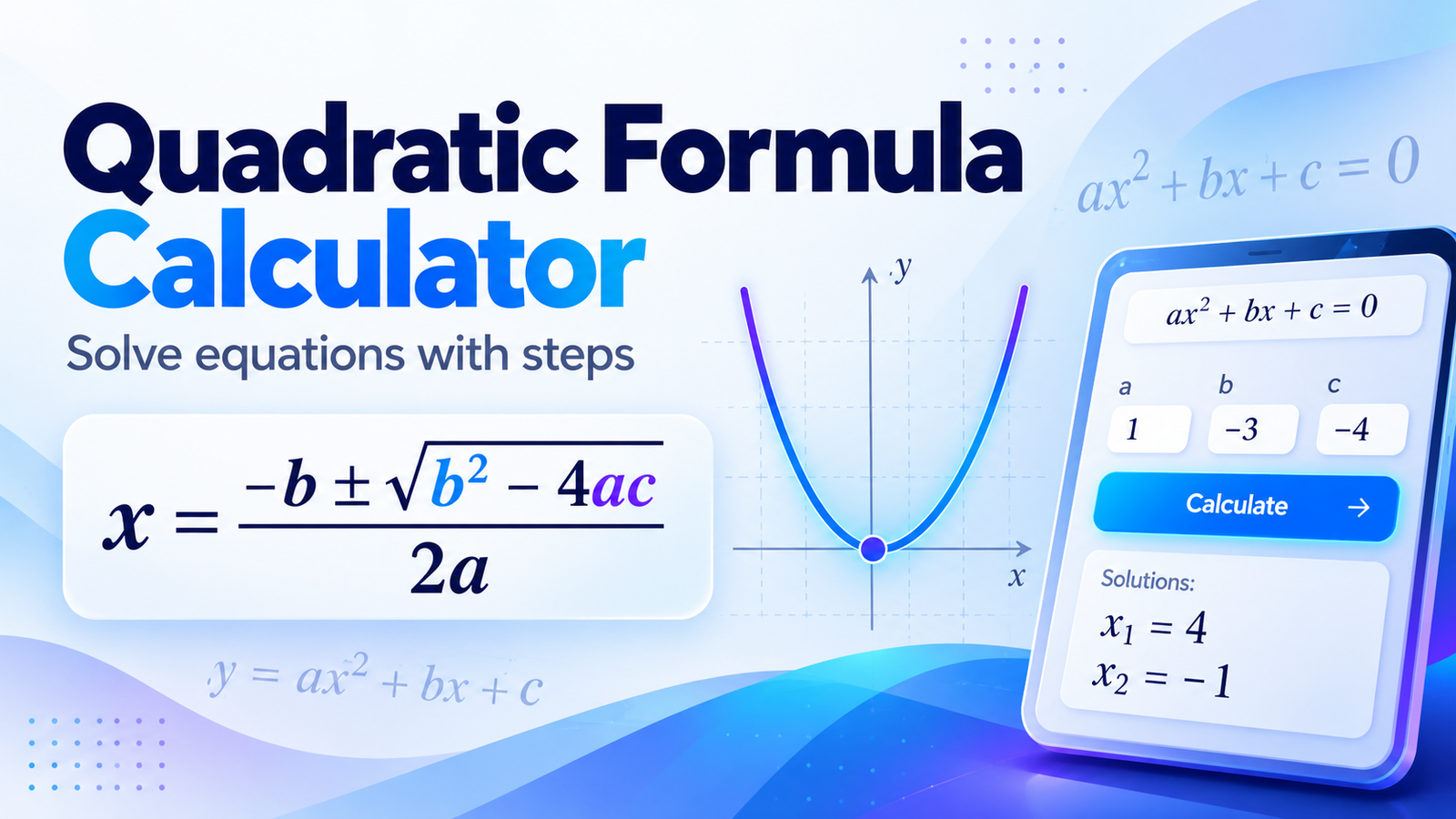
Use the Quadratic Formula Calculator to solve quadratic equations quickly and see how the answer is calculated. Enter the values of a, b, and c from an equation in the standard form:
ax² + bx + c = 0
The calculator finds the roots of the equation, calculates the discriminant, identifies the type of solutions, and shows both exact and decimal results where applicable. It also provides a step-by-step solution, making it useful for students, teachers, tutors, and anyone checking an algebra calculation.
What Is a Quadratic Formula Calculator?
A quadratic formula calculator is a tool that solves equations containing a squared variable, usually written as:
ax² + bx + c = 0
where:
- a is the coefficient of x²
- b is the coefficient of x
- c is the constant
- a cannot equal 0
The calculator substitutes these values into the quadratic formula and determines the possible values of x, also called the roots or solutions of the equation.
Unlike a calculator that only gives the final answer, this tool also shows the discriminant and calculation steps so you can understand how the solutions were found.
How to Use the Quadratic Formula Calculator
Using the calculator is straightforward.
1. Enter the Value of a
Enter the coefficient attached to x².
For example, in:
2x² + 5x − 3 = 0
the value of a is 2.
Remember that a cannot be zero, because an equation without an x² term is not quadratic.
2. Enter the Value of b
Enter the coefficient of x.
For the equation:
2x² + 5x − 3 = 0
b = 5
If there is no x term, enter 0.
3. Enter the Value of c
Enter the constant term.
For:
2x² + 5x − 3 = 0
c = −3
If there is no constant term, enter 0.
4. Click Calculate
The calculator will display:
- The original quadratic equation
- First root, x₁
- Second root, x₂
- Discriminant
- Type of roots
- Exact solutions
- Decimal solutions
- Step-by-step calculations
You can also use Copy Result to copy the main answer for your notes or calculations.
What Is the Quadratic Formula?
The quadratic formula is used to solve equations in the standard quadratic form:
ax² + bx + c = 0
The formula is:
x = (−b ± √(b² − 4ac)) / 2a
The symbol ± means that two calculations may be required:
x₁ = (−b + √(b² − 4ac)) / 2a
and
x₂ = (−b − √(b² − 4ac)) / 2a
Depending on the discriminant, these calculations can produce two different real roots, one repeated root, or two complex roots.
How to Identify a, b, and c
Correctly identifying the coefficients is important when using a quadratic equation calculator.
Consider:
3x² − 7x + 2 = 0
The coefficients are:
a = 3b = −7c = 2
The signs belong to the coefficients, so the negative sign before 7 must be included.
Example With a Missing x Term
For:
x² − 16 = 0
write it as:
x² + 0x − 16 = 0
Therefore:
a = 1b = 0c = −16
Example With a Missing Constant
For:
2x² + 6x = 0
the coefficients are:
a = 2b = 6c = 0
Entering zero for missing terms helps the calculator interpret the equation correctly.
What Is the Discriminant?
The discriminant is the expression inside the square root of the quadratic formula:
D = b² − 4ac
It tells you what type of roots a quadratic equation has before the complete solutions are calculated.
| Discriminant | Type of Solution |
|---|---|
| D > 0 | Two distinct real roots |
| D = 0 | One repeated real root |
| D < 0 | Two complex roots |
The calculator automatically finds the discriminant and shows the corresponding root type.
Two Distinct Real Roots
If:
D > 0
the equation has two different real solutions.
For example:
x² − 3x + 2 = 0
Here:
a = 1b = −3c = 2
The discriminant is:
D = (−3)² − 4(1)(2)
D = 9 − 8
D = 1
Because the discriminant is positive, there are two distinct real roots:
x₁ = 2
x₂ = 1
One Repeated Real Root
If:
D = 0
the two solutions are equal.
For example:
x² − 6x + 9 = 0
The discriminant is:
D = (−6)² − 4(1)(9)
D = 36 − 36
D = 0
The equation therefore has one repeated root:
x = 3
You may also see this written as:
x₁ = 3
x₂ = 3
Complex Roots
If:
D < 0
there are no real roots. Instead, the equation has two complex conjugate roots involving the imaginary unit i, where:
i² = −1
For example:
x² + 4x + 5 = 0
The discriminant is:
D = 4² − 4(1)(5)
D = 16 − 20
D = −4
Because the discriminant is negative, the solutions are complex:
x₁ = −2 + i
x₂ = −2 − i
The calculator automatically handles negative discriminants and displays the resulting complex solutions.
Quadratic Formula Example Step by Step
Consider the equation:
2x² + 5x − 3 = 0
Step 1: Identify the Coefficients
a = 2b = 5c = −3
Step 2: Calculate the Discriminant
D = b² − 4ac
Substitute the values:
D = 5² − 4(2)(−3)
D = 25 + 24
D = 49
Since 49 > 0, the equation has two distinct real roots.
Step 3: Substitute Into the Quadratic Formula
x = (−5 ± √49) / 4
Since:
√49 = 7
we get:
x = (−5 ± 7) / 4
Step 4: Find Both Roots
Using the positive sign:
x₁ = (−5 + 7) / 4
x₁ = 2 / 4
x₁ = 0.5
Using the negative sign:
x₂ = (−5 − 7) / 4
x₂ = −12 / 4
x₂ = −3
Final Answer
x₁ = 0.5
x₂ = −3
The calculator performs these steps automatically.
Exact Solutions vs. Decimal Solutions
Some quadratic equations produce roots that cannot be represented neatly as whole numbers or simple fractions.
For example, an answer may contain a square root such as:
(−3 + √17) / 2
This is an exact form because no approximation has been introduced.
A calculator can also provide a decimal approximation, which may look like:
x ≈ 0.5616
Both representations are useful.
Use the exact form when you need the mathematically precise result. Use the decimal form when an approximate numerical value is easier to work with.
Why Use a Quadratic Formula Calculator?
A quadratic calculator can save time while also helping you verify your algebra.
Faster Calculations
Enter the coefficients and get the roots without manually repeating each arithmetic step.
Step-by-Step Explanation
See how the coefficients, discriminant, and quadratic formula lead to the final solutions.
Helps Catch Sign Errors
Negative coefficients can easily cause mistakes when solving an equation by hand. Seeing the substituted values makes the calculation easier to check.
Handles Different Root Types
The calculator can identify:
- Two real roots
- One repeated root
- Two complex roots
Exact and Decimal Answers
You can see both forms when they are useful.
Useful for Learning
Students can compare their own calculations with the calculator's steps rather than simply checking a final number.
Common Quadratic Formula Mistakes
Forgetting the Negative Sign on b
The formula begins with −b, not simply b.
If:
b = −5
then:
−b = 5
Forgetting ±
The plus-minus symbol usually requires calculating two possible solutions.
Incorrectly Calculating b²
If b is negative, square the entire coefficient.
For example:
(−4)² = 16
not −16.
Forgetting the Full Denominator
The complete numerator is divided by:
2a
not just the square-root term.
Entering a = 0
A quadratic equation must contain a nonzero x² coefficient. If a = 0, the equation becomes linear rather than quadratic.
Can a Quadratic Equation Be Solved Without the Formula?
Yes. Depending on the equation, other methods may include:
- Factoring
- Completing the square
- Graphing
However, the quadratic formula is especially useful because it can solve any quadratic equation with a ≠ 0, including equations that do not factor easily.
Frequently Asked Questions
What is a quadratic formula calculator?
It is a calculator that uses the quadratic formula to find the roots of an equation in the form ax² + bx + c = 0.
What are the roots of a quadratic equation?
The roots are the values of x that make the equation equal to zero. They are also called solutions or zeros.
Can a quadratic equation have two solutions?
Yes. If the discriminant is greater than zero, the equation has two distinct real roots.
Can a quadratic equation have only one solution?
Yes. When the discriminant equals zero, the equation has one repeated real root.
What happens when the discriminant is negative?
A negative discriminant produces two complex conjugate roots.
What if b is missing?
Enter 0 for b.
For example:
x² − 25 = 0
has:
a = 1, b = 0, c = −25
What if c is missing?
Enter 0 for c.
Can a equal zero?
No. If a = 0, there is no x² term, so the equation is not quadratic.
Can the calculator use decimal coefficients?
Yes. You can enter decimal values for a, b, and c.
Does the calculator show the steps?
Yes. The calculator displays the coefficients, discriminant calculation, formula substitution, and resulting solutions so you can follow the process.
Solve Your Quadratic Equation
Enter a, b, and c into the Quadratic Formula Calculator and select Calculate to find the roots.
The calculator gives you the main answer first, followed by the discriminant, root type, exact and decimal forms, and a step-by-step explanation.
It is designed to help you both solve the quadratic equation and understand how the answer was obtained.