
Estimate Your Blood Alcohol Concentration
Use the BAC Calculator above to estimate your blood alcohol concentration (BAC) from your body weight, drinks consumed, serving sizes, alcohol by volume (ABV), and time since your first drink.
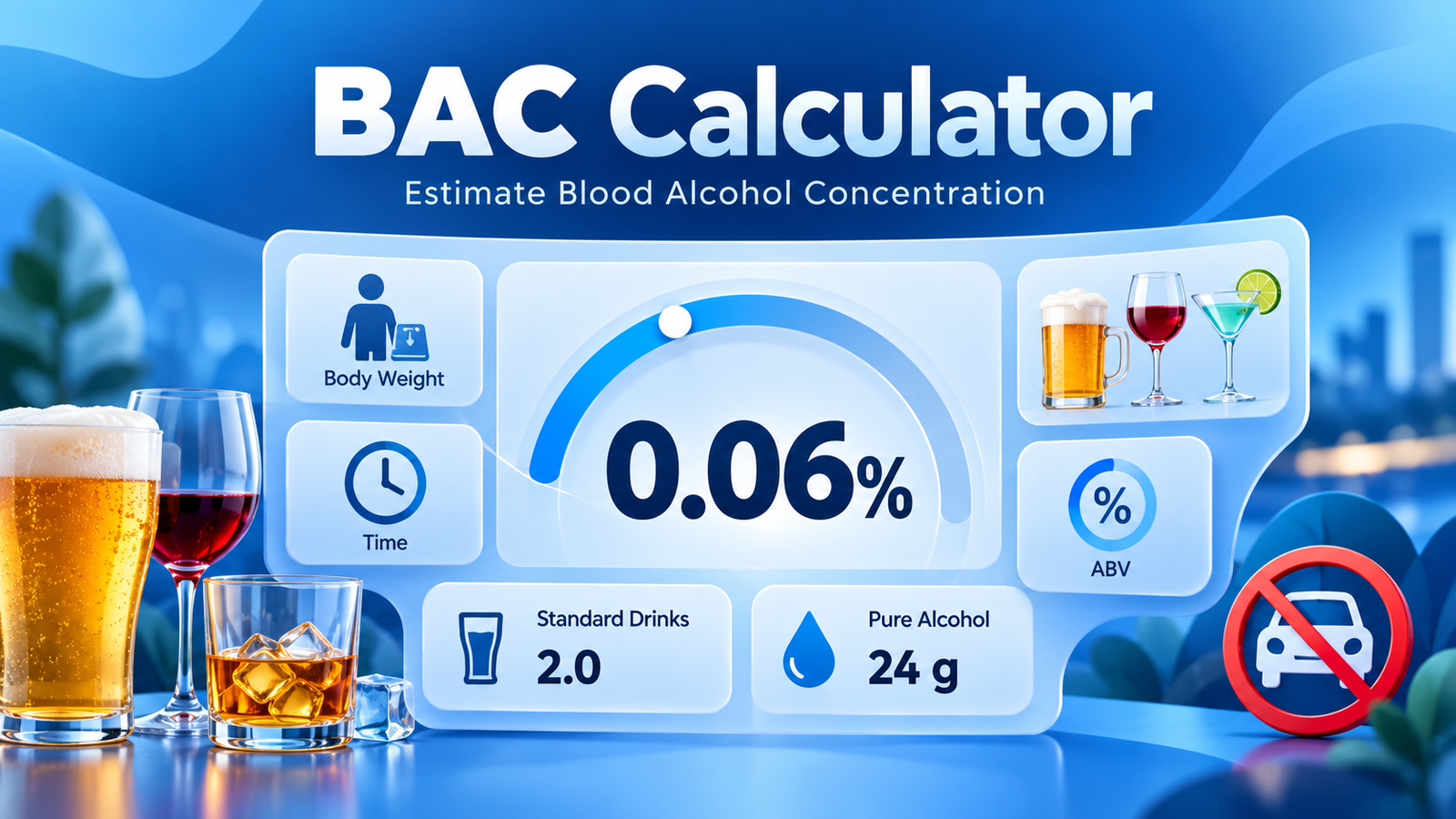
How to Use the BAC Calculator
Start by entering your body weight, selecting the appropriate formula coefficient, and entering how much time has passed since your first drink.
Next, add each alcoholic drink you consumed.
You can quickly add:
- Beer
- Wine
- Distilled spirits or shots
- Hard seltzer
- Custom drinks
For each drink, you can adjust the quantity, serving size, and ABV to better match what you actually consumed.
The calculator then estimates your BAC and also shows:
- Approximate U.S. standard drinks
- Total pure alcohol consumed
- Elapsed drinking time
- BAC before the elimination estimate
- An illustrative metabolism range
Because drink strength and serving size can vary considerably, entering each drink separately can give you a more useful estimate than simply counting the number of glasses or cans.
What Does BAC Mean?
BAC stands for Blood Alcohol Concentration. It represents the amount of alcohol estimated to be present in the bloodstream.
For example:
0.05% BAC
means an estimated concentration of 0.05 grams of alcohol per 100 milliliters of blood.
BAC can rise as alcohol is consumed and may gradually decline as the body processes alcohol.
However, the exact BAC of an individual cannot be known accurately from an online calculator alone. A breath, blood, or other appropriate alcohol test is required for an actual measurement.
Understanding Your BAC Calculator Results
The calculator provides several results rather than only one BAC number.
Estimated BAC
This is the main estimate based on:
- Total pure alcohol consumed
- Body weight
- Sex-based distribution coefficient
- Time since the first drink
The result is displayed as a percentage, such as:
0.042%
It should be treated as an estimate only.
Standard Drinks
The calculator converts the alcohol entered into approximate U.S. standard drinks.
One U.S. standard drink contains approximately 14 grams of pure alcohol.
Typical examples that contain roughly one standard drink include:
| Beverage | Approximate Serving | Typical ABV |
|---|---|---|
| Regular beer | 12 fl oz | 5% |
| Wine | 5 fl oz | 12% |
| Distilled spirits | 1.5 fl oz | 40% |
These are examples only. Actual products and pours can contain significantly more or less alcohol.
Pure Alcohol
The calculator also displays the estimated amount of pure ethanol in grams.
This is useful because two drinks of the same size can contain very different amounts of alcohol when their ABV values differ.
Elapsed Time
Elapsed time is measured from the start of your first drink.
The BAC estimate accounts for an assumed amount of alcohol elimination over this period.
BAC Before Elimination
This value shows the estimated BAC contribution from the entered alcohol before the calculator subtracts its assumed alcohol elimination over time.
It helps explain how elapsed time affects the final estimate.
How Does the BAC Calculator Work?
The calculator first determines how much pure alcohol is contained in every drink you enter.
A simplified version of the process is:
Drink volume × ABV × alcohol density = estimated pure alcohol
The alcohol from all entered drinks is then added together.
The calculator uses a Widmark-style formula to estimate how that amount of alcohol may relate to body weight and alcohol distribution.
A simplified form is:
Estimated BAC ≈ Alcohol ÷ (Body Weight × Distribution Factor) − Alcohol Elimination
The tool then applies an estimated alcohol elimination rate based on the time since your first drink.
What Is the Widmark Formula?
The Widmark approach is commonly used to estimate BAC from the amount of alcohol consumed and body weight.
Our calculator uses different sex-based distribution coefficients because alcohol is not distributed uniformly throughout total body weight.
The calculator currently uses:
- Male coefficient: 0.68
- Female coefficient: 0.55
These are mathematical assumptions used for estimation. They do not measure an individual's actual body-water distribution.
Two people with the same body weight and the same number of drinks can still have different actual BAC levels.
How Is Alcohol Elimination Estimated?
The calculator applies an average elimination assumption of approximately:
0.015 BAC percentage points per hour
It also displays an illustrative range using slower and faster assumptions so you can see how the estimated elimination rate affects the result.
This does not mean your personal BAC will decline at exactly that rate.
Alcohol processing can vary considerably between individuals.
The calculator therefore should not be used to predict an exact time when someone will become sober or safe to drive.
Why Serving Size and ABV Matter
Counting drinks alone can be misleading.
For example, these two drinks are not necessarily equivalent:
12 oz beer at 5% ABV
and
16 oz beer at 8% ABV
The second drink contains substantially more pure alcohol even though both might casually be described as “one beer.”
The same issue applies to:
- Large wine pours
- Strong craft beer
- Double shots
- Cocktails
- Mixed drinks
- High-ABV canned beverages
For a more useful BAC estimate, enter the actual serving size and ABV whenever those values are available.
What Is ABV?
ABV means Alcohol by Volume.
It describes what percentage of a beverage's total volume consists of alcohol.
For example:
5% ABV beer means approximately 5% of the beverage volume is alcohol.
12% ABV wine contains a larger percentage of alcohol by volume.
40% ABV spirits contain a much higher concentration of alcohol.
ABV alone does not tell you the total amount of alcohol consumed. Serving size matters too.
A small serving of a high-ABV beverage may contain a similar amount of alcohol to a larger serving of a lower-ABV beverage.
BAC Calculator Example
Suppose a person enters:
- Body weight: 180 lb
- Two beers
- 12 oz per beer
- 5% ABV
- Two hours since the first drink
The calculator first estimates the amount of pure alcohol in the two beers.
A typical 12 oz beer at 5% ABV contains roughly one U.S. standard drink, so two beers would represent approximately:
2 standard drinks
The BAC formula then considers body weight, the selected distribution coefficient, and elapsed time to produce an estimated BAC.
The final result is still only an approximation because real alcohol absorption and elimination differ between individuals.
What Can Affect Your Actual BAC?
An online calculator cannot capture every factor affecting blood alcohol concentration.
Actual BAC can be influenced by factors such as:
- Amount of alcohol consumed
- Speed of drinking
- Serving sizes
- Beverage strength
- Body weight
- Body composition
- Food consumed before or during drinking
- Time between drinks
- Individual alcohol absorption
- Liver function
- Certain medications
- Individual physiology
Even accurately entering every drink cannot remove this uncertainty.
Does Food Lower BAC?
Eating before or while drinking may affect how quickly alcohol is absorbed.
However, food does not remove alcohol that has already entered the body.
A BAC calculator cannot accurately determine the effect of a particular meal, which is one reason the result should be treated as an estimate rather than a measurement.
Does Coffee Lower BAC?
Coffee may make someone feel more awake, but it does not remove alcohol from the bloodstream.
Similarly, commonly suggested methods such as cold showers or fresh air do not provide a reliable way to rapidly eliminate alcohol from the body.
The passage of time is required for the body to process alcohol.
Can You Calculate BAC From the Number of Drinks?
You can estimate BAC from drink information, but simply entering a number of drinks is less useful when serving sizes and alcohol strengths differ.
Consider two people who each report drinking three drinks.
One may have consumed:
Three 12 oz beers at 5% ABV
while another may have consumed:
Three strong cocktails containing multiple servings of spirits
The amount of alcohol consumed could be very different.
That is why this calculator asks for serving size and ABV for each drink.
BAC and Driving Safety
A BAC calculator should never be used to determine whether you are safe to drive.
Alcohol can affect:
- Reaction time
- Judgment
- Coordination
- Attention
- Decision-making
Impairment can occur before someone notices obvious symptoms.
Driving laws also vary by location, age, license type, and driver category.
Being below a particular legal threshold does not automatically mean a person is unimpaired or safe to drive.
If you have been drinking, choose a safer transportation option such as a sober driver, taxi, rideshare, or public transportation.
Why Your Actual BAC May Be Different
Two people can consume the same amount of alcohol and still reach different BAC levels.
An online BAC calculator relies on mathematical assumptions about:
- Alcohol distribution
- Body weight
- Absorption
- Elimination rate
- Drink strength
- Drinking duration
Your actual physiology may differ from those assumptions.
This is why calculator results may differ from a breathalyzer, blood test, or another BAC calculator.
Estimated BAC vs. Breathalyzer Result
A BAC calculator and a breathalyzer do not perform the same task.
A calculator predicts BAC from the information entered.
A breath alcohol device attempts to measure alcohol from a breath sample and estimate blood alcohol concentration from that measurement.
Because the calculator does not directly measure alcohol in your body, its result should not be treated as equivalent to a breath or blood test.
Related Health Calculators
These related Skills Elevate tools can help with other body and health calculations:
- BMI Calculator — calculate body mass index from height and weight.
- Body Fat Calculator — estimate body-fat percentage.
- Ideal Weight Calculator — compare several estimated ideal-weight formulas.
- Calorie Calculator — estimate daily calorie needs.
- Macro Calculator — estimate daily protein, carbohydrate, fat, and calorie targets.
These tool URLs are present in your Skills Elevate sitemap. Pasted text
Important Limitations
The BAC Calculator provides an educational estimate only.
It cannot directly measure your blood alcohol level and cannot account perfectly for individual differences in absorption or alcohol metabolism.
Do not use the calculator to decide whether you are:
- Sober
- Safe to drive
- Legally permitted to drive
- Ready to operate machinery
- Free from alcohol-related impairment
If someone who has consumed alcohol is unconscious, difficult to wake, breathing slowly or irregularly, repeatedly vomiting, severely confused, or showing other signs of a medical emergency, seek emergency medical assistance.
Frequently Asked Questions
What does BAC stand for?
BAC stands for Blood Alcohol Concentration. It represents the concentration of alcohol in the bloodstream and is commonly expressed as a percentage.
How accurate is a BAC calculator?
A BAC calculator can provide a useful estimate, but it cannot directly measure BAC. Real results may differ because alcohol absorption, metabolism, body composition, food intake, drink timing, and other factors vary between individuals.
How is BAC calculated?
The calculator estimates the amount of pure alcohol consumed, considers body weight and a distribution coefficient, and subtracts an assumed amount of alcohol elimination based on elapsed time.
What is one standard drink?
In the United States, one standard drink contains approximately 14 grams of pure alcohol. The actual beverage volume required to reach that amount depends on ABV.
Does a stronger drink increase BAC more?
If serving sizes are equal, a beverage with a higher ABV generally contains more alcohol and can contribute more to estimated BAC.
However, both serving size and ABV must be considered together.
Why does the calculator ask when I started drinking?
Elapsed time matters because the body begins processing alcohol over time. The calculator uses the time since your first drink when applying its estimated elimination rate.
Can eating reduce my BAC?
Food may change the speed at which alcohol is absorbed, but it does not instantly remove alcohol from the body. This calculator does not attempt to calculate the exact effect of food.
Can coffee make BAC go down faster?
Coffee does not significantly speed up alcohol elimination. It may make someone feel more alert while alcohol remains in the body.
Can this calculator tell me when I can drive?
No. Do not use a BAC estimate to decide when it is safe or legal to drive. The calculator is educational and cannot measure your actual BAC or impairment.
Why is my BAC estimate different from another calculator?
Different calculators may use different alcohol-distribution factors, alcohol elimination assumptions, drink definitions, rounding rules, or formulas.
Small or even meaningful differences between calculators are therefore possible.
Does BAC always fall at the same rate?
No. Alcohol elimination varies among individuals. The calculator uses an assumed average rate for estimation purposes, not a guaranteed personal metabolism rate.
Can BAC continue rising after the last drink?
Yes. Alcohol may still be absorbing after drinking stops, so actual BAC can continue changing for a period of time. This is another reason a calculator cannot predict a precise real-time BAC measurement.